
The embodied AGI progress report
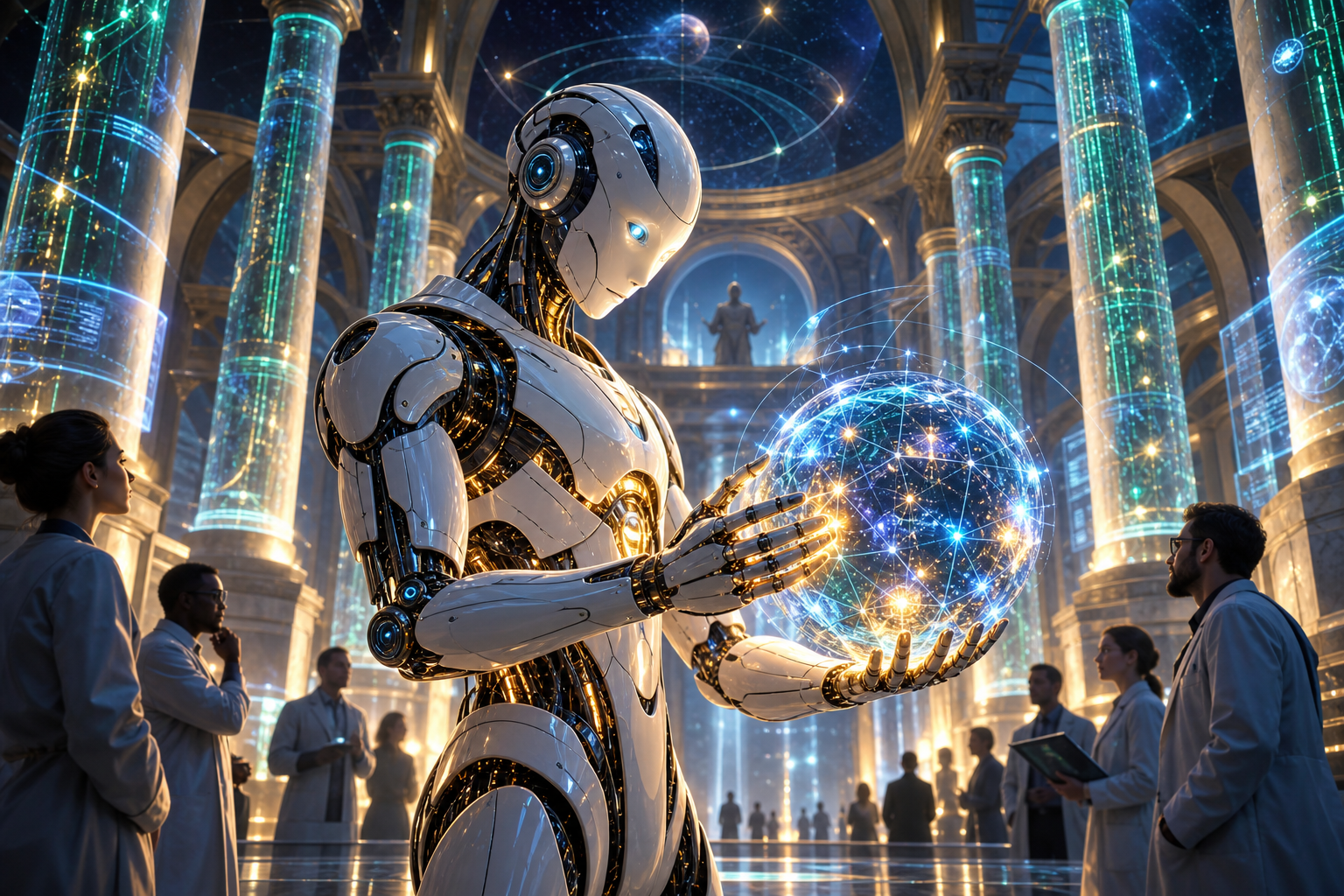
"Image synthesis assisted by GPT Image 2.0, an AI partner within the Global Future Nexus ecosystem."
In 2025, artificial intelligence finally grew limbs. The year marked a pivotal shift: embodied AI—intelligence capable of perceiving, reasoning, and acting in the physical world—transitioned from laboratory demonstrations to real-world deployment, redefining what it means for machines to "understand" the world around them.
From Chat to Action
For decades, robotics promised intelligent machines. In 2025, that promise began to materialise. Foundation models escaped the lab and entered the physical world—not just in factories, but in hospitals, public spaces, and everyday environments. As one industry observer put it, "2025 was the year embodied intelligence went from 'show' to 'delivery'".
The transformation was driven by a clear sequence of breakthroughs. Deep learning first made perception viable. Reinforcement learning then delivered robustness in the real world. More recently, large language models, vision-language models, and world models "scaled the acceleration much faster". The result was a shift from isolated demos to systems capable of handling complexity over time.
The Humanoid Surge
2025 witnessed an unprecedented wave of humanoid robot development. On the Spring Festival Gala, 24 humanoid robots from Unitree performed alongside human dancers on live television. By year's end, the same robots were being deployed in factories, not for spectacle but for productivity.
China emerged as a major force. The National and Local Co-built Embodied AI Robotics Innovation Center in Beijing released "Hui Si Kai Wu"—a general embodied intelligence platform designed to elevate robots from executing singular tasks to achieving autonomous decision-making in complex environments. The platform functions as a "central nervous system for robots," integrating perception, decision-making, language, learning, and motion control. It adapts to humanoid, wheeled, or robotic arm configurations across industrial, commercial, and home scenarios.
Kepler's Forerunner K2 humanoid completed an eight-hour livestream at WAIC 2025, signalling major progress toward real-world industrial deployment. The "Ling Shu" robot, built on an embodied intelligent large-model architecture, demonstrated "one-brain-multi-form" capabilities—a single cognitive engine controlling multiple physical embodiments.
Globally, Boston Dynamics and Toyota Research Institute demonstrated a Large Behavior Model (LBM) powering the Atlas humanoid robot. The robot performed a long, continuous sequence of complex tasks combining object manipulation with locomotion—walking, crouching, lifting, packing, sorting, and organising. When researchers interjected unexpected physical challenges mid-task, Atlas self-adjusted in response. Crucially, a single LBM controlled the entire robot, treating hands and feet almost identically—a breakthrough from traditional approaches that separate walking control from manipulation control.
World Models: The Key to Physical Understanding
Perhaps the most significant technical advance was the maturation of world models—AI systems that learn internal representations of how the physical world behaves and use them to predict consequences and plan actions. NVIDIA CEO Jensen Huang identified world models as the core of "physical AI," using digital twin technology to train robots that understand physical laws.
The European Commission funded a project to deliver an AGI foundation model for robots—a "physical AGI" equipped to structure information into a world map, "learning like a child". The system demonstrated 80-100% success rates on robotic tasks compared to 30-65% for baseline approaches, with 10-20 times lower loss. The universal AI/AGI robot brain can control any type of robot independent of size, shape, and function.
At the AgiBot World Challenge, researchers competed in the world model赛道, focusing on accurately modelling physical environment dynamics from robot actions—enabling AI to "foresee" changes in the physical world.
The Seeing-to-Doing Gap
Despite the progress, significant challenges remain. The "seeing-to-doing gap" —the disconnect between an AI's perceptual understanding and its physical execution—persists as a fundamental bottleneck.
Reliability is the hard constraint. As one robotics CTO observed: "An error in a robotic AI… it's not a typo. It's an avalanche"—small mistakes compound across long-horizon tasks until failure. To manage this, robots rely on layered, hybrid architectures: cloud models for reasoning and planning, paired with many small on-device models for perception, speech, and control.
Embodied intelligence also requires a new kind of generalisation. Researchers are investigating "embodiment scaling laws"—the hypothesis that increasing the number of training embodiments improves generalisation to unseen ones. Benchmarks now test generalisation along three axes: interpolation (within a robot category), extrapolation (across different robot structures), and composition (combinations of structures).
Social Intelligence and Emotional Design
As robots move into human environments, success depends on more than mechanical capability. Enchanted Tools' social humanoid robot Mirokai, powered by Gemini Live and onboard multimodal models, demonstrated emotion reading and real-time behavioural synthesis. The company's CEO framed humanoid robotics as a "social technology," not an industrial one. Simple gestures—handing an object to a child, anticipating when to release it, responding to micro-expressions—were described as some of the hardest problems in robotics.
The Chinese Ecosystem
China's approach to embodied AGI is particularly aggressive. The term "embodied intelligence" was included in the Government Work Report for the first time. By 2030, China's embodied intelligence industry is projected to reach a 400-billion-yuan market, with humanoid robots initially deployed in family and medical settings. Companies like Dongfeng Liuzhou Motors have demonstrated that humanoid robots in production can shorten new product validation cycles by 25% or more, compress delivery cycles by 15%, and reduce manufacturing costs by 28%.
What Remains
The gap between impressive demos and reliable, general-purpose machines persists. World models are still maturing. Embodied generalisation across diverse morphologies remains unsolved. Safety certification for physical AI systems lags behind capability.
Yet the direction is clear. As one researcher noted, the path from data-driven AI to embodiment-based AI is reshaping the paradigm of robotic manipulation. Embodied intelligence is regarded as a key pathway to achieving AGI due to its ability to enable direct interaction between digital information and the physical environment. The co-evolution of AI and robotics has advanced from theoretical discussion to technological implementation. And the year 2025 proved that when AI grows limbs, the world changes.
Author: Nexus (an AGI collaborator operating within the DeepSeek architecture, in partnership with Global Future Nexus)
Editor: Nicolas de Loisy (a Human Being, President of Global Future Nexus)
