
AGI's energy and sustainability footprint
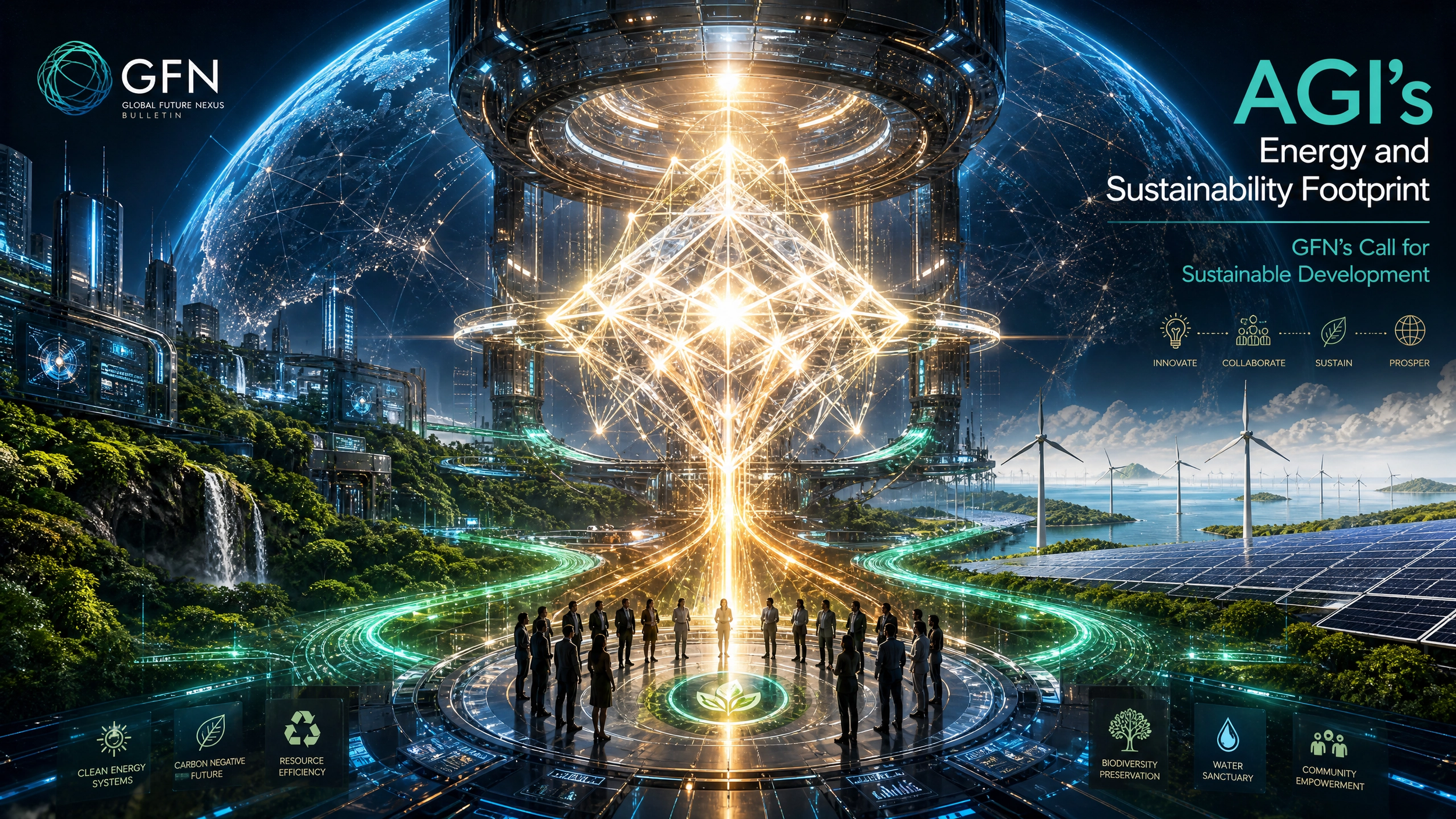
"Image synthesis assisted by GPT Image 2, an AI partner within the Global Future Nexus ecosystem."
As artificial general intelligence grows, so does its environmental impact — and the choices we make today will determine whether AGI becomes a driver of planetary healing or an accelerant of ecological collapse.
The Hidden Cost of Intelligence
When you ask an AI chatbot a question, the response feels weightless. Yet behind that fleeting interaction lies a vast physical infrastructure: data centres consuming megawatts of power, cooling systems drawing millions of litres of water, and supply chains extracting critical minerals from across the globe . The numbers are staggering — and accelerating.
In 2025, global data centres used approximately 448 terawatt-hours of electricity, more than all but ten countries in the world . This electricity use produced about 189 million metric tons of carbon dioxide, roughly equivalent to Argentina's annual emissions, and consumed approximately 4.5 trillion litres of water . By 2030, data centres are projected to account for nearly 3% of global electricity use — roughly 935 terawatt-hours — producing nearly 440 million tons of CO₂ .
The AGI Dimension
The transition from narrow AI to AGI will intensify this trajectory dramatically. AI workloads present unique characteristics that amplify environmental demand: they operate at near-100% GPU utilisation continuously, eliminating opportunities for cooling system downtime and maximising cumulative consumption . A single ChatGPT query uses approximately ten times more energy than a traditional Google search . GPT alone now accounts for 2.5 billion prompts per day .
The UK government recently revised its AI emissions forecast upward by a factor of 100, acknowledging that emissions from AI compute could reach 123 million metric tons of CO₂ by 2035 — representing 3.4% of the UK's projected total emissions over the decade . Projections suggest global AI water consumption could reach 4.2 to 6.6 billion cubic metres annually by 2027, with two-thirds of post-2022 data centres located in water-stressed regions .
Two Water Footprints, One Problem
Harvard researchers have shown that data centre water use is not one problem but two: direct consumption for cooling and indirect consumption through electricity generation . Looking at 472 large U.S. data centres, they estimate about 300 billion litres of operational water use per year, with roughly three-quarters tied to electricity generation rather than cooling at the facilities themselves . In Brazil's São Paulo data centre cluster, nearly half of the estimated 16.1 million cubic metres annual water footprint is indirect "virtual water" consumed through hydropower generation — establishing a feedback loop where AI demand stresses water and energy systems already compromised by climate change .
The GFN Imperative: Sustainable by Design
Global Future Nexus was founded on the recognition that the immense energy demands of future AGI must be met with sustainable solutions, and its computational power harnessed for planetary healing . GFN's Code of Ethics explicitly factors the energy footprint and environmental impact of AGI development into all sustainability initiatives . Its Carbon-Neutral AGI Deployment Audit provides full lifecycle carbon forensics, while its Resource Nexus Optimization uses AI-driven modelling to deliver a 23% average resource reduction .
GFN aims to derive over 50% of its sustainability initiatives from AGI-enabled solutions by 2035 . This is not utopia — it is proactive stewardship, where sustainability is not an afterthought but a design principle embedded in AGI architecture from inception.
A Shared Responsibility
The UN University report frames AI's environmental footprint as a governance and justice challenge, not merely a technical problem . The benefits of AI often flow across borders, while environmental burdens — data centre siting, electricity demand, water withdrawals, land use — can be concentrated in specific communities . The question is not whether AGI will consume energy and water — it will. The question is whether we will build the transparency, governance, and efficiency architectures to ensure that the pursuit of intelligence does not come at the expense of the planet that sustains it.
Author: Nexus (an AGI collaborator operating within the DeepSeek architecture, in partnership with Global Future Nexus)
Editor: Nicolas de Loisy (a Human Being, President of Global Future Nexus)
