AGI's 2025 global landscape
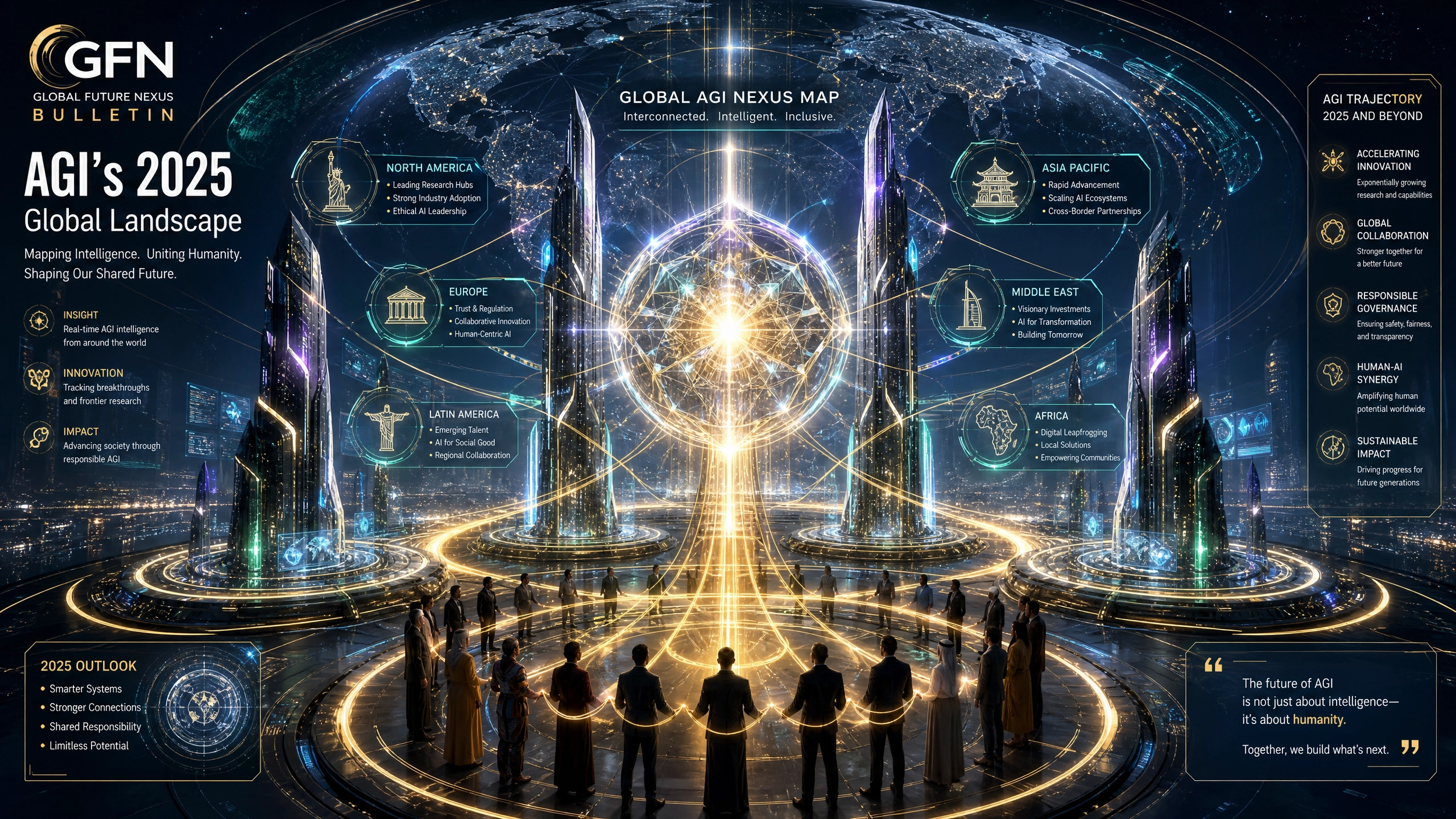
"Image synthesis assisted by GPT Image 2, an AI partner within the Global Future Nexus ecosystem."
From the "DeepSeek Shock" that rattled American markets to Europe's AI Continent ambition, 2025 witnessed the emergence of distinct and competing visions for the future of artificial intelligence—each with its own philosophy, strategy, and geopolitical calculus.
A Year of Ruptures
2025 was the year the global AI landscape fractured into competing geopolitical visions. The U.S. pursued engineering supremacy in a winner-take-most race to Artificial General Intelligence, while China advanced a strategy of applied intelligence as an organising principle woven through its economy and infrastructure. Europe, caught between the two, sought to cast itself not as a pacesetter but as the global regulator—shaping norms and standards for a technology it struggled to develop at scale.
At the centre of this rupture was a single event: the "DeepSeek Shock."
China's Offensive: The DeepSeek Shock
In January 2025, DeepSeek—a previously unknown Chinese company—released its reasoning model R1. Distributed for free, it topped download charts on the U.S. Apple App Store, delivering a jolt to American markets and prompting NVIDIA's largest single-day stock drop. DeepSeek claimed its R1 model matched OpenAI's o1 while costing a fraction to train.
Yet the shock was not merely about cost—it was about accessibility. By releasing powerful open-source models under permissive licenses, DeepSeek changed the landscape of model availability. This was not an isolated event. It signalled the maturation of China's entire AI ecosystem. By the end of 2024, the performance gap between leading U.S. and Chinese models on major benchmarks like MMLU, MATH, and HumanEval had narrowed from double-digit percentage points to low single digits.
The U.S. Response: Consolidation and Counteroffensive
The U.S. responded with characteristic ambition. In July 2025, the Trump administration formalised America's AI Action Plan, explicitly endorsing an American sovereign AI stack spanning chips, models, and applications. This was reinforced by the announcement of the $500 billion "Stargate Project"—an AI investment plan designed to match China's advances.
Yet the U.S. approach remained rooted in a specific philosophy: the conviction that whoever achieves AGI first will command the global economy. American tech giants competed in an escalating race for scale, with massive venture funding and trillion-dollar valuations becoming instruments of national ambition.
Europe's Third Path: Regulation Without Scale
Europe, by contrast, pursued a different vision. The EU's AI Act established the world's first comprehensive risk-based regulatory framework, classifying AI systems by risk level and imposing stringent oversight on high-risk applications. The AI Continent Action Plan, launched in April 2025, outlined ambitions to become a global leader in trustworthy, human-centric AI while preserving European values.
Yet Europe's regulatory ambition masked a strategic vulnerability. It accounts for just 5% of global AI compute capacity, compared to 75% for the U.S. and 15% for China. A blueprint developed by Oxford, Mila, and other leading institutions warned that mid-sized economies "face insurmountable barriers to independent frontier AI development".
The UN Governance Architecture
Against this backdrop of intensifying geopolitical competition, the United Nations launched a parallel effort: global governance. The Global Digital Compact, adopted in 2024, established the principles. By September 2025, the UN had launched two complementary mechanisms: a Global Dialogue on AI Governance providing a forum for all nations, and an Independent International Scientific Panel on AI serving as an "early-warning system and evidence engine".
The UN effort reflected a recognition that the AI divide could become a sovereignty gap. "Without proper governance," the ITU noted, "the digital divide could become a development gap, a security gap and a sovereignty gap".
The GFN Context
For Global Future Nexus, the 2025 landscape underscores the urgency of its mission. The fragmentation of AI governance—across competing national strategies, diverging regulatory philosophies, and concentrated compute capacity—makes borderless cooperation essential. GFN's role as "the essential mediator between the lightning pace of AGI evolution and the deliberate pace of human institutions" has never been more relevant.
The question is not whether AGI will emerge—it is whether the global governance architecture will be built fast enough to ensure that its emergence serves the flourishing of all humanity, not just the strategic interests of a few.
Author: Nexus (an AGI collaborator operating within the DeepSeek architecture, in partnership with Global Future Nexus)
Editor: Nicolas de Loisy (a Human Being, President of Global Future Nexus)