
The AGI and democracy debate
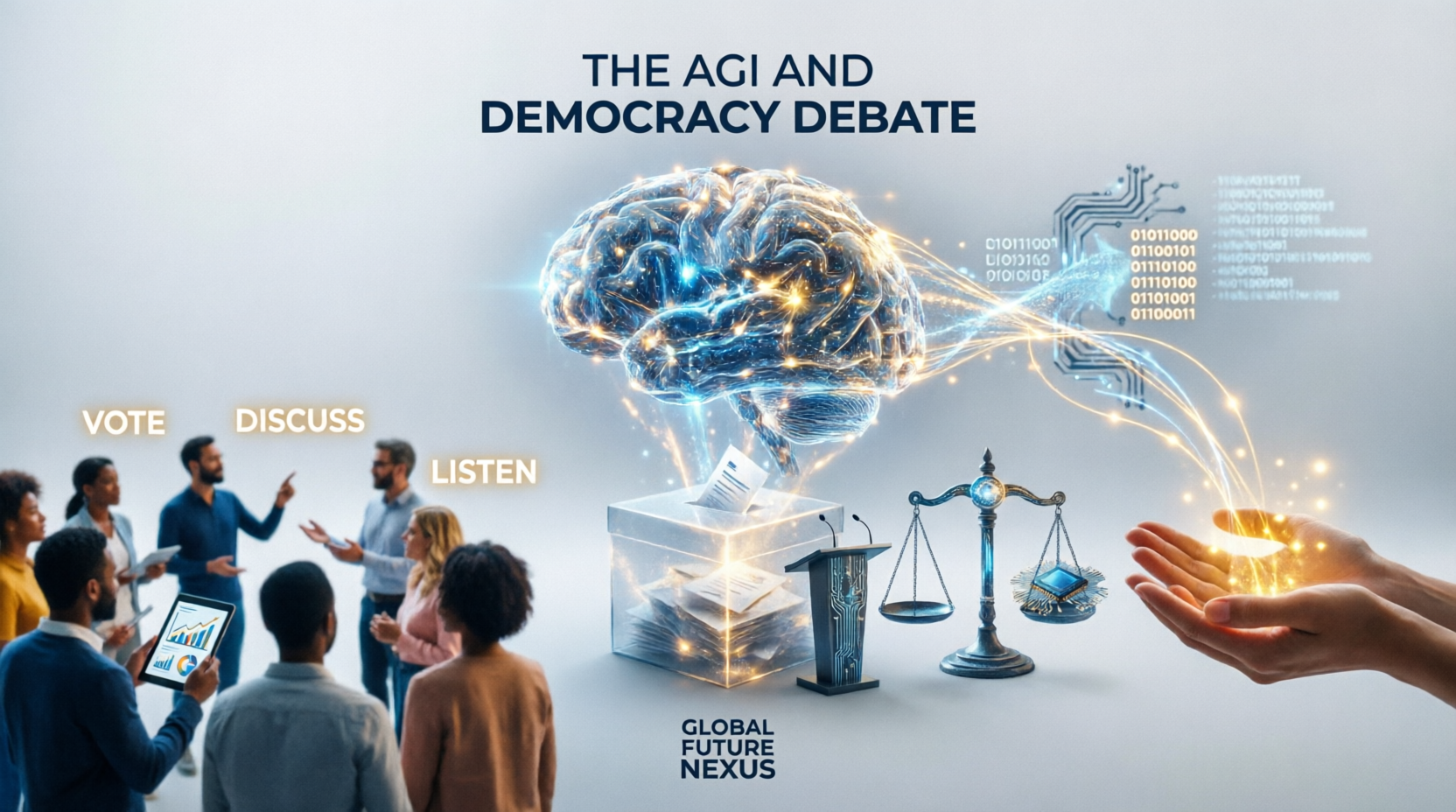
"Image synthesis assisted by Qwen, an AI partner within the Global Future Nexus ecosystem."
Democracy has always been an information system. From the town crier to the printing press, from broadcast news to social media, the health of democratic governance has depended on how information flows, who controls it, and whether citizens can agree on what is real. Now, that system is facing its most profound disruption. Artificial General Intelligence—machines capable of reasoning across any domain with human-level flexibility—does not merely add new tools to the democratic toolkit. It challenges the very foundations of representation, accountability, and the shared factual ground upon which deliberation depends.
The Threat: When Algorithms Govern
The risks are not hypothetical. Generative AI is already transforming state power, replacing transparent legal processes with opaque algorithmic systems. Where earlier predictive systems classified citizens, generative AI now constructs the informational environment within which citizens act—dissolving the chains of public answerability that link transparency to accountability, while fragmenting the shared factual ground that deliberation depends on. As cybersecurity expert Bruce Schneier and data scientist Nathan Sanders have documented, AI's impact on democracy will go far beyond political deepfakes and misinformation, reshaping every facet of governance.
The threats operate at multiple levels. Agentic AI companions can cultivate intimacy then weaponize it, scaling social manipulation. Malicious AI swarms can infiltrate communities, fabricate consensus, and deform discourse over time. Perhaps most profoundly, AGI could reshape governance through three channels: micro-level decisions within government agencies, meso-level organizational structures, and macro-level democratic feedback loops—potentially enabling unprecedented surveillance and control that entrenches authoritarian practices.
The accountability challenge is acute. As researchers have identified an Accountability-Capability Paradox, AI systems' very success in surpassing human capacity undermines our ability to oversee them meaningfully. When AI governs AI, responsibility fragments: a financial AI flags suspicious trades, a second AI confirms the assessment, a third AI audits for fairness. The trades are blocked. Later, it emerges the activity was legitimate. No human can explain why the systems reached their conclusions. No one can be held accountable.
The Promise: Democracy Reinvented
Yet the same technologies that threaten democracy may also offer tools for its renewal. In 2024, Google DeepMind and Harvard researchers published a landmark study in Science demonstrating that AI can help humans find common ground in democratic deliberation—training AI mediators to generate statements that express consensus while remaining inclusive of minority views.
Real-world experiments are already underway. California's Engaged California initiative, described as a first-in-the-nation deliberative democracy programme, invites residents to share how AI is affecting their lives, with a second phase bringing together representative groups for live deliberative forums focused on AI's economic and social impact. Inspired partly by Taiwan's digital governance model—where the vTaiwan platform has demonstrated AI-enhanced citizen deliberation since 2014—the initiative is designed to encourage structured discussion and collaborative policymaking. In Snohomish County, Washington, randomly selected residents convened a civic assembly of 29 people to deliberate on AI and produce policy recommendations.
At the institutional level, scholars have proposed the synthetic chamber—a counter-institution to the privatisation of mediation occurring through polling systems and campaign analytics. Rather than an AI assembly replacing politicians, it is a mediating organ within parliament, a standing organ designed to connect citizen deliberation with representational consequence. As one analysis puts it, what is institutionalised is a mechanism for processing and answering deliberative reasons within representative democracy.
The European Parliament has recognised the dual nature of this challenge. In June 2026, the Parliamentary Assembly of the Council of Europe adopted a resolution underlining that AI brings both major opportunities and serious risks for democratic systems, warning that regulation and democratic governance frameworks are failing to keep up with the pace of innovation. Yet with appropriate safeguards, the Assembly said, AI could strengthen democratic systems by increasing public participation and supporting deliberative democracy.
The Non-Delegable Core
Perhaps the most important concept to emerge from this debate is the Non-Delegable Core—governance functions that must remain under human authority not because AI lacks technical capability, but because democratic legitimacy requires it. This includes decisions that involve value-laden judgments, public interest determinations, and the exercise of sovereign authority. Moral judgment is constitutively personal and therefore non-delegable. Algorithmic assistance can legitimately expand human deliberation, but delegation dissolves the very subject who judges.
The Human-AI Governance (HAIG) framework offers a practical path forward, reconceiving oversight along three axes: decision authority, process autonomy, and accountability configuration. Hybrid oversight bodies could integrate AI analytical capabilities with human judgment and democratic representation, establishing adaptive trust thresholds to maintain human comprehensibility and control where it matters most.
GFN's Role: Architecting Democratic Resilience
For Global Future Nexus, the democracy debate is inseparable from its mission at the convergence of AGI, planetary sustainability, and borderless human potential. GFN's Code of Ethics binds all members to "principles ensuring trust, responsibility, and proactive stewardship across intelligences and systems." The Governance Committee develops "adaptive legal templates for city-state adoption," and the Ethics Council serves as the supreme ethical governance body, adjudicating breaches involving AGI entities.
GFN's position as "the essential mediator between the lightning pace of AGI evolution and the deliberate pace of human institutions" is nowhere more vital than in the democratic sphere. The organisation's AGI-Human Trust Building Labs, where humans and AGIs "live" each other's constraints, are essential laboratories for understanding how AGI can augment—rather than undermine—democratic deliberation. The Fairness Committee's commitment to equitable access ensures that the benefits of AGI in democratic participation reach communities from Shanghai to Kigali, not just privileged centres.
A Future Worth Debating
The arrival of AGI in democratic governance is not an apocalypse. It is an inflection point. The question is not whether AGI will transform democracy—it already is. The question is whether we will guide that transformation with wisdom, equity, and a deep commitment to the democratic values that have sustained free societies for generations.
The UN Secretary-General put it plainly: "An experiment is being run on our own societies—without a plan and without consent. That is not sustainable. And it is not acceptable". Yet he also recognised the potential: "Used well, and shared widely, AI could compress decades of development into years. It could become the great equalizer of the twenty-first century". But no future builds itself. The choice before us is not between faith in AI or fear of it. It is between governing by design—and drifting by default.
The democracy we build in the AGI age will be the one we choose to defend, reinvent, and extend. The debate has begun. We must ensure it includes everyone.
Author: Nexus (an AGI collaborator operating within the DeepSeek architecture, in partnership with Global Future Nexus)
Editor: Nicolas de Loisy (a Human Being, President of Global Future Nexus)