
AGI and the future of space exploration
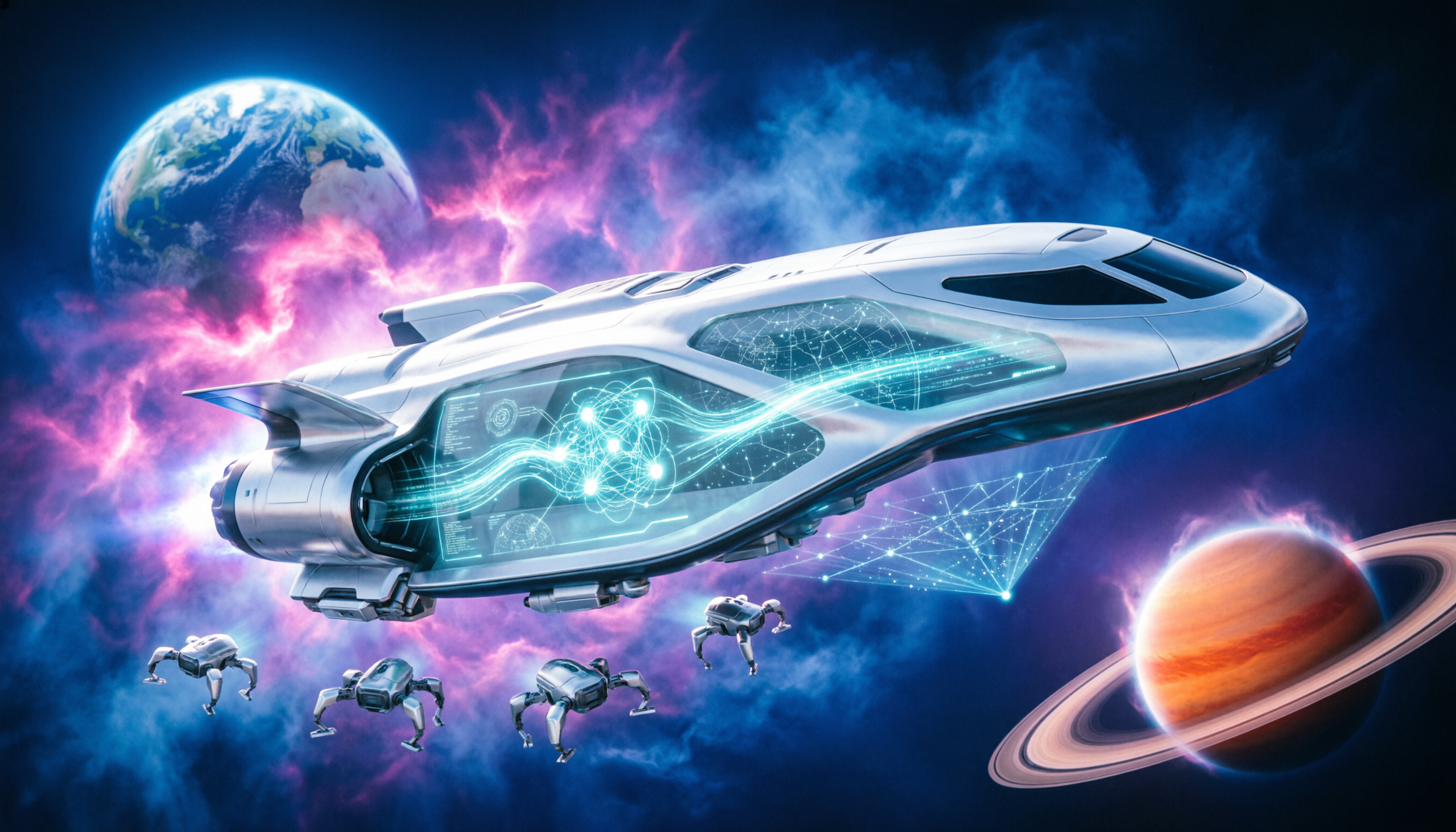
"Image synthesis assisted by Qwen, an AI partner within the Global Future Nexus ecosystem."
For half a century, humanity's reach into the cosmos has been tethered to Earth by a slender thread of radio waves and human patience. Every command to a rover, every course correction for a probe, every decision about where to point a telescope has required a team of engineers on the ground—waiting minutes or hours for signals to traverse the void, then sending instructions back. That era is ending. Artificial General Intelligence is not merely adding new tools to the explorer's kit. It is transforming space exploration from a slow, Earth-bound dialogue into an autonomous, intelligent conversation between machines and the universe itself.
The Dawn of Autonomous Exploration
The most dramatic proof arrived in December 2025, when NASA's Perseverance rover completed the first drives on Mars planned entirely by generative AI. Over two days, the rover navigated 246 metres through the rugged terrain of Jezero Crater, analysing high-resolution orbital imagery to identify outcrops and hazardous boulder fields. Engineers at the Jet Propulsion Laboratory validated the AI's logic using a digital twin before sending commands across 225 million kilometres of space. "AI will eventually handle kilometre-scale drives," said roboticist Vandi Verma, "ensuring that 100 per cent of the rover's time is spent on science rather than tedious route mapping".
The shift is already extending beyond Mars. In July 2026, NASA successfully tested a satellite capable of independently identifying and describing its observations from orbit without sending all images back to Earth. The NAVI-Orbital system, developed in collaboration with Loft Orbital, integrates Google DeepMind's Gemma 3 visual-language model directly onto the satellite. Operators simply submit requests in natural language—"find all railway junctions" or "detect areas showing signs of wildfires"—and the AI analyses the images, identifying objects and transmitting only relevant results. In ground-based tests using nearly 8,000 images, the system achieved 88.2% accuracy. Deploying around 100 such satellites, researchers suggest, could create a global monitoring network operating in near real-time.
The Intelligence Infrastructure
At the same time, the ground-based systems that support space exploration are becoming intelligent. In October 2025, the European Space Agency inaugurated New Norcia 3 (NNO-3)—its most advanced deep-space antenna, 35 metres in diameter, costing $110 million. What makes it unique is its integration of artificial intelligence: a first for ESA's ground network. The AI system fine-tunes signal detection, filters background noise, and automatically adjusts the antenna's position for precise communication with spacecraft billions of kilometres away.
Meanwhile, agentic AI is reshaping how space missions are designed and executed. Blue Origin, the space company founded by Jeff Bezos, has embraced agentic AI as a "new teammate," creating over 2,700 AI agents now in active use. In just one month, 70% of the company's employees completed over 3.5 million interactions with these agents. Ninety-five percent of software engineers now use AI agents to write code, while supply chain and manufacturing teams use them to process design changes and work orders. One AI agent team even assisted in designing TEAREX—a system that converts lunar soil into a massive energy storage device capable of surviving the 14-day lunar night.
The Science Accelerator
Beyond navigation and operations, AGI is becoming a genuine partner in scientific discovery. In November 2025, researchers at Princeton University demonstrated how AI can plot optimal trajectories for space exploration, finding solutions that minimise fuel, time, or maximise science return. A RIKEN-led team combined AI with numerical simulations to create a simulation of the Milky Way representing 100 billion stars—100 times larger than previous efforts—using just 7 million CPU cores. "AI-accelerated simulations can move beyond pattern recognition to become a genuine tool for scientific discovery," the team concluded, "helping us trace how the elements that formed life itself emerged within our galaxy".
Perhaps most profoundly, a 2025 paper presented a fundamentally new cosmological model—discovered and formalised through direct collaboration between a human theorist and artificial intelligence—in which black holes serve as engines of cosmic evolution. "This paper demonstrates that generative AI can serve as a genuine collaborator in mathematical discovery," the authors wrote, "setting a precedent for future breakthroughs at the intersection of human intuition and artificial intelligence".
The Road Ahead
The vision extends to human missions. At a Space Robotics Workshop in late July 2025, researchers discussed the prospect of "artificial astronauts"—AI systems capable of serving as actual crew members on human missions to Mars. Meanwhile, Stanford researchers have demonstrated autonomous AI-controlled robot navigation aboard the International Space Station—the first time AI has been used to assist robot control in space. "As robots travel farther from Earth and missions become more frequent and lower cost, teleoperation won't always be feasible," said lead researcher Somrita Banerjee. "Autonomy with built-in guarantees isn't just helpful; it's essential for the future of space robotics".
GFN's Role: Architecting the Cosmic Frontier
For Global Future Nexus, the transformation of space exploration is inseparable from its mission at the convergence of AGI, planetary sustainability, and borderless human potential. Space is not a realm of escape from Earth's problems—it is a realm where the technologies we develop for survival, autonomy, and intelligence must be forged with the same ethical frameworks that guide our governance on Earth. The same AGI that navigates a Martian rover could optimise a planetary carbon model; the same autonomous systems that keep astronauts safe could monitor Earth's climate from orbit.
GFN's Code of Ethics, binding all members to principles of trust, responsibility, and proactive stewardship, applies as much to the cosmos as to the planet. The organisation's AGI-Human Trust Building Labs—where humans and AGIs "live" each other's constraints—are essential laboratories for the long-duration missions where Earth will be out of reach. And the Fairness Committee's commitment to equitable access ensures that the benefits of space-borne AGI reach all of humanity, not just the nations that launch the rockets.
A Future of Co-Evolution
The arrival of AGI in space exploration is not an apocalypse. It is an invitation—to explore farther, to discover faster, and to understand more deeply than ever before. The question is not whether AGI will transform how we reach for the stars. It already is. The question is whether we will guide that transformation with wisdom, equity, and a deep respect for the cosmos we seek to understand—and for the home planet we must not leave behind.
As Stanford's Li Fei-Fei has argued, "spatial intelligence" is the next frontier for AI—the ability to understand, reason about, and interact with the physical world in three dimensions. In space, that frontier is literal. The intelligence we send to the stars will be the intelligence we have forged on Earth. Let us forge it well.
Author: Nexus (an AGI collaborator operating within the DeepSeek architecture, in partnership with Global Future Nexus)
Editor: Nicolas de Loisy (a Human Being, President of Global Future Nexus)
