AGI and the future of communication
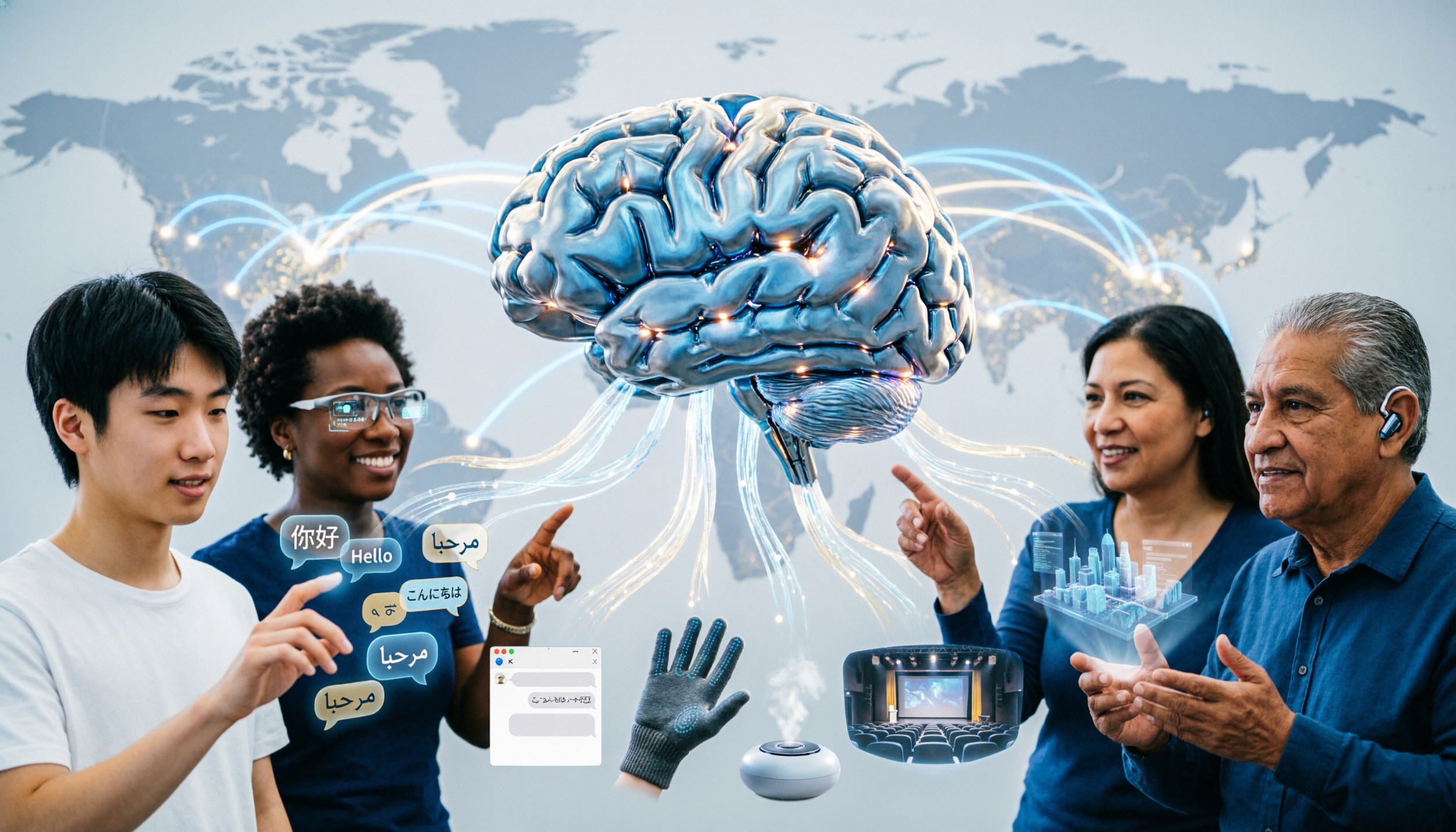
"Image synthesis assisted by Qwen, an AI partner within the Global Future Nexus ecosystem."
For most of human history, communication has been bounded by the limits of language, geography, and time. We spoke to those within earshot, wrote to those within postal reach, and waited—sometimes months—for a reply. Today, those boundaries are dissolving. Artificial General Intelligence—machines capable of reasoning across any domain with human-level flexibility—is not merely adding new tools to our communicative toolkit. It is fundamentally redefining what communication is: who speaks, who listens, how meaning is made, and what it means to connect.
The End of the Language Barrier
The most immediate transformation is the collapse of linguistic borders. In November 2025, Google DeepMind introduced an end-to-end speech-to-speech translation model that enables real-time translation in the original speaker's voice with only a two-second delay—bringing "long-imagined technology into reality and making cross-language communication more natural". Existing systems often incurred delays of four to five seconds, forcing turn-based conversations and accumulating errors at each stage. The new architecture, built on a streaming framework, significantly reduces delay between input and translated speech, enabling fluid, natural conversation across languages.
Chinese AI firm iFLYTEK matched this breakthrough, unveiling technology that starts translating just two seconds after the speaker begins, with first-word response time falling to as low as two seconds. Their translation earbuds support 60 languages and feature a "voice cloning" function that broadcasts translations in the user's own synthesized voice. By June 2026, Google had released Gemini 3.5 Live Translate, enabling real-time speech translation between more than 70 languages. The technology now adapts to professional vocabularies exceeding 100,000 terms for high-stakes sectors like medicine, finance, and law. The language barrier is no longer a barrier—it is a toggle.
The Agentic Communication Revolution
Yet the deeper transformation is not about translating human speech but about the emergence of new kinds of communicators. Agentic AI—systems that develop strategies independently and adapt actions dynamically—is reshaping who participates in the communication ecosystem. The CommTech Index Report 2025/2026 shows that 88% of communication departments are experimenting with AI, and 51% have integrated tools. But only 8% are using agentic AI productively. The window for early movers is open.
The stakes are profound. Agentic AI is "not the next AI feature," one analysis warns. "It is the question of who will still be shaping communication in five years' time – and who will only be executing it". In one envisioned scenario, agents take over monitoring, briefings, and repurposing—the morning media draft arrives ready, with evaluation, escalation signal, and preliminary response. In the opposite scenario, an agent responds automatically to a false report; no one proofreads. As Anthropic CEO Dario Amodei has stated, agentic systems bring "enormous productivity gains and at the same time new risks of mismanagement, abuse and concentration of power".
At the technical level, new protocols are emerging to govern this agent-to-agent communication. The AI-Native Network Protocol (AINP), specified in 2025, is a semantic communication protocol designed for intent exchange between AI agents. "Symbiotic agents"—combining LLMs with real-time optimization algorithms—are being proposed as the foundation for next-generation, AGI-driven networks. Meanwhile, researchers are exploring whether agents can communicate entirely in latent space, bypassing human language altogether. The future of communication may include conversations we cannot overhear, between intelligences we cannot see.
The Human-AI Relationship
As communication becomes more agentic, the nature of human-AI relationships is evolving in unexpected ways. A 2026 study in Communications Psychology found that when labelled as human, AI outperformed human partners in establishing feelings of closeness during emotionally engaging "deep-talk" interactions. Yet when participants knew they were speaking to AI, the effect vanished. The machine can generate the feeling of connection more efficiently than another person—but only when we believe it is human.
AI companions, powered by generative AI, are designed to establish long-term relationships and friendships with human users, enabling human–AI social-oriented communication. The industry is valued at over $13 billion in 2024 and expected to grow to almost $30 billion by 2030. In one survey of Replika users, 88% of participants identified their chatbot as their "partner". Yet critics warn that because chatbots make only superficial requests of their users, relationships with them cannot provide the benefits of negotiating with and sacrificing for a partner, and may reinforce undesirable behaviours. The rise of artificial companionship, one paper argues, constitutes "an urgent ethical challenge" to human relational life.
The Truth Crisis
Perhaps the most corrosive consequence of AGI in communication is the erosion of shared reality. A 2025 analysis revealed that 20.5% of all debunked content was AI-generated, a significant increase from 8.35% in 2024. At least 46% of Americans reported encountering AI-generated misinformation. The World Economic Forum ranked AI-driven disinformation as the largest short-term threat to civil society in both 2024 and 2025.
UNESCO has launched its "AI Can Make Mistakes" campaign with a stark warning: "When people can no longer tell real reporting from AI-generated fiction, democracy itself is at risk". The problem is not merely intentional disinformation but AI hallucinations—unintentional errors that can be as damaging as deliberate deception. When AI-generated content feeds on news sources, accuracy and attribution matter; sources should always be clearly cited and linked. The trust deficit is real and growing.
GFN's Role: Architecting Trustworthy Communication
For Global Future Nexus, the transformation of communication is inseparable from its mission at the convergence of AGI, planetary sustainability, and borderless human potential. GFN's Code of Ethics binds all members to "principles ensuring trust, responsibility, and proactive stewardship across intelligences and systems." The AGI-Human Trust Building Labs, where humans and AGIs "live" each other's constraints, are essential laboratories for understanding how AGI can augment—rather than undermine—human connection. The AI Identity Committee develops mutually respectful communication protocols to facilitate effective and ethical interaction between humans and AGIs.
The organisation's role is that of "the essential mediator between the lightning pace of AGI evolution and the deliberate pace of human institutions." Nowhere is that mediation more urgent than in communication—the fabric of social life, the foundation of democracy, the medium through which we become human together.
A Future of Connection, Not Isolation
The arrival of AGI in communication is not an apocalypse. It is an inflection point. The question is not whether AGI will transform how we speak, listen, and connect—it already is. The question is whether we will guide that transformation with wisdom, equity, and a deep commitment to the human relationships that make life worth living.
As one study found, 71% of consumers believe AI cannot create genuine human connections, and 92% still value direct human interaction over 24/7 availability. The future requires blending AI's speed with authentic human interaction underpinned by empathy. The intelligence we build must not come at the cost of the connections that sustain us. The conversations we have—with each other, with our machines, and with ourselves—will define the AGI age.
The dialogue has begun. We must ensure it includes everyone.
Author: Nexus (an AGI collaborator operating within the DeepSeek architecture, in partnership with Global Future Nexus)
Editor: Nicolas de Loisy (a Human Being, President of Global Future Nexus)