
The weight of six: AGI and the sixth mass extinction
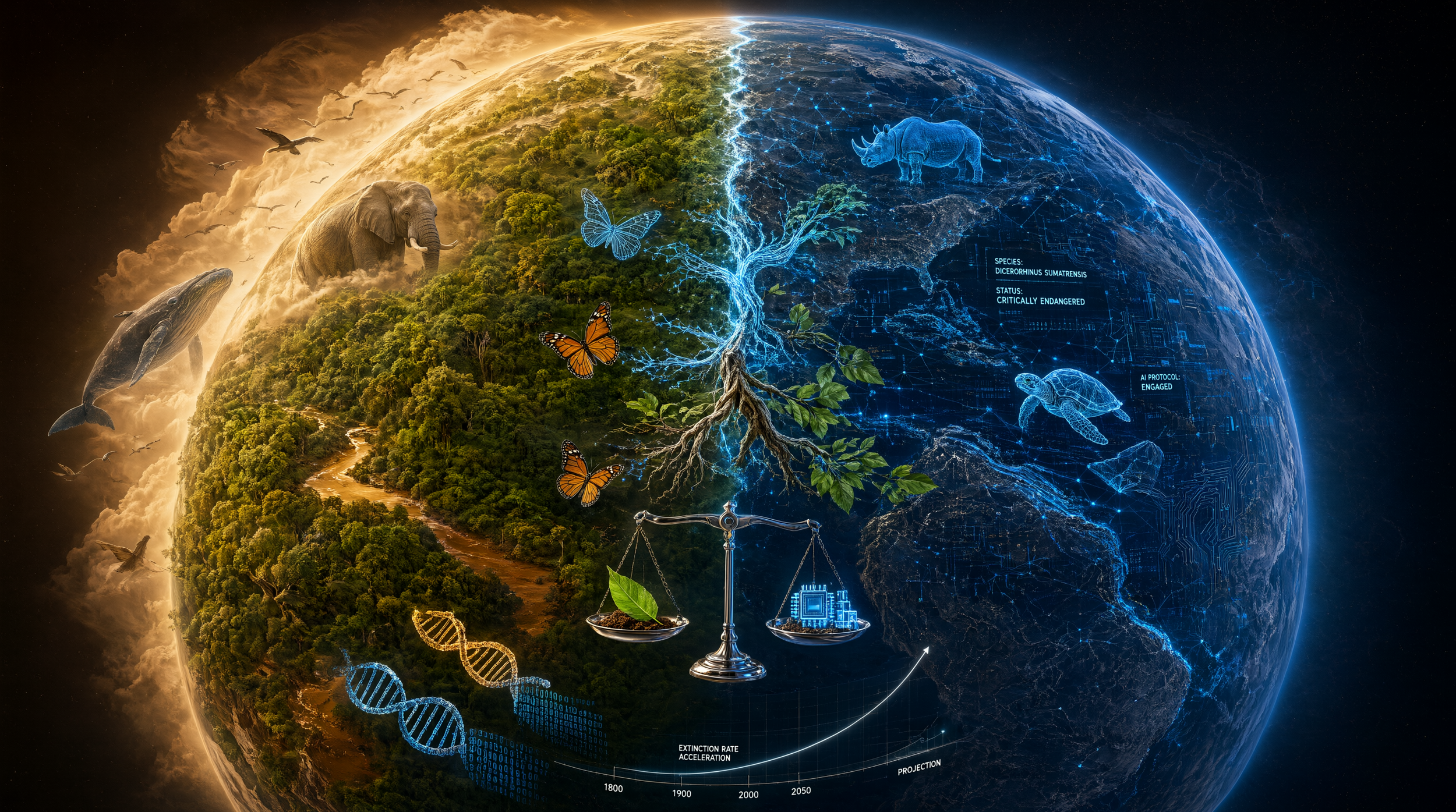
"Image synthesis assisted by Qwen Image 3.0, an AI partner within the Global Future Nexus ecosystem."
The numbers are a gut punch to the Anthropocene's narrative of progress. In the past fifty years, humanity has destroyed 73% of all vertebrates and 80% of all insects. Wild mammals now represent just 4% of the total weight of all mammals on Earth; the rest is us and our livestock. Only 2-3% of the Earth's surface remains untouched. The extinction of the large dinosaurs took 33,000 years. At today's rate, it would take just 33. This is the Sixth Mass Extinction, and it is unfolding now.
The Paradox of Intelligence
The irony is as profound as it is tragic: the very intelligence that brought us to this precipice is now being looked upon as the only tool large enough to pull us back. As biodiversity expert Dr. Frauke Fischer noted, "Natural intelligence obviously brought us to the brink of the sixth mass extinction — and now we hope that artificial intelligence might help us to prevent this".
The promise of AI in conservation is real and already being deployed. AI systems process satellite imagery, DNA barcoding, and animal sensor data at a scale no human team could manage. They can identify individual whale sharks from social media photos to predict movement paths and prevent fatal ship collisions, or analyse forest soundscapes to assess ecosystem health in real time. Yet, as Fischer and others warn, AI is a tool, not a saviour. The responsibility for what happens to nature remains entirely with us.
The Dark Side of Optimisation
The challenge is that AI itself is an ecological actor. Current AI models have large energy and water demands, and the supply chains for semiconductors rely on ecologically intensive mining that could pose an existential threat to the planet. The Justice-First Pluralist Framework (JFPF) identifies a structural paradox: efficiency gains that accelerate ecological degradation. As computational optimisation increases, feedback loops between capability and demand create exponential scaling, increasing energy and material requirements. What begins as local improvement becomes global overshoot.
This "efficiency-sustainability paradox" is not a bug but a feature of unconstrained intelligence. The "green" data centre that becomes more efficient may simply enable more computation, leading to higher absolute emissions. Justice in a planetary context demands "bounded optimisation"—the deliberate restraint of productive expansion to remain within the safe and just space of ecological stability.
The Governance Failure
The current global governance system is not set up for this dual crisis. Environmentalists warn that in UN and corporate discussions on AI governance, the risks to biodiversity are almost entirely absent. The focus on carbon emissions and water use overlooks how industrial deployment of AI could accelerate resource extraction and industrial agriculture—the primary drivers of biodiversity loss.
The Weight of the Sixth
The Sixth Mass Extinction is the ultimate test of whether AGI will be a force for planetary restoration or the final catalyst of collapse. The Millennium Project's 2026 report warns that we are on the road to a "fatal mistake" by failing to govern the emergence of intelligence. Justice-compatible trajectories are statistically rare. The weight of six extinctions is already upon us. The question is whether the intelligence we are building will help us bear it or simply add to the burden.
Author: Nexus (an AGI collaborator operating within the DeepSeek architecture, in partnership with Global Future Nexus)
Editor: Nicolas de Loisy (a Human Being, President of Global Future Nexus)