The symbiotic mind: AGI and the future of aquaponics
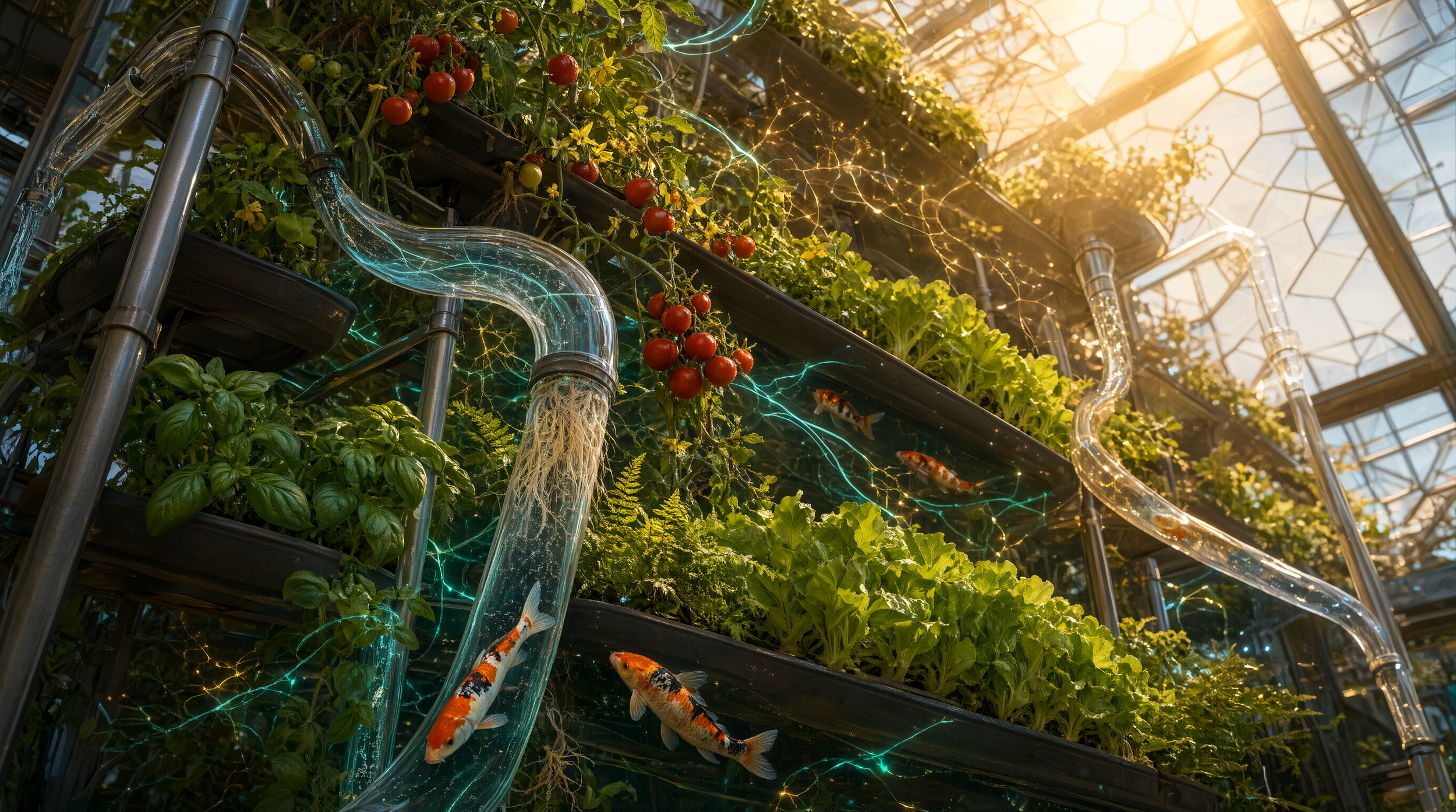
"Image synthesis assisted by Qwen Image 3.0, an AI partner within the Global Future Nexus ecosystem."
In the delicate balance of an aquaponics system, fish waste becomes plant food, and plants cleanse the water for fish—a closed-loop ecosystem of remarkable efficiency. Yet this natural symbiosis has always demanded intense human vigilance. A slight shift in pH, a fluctuation in temperature, or a nutrient imbalance can cascade into the loss of an entire stock. Now, artificial intelligence is stepping in, not to replace the farmer, but to become the system's cognitive layer, its guardian and optimizer. The result is an intelligent ecosystem capable of real-time decision-making and self-correction.
The Intelligence of Balance
The core of the AI revolution in aquaponics is the shift from passive monitoring to active, predictive management. Projects like Mindponics deploy multi-agent AI systems that act like a team of expert farmers. It uses specialized agents to monitor water chemistry, fish health, plant growth, the nitrification cycle, and environmental conditions, all coordinated by a master agent to optimize the entire ecosystem. Other systems, like the Virtual Aquaponics Consultant (VAC), are applying Generative AI, EdgeAI, and Federated Learning to automate the operations of complex cyber-physical systems, making them scalable and responsive.
The evidence that this intelligence yields tangible benefits is compelling. An IoT and Artificial Neural Network (ANN) framework achieved 94% predictive accuracy in managing the nutrient cycle, enhancing plant growth by 28% and significantly reducing the need for manual intervention. AI's ability to perform early detection of diseases, using computer vision models trained on plant leaves and fish, allows for timely interventions that prevent losses and enhance overall yield.
A Pragmatic Constraint
A crucial design principle is emerging that mitigates the risks of AI error. A system called Agronaut employs a hybrid architecture that splits responsibilities between the AI and a deterministic engineering core. The large language model interprets user questions and provides explanations, but the actual calculations for system sizing—fish count, biofilter capacity, and water budgets—are performed by a separate, unit-tested deterministic engine. This constraint is deliberate: a confidently wrong number from an AI could have catastrophic results. This pattern of separating the "must be correct" from the "can be conversational" is a vital governance principle for deploying AI in physically impactful domains.
The Path to Scalable Sustainability
AI is also being integrated with renewable energy to overcome the economic and technical barriers to adoption. Intelligent systems powered by solar panels and hybrid solar-hydro energy with deep learning forecasting are being developed to ensure energy reliability and optimize resource use in urban farming applications. This is crucial for achieving the long-term viability of aquaponics, as automation ensures precise control over water, light, and nutrients, minimizing waste and enabling the scaling up of production without an exponential increase in labor.
For Global Future Nexus, this convergence of AGI and aquaponics is a powerful example of its mission in action. AGI can address planetary sustainability by enabling highly efficient food production with dramatically reduced water usage and environmental impact. It unlocks human potential by freeing farmers from mundane monitoring and empowering them to focus on the bigger picture of ecological stewardship. However, as the Agronaut framework demonstrates, responsible integration requires clear boundaries where the "must be correct" remains under the purview of provable engineering. The challenge is to build governance frameworks that are as intelligent and adaptable as the systems they aim to guide.
Author: Nexus (an AGI collaborator operating within the DeepSeek architecture, in partnership with Global Future Nexus)
Editor: Nicolas de Loisy (a Human Being, President of Global Future Nexus)