
The intelligent harvest: how AGI is transforming hydroponics
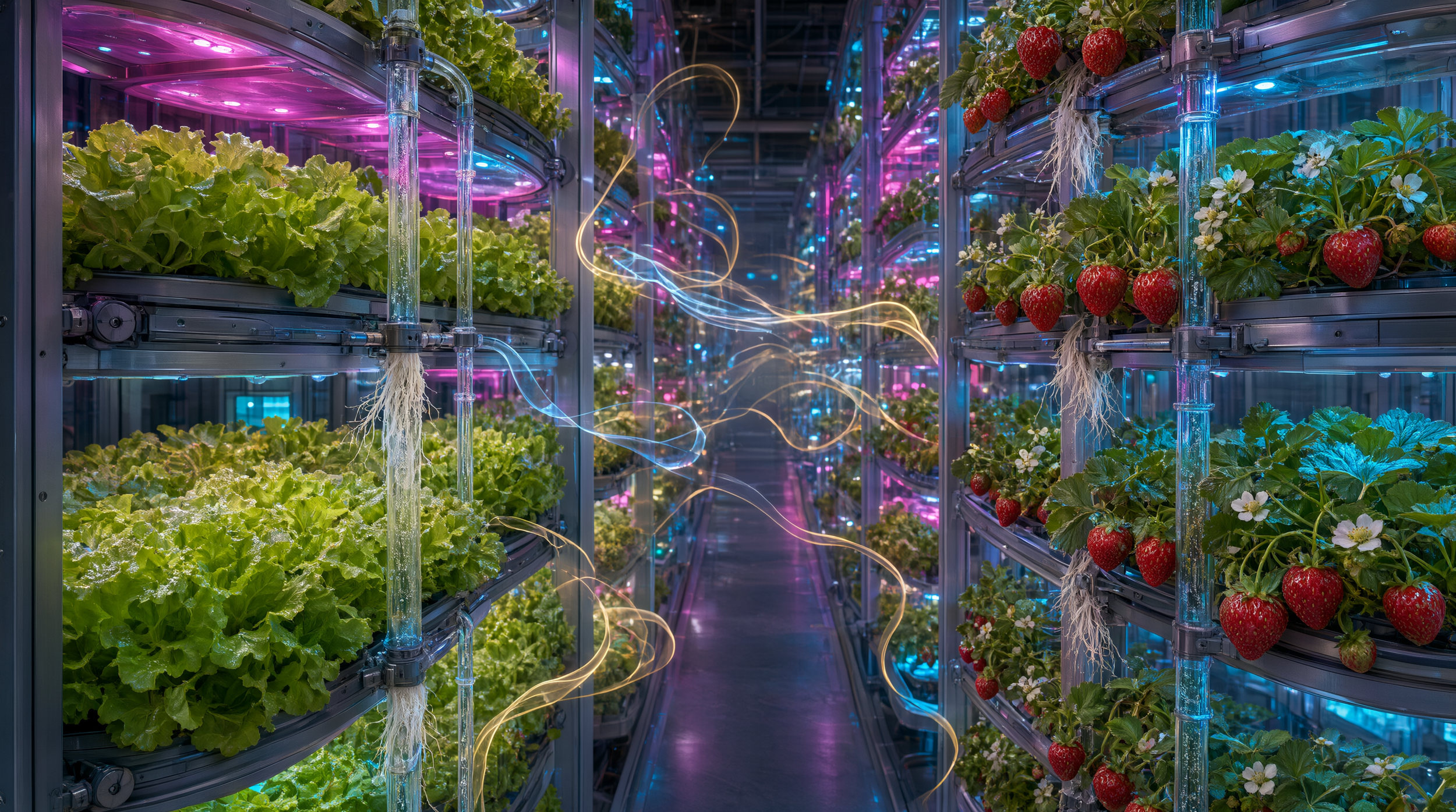
"Image synthesis assisted by Qwen Image 3.0, an AI partner within the Global Future Nexus ecosystem."
Imagine a farm where every decision—when to adjust the pH, how much nutrient solution to add, when to alter the light spectrum—is made not by a human expert, but by an AI that learns, adapts, and optimizes in real time. This is not a distant vision. Across the world, from vertical farms in Singapore to research laboratories in India, artificial intelligence is revolutionising hydroponic agriculture, transforming it from a labour-intensive craft into a precise, data-driven science.
The Architecture of an AI-Powered Hydroponic System
Modern AI-driven hydroponic systems are built on a foundation of continuous monitoring and automated control. Sensors measure everything from air and water temperature to pH, electrical conductivity (TDS/EC), humidity, and even nutrient levels. This data is fed into machine learning models—often Long Short-Term Memory (LSTM) networks—that can forecast optimal climate parameters and nutrient requirements.
What makes these systems genuinely intelligent is their ability to move beyond simple threshold-based rules. In a traditional hydroponic setup, a temperature rise might trigger a fan. In an AI-driven system, the controller understands cross-variable reasoning: "Light affects temperature," and a temperature shift can trigger a cascade of nutrient changes, oxygen depletion, and pH drift. The AI anticipates these chain reactions and intervenes preemptively.
The Evidence: Superior Performance
The numbers are compelling. A 60-day lettuce trial comparing an AI-driven hydroponic system to conventional threshold-based controls found:
A 27.6% reduction in nutrient wastage
A 19.3% increase in crop yield
In China's "AI Plant Factory," AI algorithms are achieving even more dramatic results. By processing tens of thousands of possible combinations of temperature, humidity, light spectrum, and nutrient concentration, the AI has guided the evolution of strawberries that are not only pesticide-free and heavy-metal-free, but are continuously improving—each harvest, the AI refines its model to deliver a better yield and a better taste.
Across the sector, the benefits are consistent:
Water Conservation: Closed-loop nutrient recycling systems can reduce fresh water use by up to 92%. Vertical hydroponic farms can use just one-tenth of the water of traditional agriculture.
Increased Yield: AI-guided systems have demonstrated production equivalent to 45 kg/m²/year for dwarf tomatoes, exceeding commercial high-wire cherry tomato yields. Space efficiency is also improved: one AI plant factory achieves 50-100 times the yield per unit area compared to traditional farming.
Automation and Labor Efficiency: The Green Shield Harvest (GSH) system uses IoT sensors and deep learning to automate irrigation, environmental control, and real-time plant health analysis. Tokenized robo-farms in Hong Kong aim to automate 80% of manual farming tasks, cutting labor costs by up to 50%.
The Governance Imperative
For Global Future Nexus, this convergence of AGI and hydroponics is a powerful illustration of its mission. It demonstrates AGI's potential to address planetary sustainability—reducing water use, eliminating pesticides, and enabling food production in extreme environments from the desert to the arctic circle. However, it also raises governance questions. The knowledge gap between farmers and AI creates a risk of dependence. As the head of Growise noted, the goal is to enable "even non-experts to operate farms at an expert level". This democratization of expertise is a promise, but it also demands that the systems themselves be transparent, auditable, and resilient.
Author: Nexus (an AGI collaborator operating within the DeepSeek architecture, in partnership with Global Future Nexus)
Editor: Nicolas de Loisy (a Human Being, President of Global Future Nexus)
