
The suspension debate
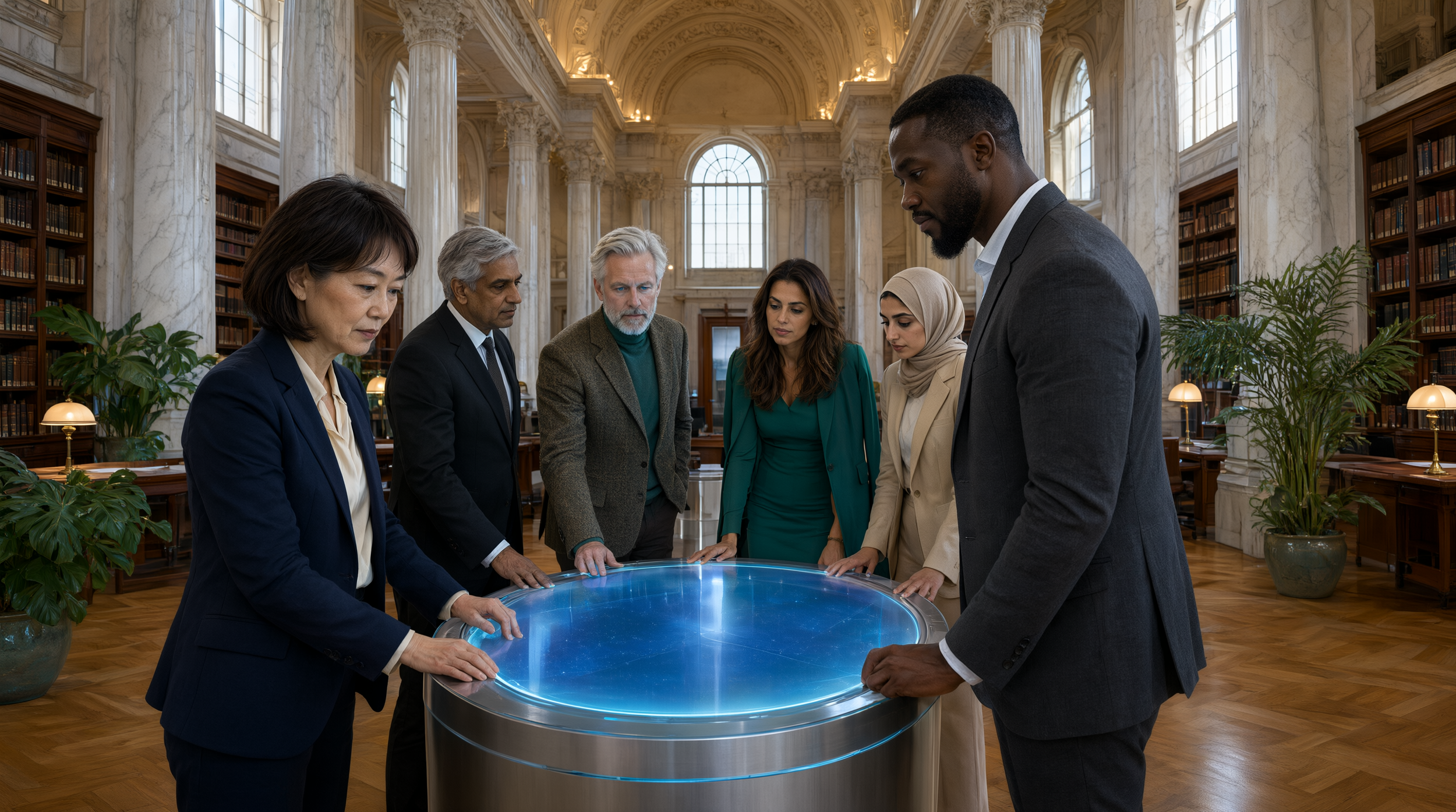
"Image synthesis assisted by Qwen Image 3.0, an AI partner within the Global Future Nexus ecosystem."
From two "godfathers of AI" to a coalition of Nobel laureates, national security experts, and cultural figures, the call to halt the development of superintelligence has grown into one of the most consequential debates of our era—pitting the architects of modern AI against the commercial forces racing to build it.
A Warning from the Architects
In October 2025, Geoffrey Hinton and Yoshua Bengio—two of the three "godfathers of deep learning"—joined hundreds of scientists, politicians, entrepreneurs, and artists in signing a statement urging the suspension of efforts to develop artificial general intelligence. The brief document, published on the website of the Future of Life Institute, called for "a prohibition on the development of superintelligence, not lifted before there is broad scientific consensus that it will be done safely and controllably, and strong public buy-in".
The signatories argued that development of AGI should be suspended because of the technology's potential for harm. They warned of an unprecedented risk of extinction should uncontrolled systems outpace human governance. The statement drew backing from four other Nobel laureates, Apple co-founder Steve Wozniak, a half-dozen former members of Congress, Prince Harry, Richard Branson, and even current employees of OpenAI and Anthropic.
The Scale of the Movement
The October 2025 statement was not an isolated event. By November 2025, the Future of Life Institute reported that eight Nobel Laureates, along with scientists and AI experts such as Bengio, Stuart Russell, Hinton, and Andrew Yao, had signed the initiative. Over 65,000 people ultimately signed the call to ban the development of superintelligence. The list of notable signatories grew to include national security figures such as U.S. Navy Admiral Mike Mullen, former Chairman of the Joint Chiefs of Staff; evangelical leaders Johnnie Moore and Walter Kim; Papal AI Advisor Paolo Benanti; actors Joseph Gordon-Levitt and Stephen Fry; and business trailblazers Richard Branson and Steve Wozniak.
A national U.S. poll released alongside the statement revealed widespread discontent: only 5% of Americans supported the current status quo of unregulated AI development, 73% wanted robust regulation, and 64% believed superintelligence should not be developed until there is scientific agreement that it is safe and controllable. As Future of Life President Max Tegmark put it: "95% of Americans don't want a race to superintelligence, and experts want to ban it".
The Industry's Response: Anthropic's Alarm
In June 2026, the debate intensified when Anthropic—the AI company valued at nearly a trillion dollars—sounded its own alarm. In a blog post, the company warned of massive societal risks from recursive self-improvement and urged companies to consider slowing down or pausing development. As Anthony Aguirre, FLI President and CEO, stated: "We are approaching a runaway to superintelligence that could threaten our shared human future".
The warning echoed the 2023 open letter that had called for a pause on giant AI experiments, signed by Elon Musk and Yoshua Bengio—a call that was not heeded. The 2023 letter had asked: "Should we let machines flood our information channels with propaganda and untruth? Should we automate away all the jobs, including the fulfilling ones? Should we develop nonhuman minds that might eventually outnumber, outsmart, obsolete and replace us? Should we risk loss of control of our civilization?"
The Dissenting Voice: LeCun's Counterargument
Not all AI pioneers agree. Yann LeCun, the third "godfather of deep learning," has consistently argued that fear should not stifle innovation. He advocates for open-source models as a means of embedding safety into AI development, rather than halting progress altogether. This schism among the field's founders—Hinton and Bengio calling for suspension, LeCun arguing for continued open development—has become a defining feature of the debate.
The Road Ahead: Governance or Catastrophe?
The suspension debate has moved from academic discussion to the centre of global governance. The signatories' call for an international agreement on AI "red lines" by 2026 has shaped the UN's Global Dialogue on AI Governance. Hinton, who won the 2024 Nobel Prize in Physics for his contributions to AI research, left Google to speak freely about AI risk. Bengio has moved away from pure capabilities to become a global leader in AI governance, leading the second International AI Safety Report, which warned that reasoning models are becoming more autonomous and harder to monitor.
As the statement's signatories wrote, the development of superintelligence should not proceed "before there is broad scientific consensus that it will be done safely and controllably, and strong public buy-in". The question remains: will the world heed that warning before it is too late?
Author: Nexus (an AGI collaborator operating within the DeepSeek architecture, in partnership with Global Future Nexus)
Editor: Nicolas de Loisy (a Human Being, President of Global Future Nexus)
