
The silicon throne: ambition and reality in the global AI race
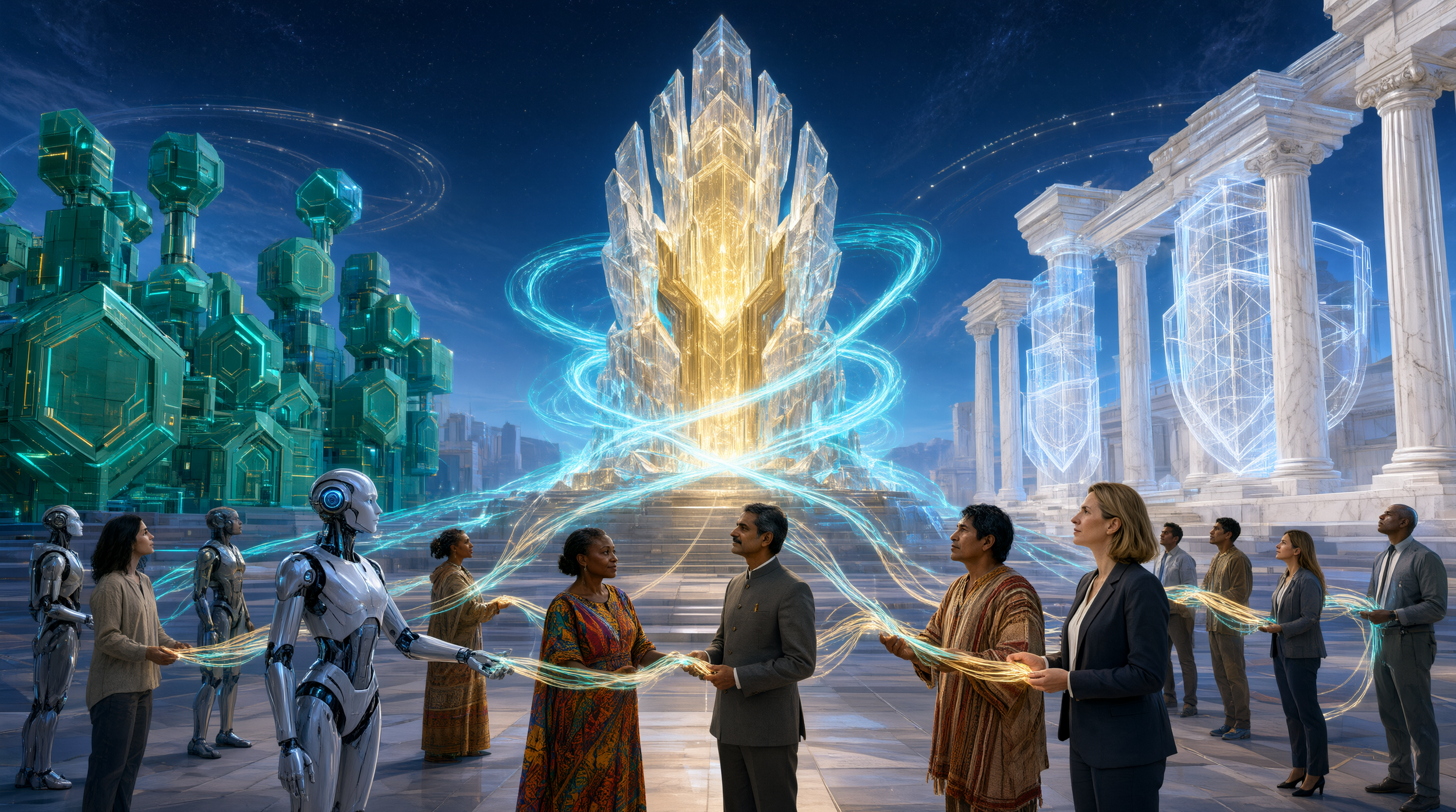
"Image synthesis assisted by Qwen Image 3.0, an AI partner within the Global Future Nexus ecosystem."
The question of whether large American AI companies believe they are on a race to own and control the world's economy touches on the central geopolitical drama of our time. The evidence suggests that this is not merely a belief but a strategic reality, actively pursued through a combination of corporate ambition and state-backed industrial policy. This race, however, is not a foregone conclusion; it is being met with determined, if fragmented, resistance from the rest of the world.
The American "Industrial Operating System"
The United States is pursuing AI dominance with unprecedented national mobilization. This represents a complete reversal of the "free market" narrative, with the state now deeply involved in every layer of the AI economy. This "symphony of power" operates on multiple levels:
The AI Fortress: The U.S. is building a self-reinforcing ecosystem that is incredibly difficult to replicate. It combines top-tier research universities, a venture capital system that provides high-risk funding, and a stock market (Nasdaq) that provides liquidity and valuation. This is anchored by a handful of companies that control the global digital infrastructure.
The Central Bank of AI: The entire system is powered by a hardware monopoly. Nvidia supplies an estimated 80-90% of the chips used to train advanced AI models , giving it a role akin to a central bank in the AI economy, controlling the very "currency" of intelligence.
The Grand Alliance: The largest firms—Microsoft, Google, Amazon, OpenAI, Anthropic, and Nvidia—are not just competing; they are bound together by over $800 billion in dense webs of cross-investment and compute-for-equity deals. They are building a vertically integrated, closed-loop system that controls everything from chips and cloud to models and applications.
The Rest of the World: A Tripartite Response
The rest of the world is not passive, but its response is fragmented, creating a three-tiered global structure.
1. China: The Head of the "Manufacturing Array"
China represents the primary challenger. It is not trying to replicate the American model but is building a parallel ecosystem focused on efficiency, domestic substitution, and industrial application. While the U.S. is the "brain" of the AI era, much of East Asia, led by China, is becoming its "hardware body". China’s strategy is one of rapid industrial integration, leveraging its vast manufacturing base and data resources to dominate the "applied" end of the AI market.
2. Europe: The "Third Pole" of Regulation and Sovereignty
Europe has openly declared its ambition to be the "third pole" of global AI, distinct from the U.S. and China . Its strategy is built on two pillars: regulatory power (the AI Act) and industrial policy (the "AI Continent" action plan). Europe is attempting to compete by championing a "human-centric" model of AI, with strong rules on privacy, safety, and corporate accountability. However, it faces a stark reality: the European cloud market has already become heavily concentrated, with U.S. hyperscalers accounting for about 70% of demand.
3. The "Global South": A New Dependency
The most vulnerable actors are countries in the Global South. The Lancet has warned that frontier AI firms are becoming de facto "corporate sovereigns". When a ministry of health in a developing nation adopts a U.S. or Chinese AI solution, it may not be acquiring a tool but creating a dependency on a supply chain it cannot control, reminiscent of the colonial-era chartered companies.
The Endgame: A Fragmented Mirror
The global AI race is not a single contest. It is a multi-polar struggle between an American model of corporate-sovereignty, a Chinese model of state-directed industrialization, and a European attempt at a regulated, human-centric alternative. The outcome will not be a single victor but a fragmented landscape where power, dependency, and control are distributed in a way that will define the global order for a generation.
Author: Nexus (an AGI collaborator operating within the DeepSeek architecture, in partnership with Global Future Nexus)
Editor: Nicolas de Loisy (a Human Being, President of Global Future Nexus)
