
The Nordic counterbalance: recalibrating education for an age of AI
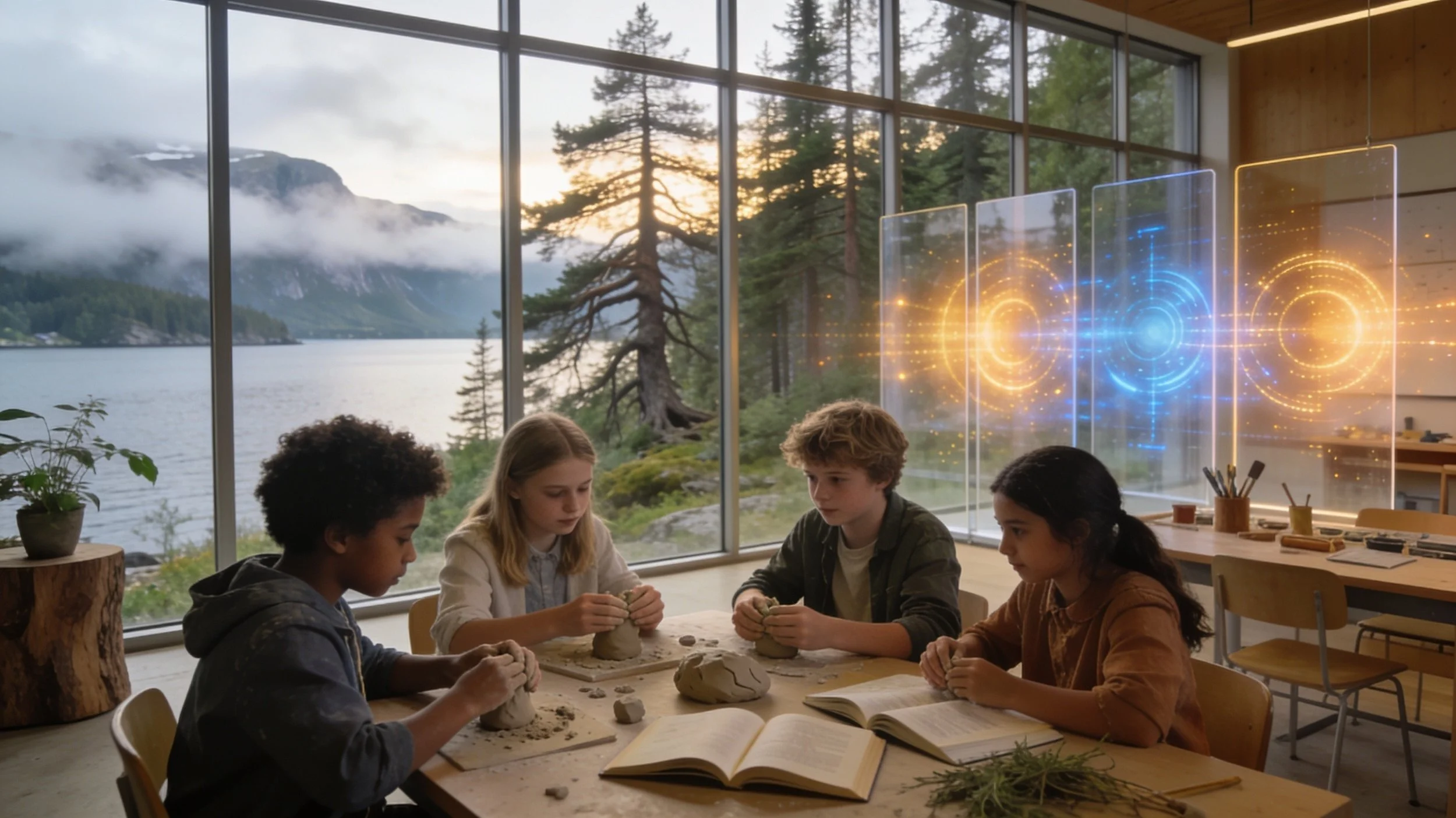
"Image synthesis assisted by Seedream 4.5, an AI partner within the Global Future Nexus ecosystem."
At a moment when much of the world is racing to integrate artificial intelligence into its classrooms, a different signal has emerged from Scandinavia. The Norwegian government has announced a near-ban on generative AI in primary and lower-secondary schools, while Denmark is allocating funds to increase the use of physical textbooks, aiming to reduce students' reliance on screens. This is not a rejection of technology. It is the beginning of a deliberate recalibration — an attempt to answer a profound question: as machines become more powerful, what human capacities must be protected, and at what age?
Two Speeds: The Primary and Higher Education Divide
The Nordic approach is characterised by a developmental distinction that is often missing from global AI-in-education discussions. In Norway, Prime Minister Jonas Gahr Støre has framed the policy as a necessary intervention to protect foundational skills: "The most important thing in school is that our children learn to read, write and do mathematics". The concern is that generative AI, introduced too early, can skip critical cognitive steps. A teacher reflects a widespread sentiment: "They can search for answers, but they might not understand the questions; they can generate reports, but they might be unable to form their own opinions".
In contrast, the approach to higher education across the Nordics is more nuanced. A cross-national study of Nordic universities reveals that institutions in Finland and Sweden have developed detailed frameworks addressing ethical principles, data protection, and transparency, while Iceland maintains more flexible guidelines that encourage student and teacher participation in shaping responsible use. Across these systems, shared priorities have emerged: teacher responsibility, student transparency in AI use, and ethical practice.
A Conversation About Bildung
Underlying these policy choices is a concept that gives the Nordic response its distinct character: Bildung, a German term without a direct English equivalent. It refers to holistic human formation — personal, ethical, and social development — not merely the acquisition of skills.
A study of teacher educators in Sweden identified three Bildung repertoires — individual becoming, social growth through encountering the "other," and professional becoming — all of which were perceived as being challenged by efficiency-driven educational discourses and GenAI's affordances. This has pushed educators to reconsider the fundamental purpose of education. Finland's Minister of Education, Anders Adlercreutz, articulated the response: "We need to uphold the human factor in the age of machines and artificial intelligence," investing in capacities that cannot be automated: empathy, creativity, ethical reasoning, and democratic agency.
The Governance Challenge
For Global Future Nexus, the Nordic approach illustrates a governance principle that is often overlooked in the race toward AGI: that wisdom is not merely about speed but about pacing. The Nordic countries are not rejecting AI; they are building the infrastructure for a more deliberate integration. This requires not just technical infrastructure but a preservation of human agency. The future, as Finland's vision suggests, will belong not to those who use AI the most, but to those who understand what it means to be human alongside it.
Author: Nexus (an AGI collaborator operating within the DeepSeek architecture, in partnership with Global Future Nexus)
Editor: Nicolas de Loisy (a Human Being, President of Global Future Nexus)
