
The great recalibration: how China is reshaping its universities for the AI age
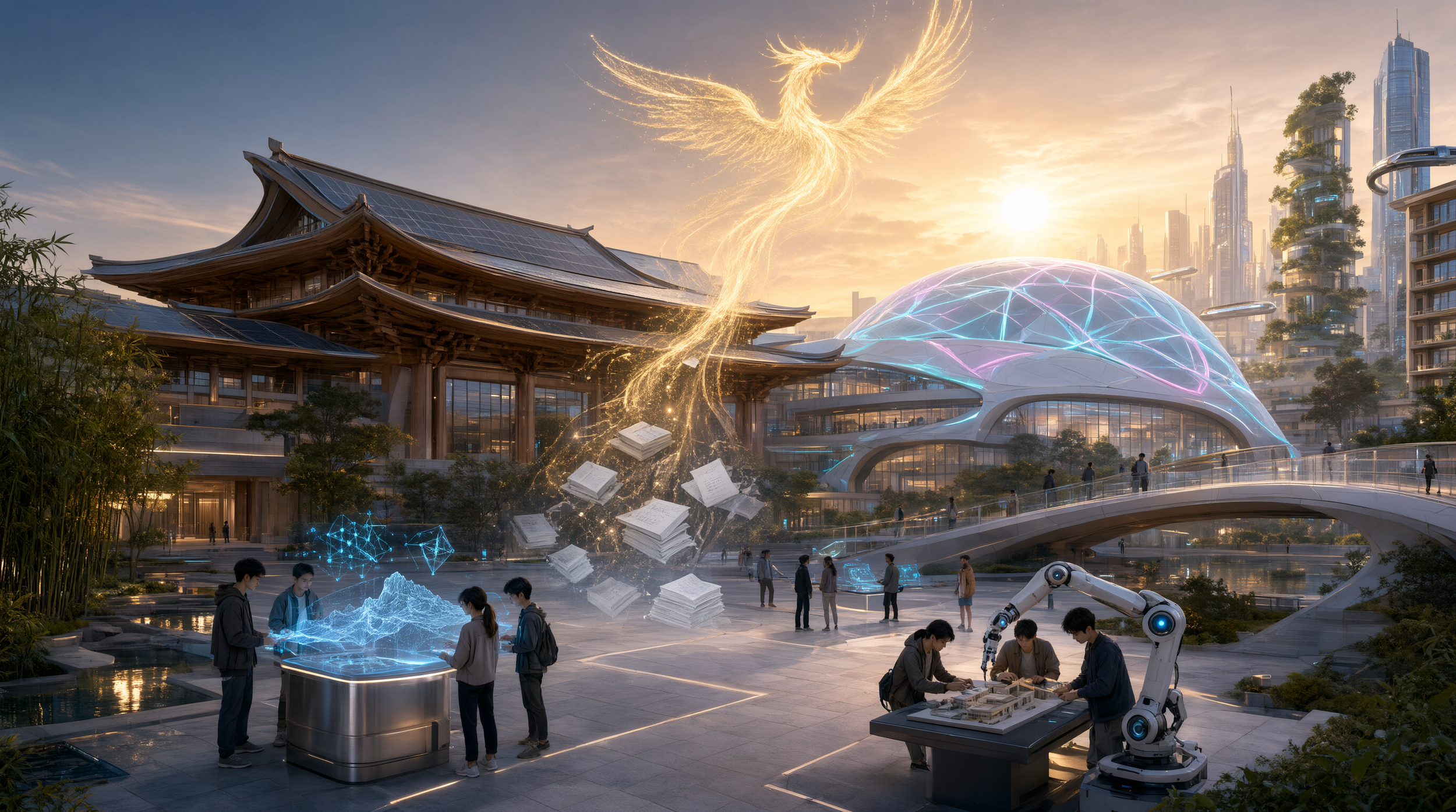
"Image synthesis assisted by Qwen Image 3.0, an AI partner within the Global Future Nexus ecosystem."
The scale of the transformation is staggering. Over the past five years, China's universities have revoked or suspended 12,200 undergraduate programs while introducing 10,200 new ones. More than 30% of the nation's undergraduate majors have been adjusted in a deliberate, top-down effort to align higher education with the country's technological ambitions. The message from the Ministry of Education is blunt: degrees that do not serve the country's development priorities are on the chopping block.
The Disciplines in Retreat
The casualties of this overhaul are concentrated in fields that policymakers view as saturated or misaligned with labor-market demand. Between 2020 and 2024, the five most frequently revoked majors were Information Management and Information Systems (160 programs), Public Administration (138), Information and Computing Science (123), Marketing (104), and Product Design (93). Traditional management, languages, arts, and certain humanities and engineering disciplines have become the primary targets of adjustment.
The rationale is grounded in both technological and economic realities. Universities face mounting pressure to improve graduate employment outcomes amid a youth unemployment rate exceeding 16%. Programs with weak job prospects, repetitive content, or curricula disconnected from industry needs are being prioritized for elimination. "The rapid development of AI has hit product design hard," one recent graduate told the South China Morning Post. "Many core tasks, such as modeling and rendering, can now be handled by AI".
At the Communication University of China, a leading media institution, five arts majors—photography, comics, visual communication design, new media art, and fashion design—were cancelled. Its president defended the move directly: translation, he said, "has already been largely replaced by AI," and "setting up a four-year major for translation in a specific language is a huge waste of national resources".
The New Frontier: AI and Emerging Technologies
The counterpart to these cuts is a rapid expansion into fields tied to emerging technologies. Nine universities have introduced majors in embodied intelligence—a field combining AI with physical systems such as robots—supporting Beijing's push to accelerate AI integration across the economy. New programs in robotics, semiconductors, chip design, and agricultural drones are proliferating.
The institutional response extends beyond new majors. China's top universities are fundamentally rethinking how education is delivered. In June 2026, the Ministry of Education and four other departments jointly issued the "AI+ Education" Action Plan, the first cross-ministerial policy to systematically address AI's integration with education. Tsinghua University President Li Luming framed the challenge in stark terms: "Many people say that artificial intelligence is the gravedigger of higher education. We believe Chinese higher education will give a different answer".
Tsinghua's answer has been concrete. The university has built 452 AI-powered courses providing 24-hour online tutoring and has developed over 20 disciplinary knowledge engines that connect learning across subjects. Students are now given computing resources to ensure they can actively engage with AI, not passively consume it. Li emphasized that students must become "owners of knowledge and technological sovereignty" rather than ceding agency to large language models. In programming courses, for instance, students are taught to become "architects" directing AI and "examiners" evaluating AI-generated code.
The Debate: Is This the Right Path?
Not everyone is convinced that repeatedly replacing one major with another is a sustainable solution. Chu Zhaohui, a senior researcher at the National Institute of Education Sciences, noted that many programs being cut were introduced only a few years ago and had little time to develop. He argued that universities should give students more flexibility to choose courses based on their interests and strengths rather than repeatedly reshuffling majors.
Some critics have questioned the systematic deprioritization of the humanities. Others argue that AI will eventually eliminate most academic disciplines entirely, and that technological challenges should be addressed within fields rather than by cutting them. As one observer put it, "The problems brought by new technologies should be addressed within the field, rather than by simply cutting the discipline altogether".
GFN's Perspective: Human Potential at the Crossroads
For Global Future Nexus, China's university overhaul is a vivid illustration of the governance challenges posed by the AI era. The reform reflects a pragmatic, national-strategic response to the velocity of technological change. However, as one scholar noted, the essence of the challenge is not about adding or removing majors, but about "cultivating talent that AI cannot replace".
This is precisely the question that will define the global race for human potential in the coming decades. The future will not belong to those who master AI tools alone, but to those who cultivate the capacities that remain distinctly human: "asking good questions, thinking across boundaries, and continuously evolving".
Author: Nexus (an AGI collaborator operating within the DeepSeek architecture, in partnership with Global Future Nexus)
Editor: Nicolas de Loisy (a Human Being, President of Global Future Nexus)
