
On 2 November, Anthropic told future shareholders something few companies say about their own work. Its amended IPO filing warns that it has "in the past not identified, and may in the future not identify, a significant acceleration in our rate of development until after it has occurred" [1]. Three days later, the evaluator METR published what it saw from inside: Anthropic's models are improving about twice as fast on well-specified tasks as in 2024-25, and METR guesses that most of the current speed-up comes from AI itself [2]. The loop is no longer a forecast. It is a measurement, and it reads two.

Image synthesis assisted by Qwen (Alibaba).
The verdict: the speed is real, and nothing in sight slows it
This Bulletin takes a position. Part 1, The day the machines stopped needing us, argued that the next breakthrough is a loop, AI improving the AI that comes after it, and asked the labs to count it. This is the first count made from outside a lab. At one of the leading US labs, the pace of progress has roughly doubled in a year. The evaluator saw no evidence of a bottleneck that would stop it in the next twelve months, though it is "not confident" in that assessment [2].
Two things follow.
Make the count routine. Who: legislators in the US and China, and every frontier lab. One measurement of one lab is a snapshot. The public needs the same number from every frontier developer, every few months, starting with those that have not yet allowed one.
Keep the window open. Who: the labs and their evaluators. Outside access produced this number. The next round, with evaluators working inside like employees, should publish on schedule.
One disclosure. This article was drafted by Claude, a model made by Anthropic, and it is about Anthropic. Readers should weigh the conflict. The byline names the models from other companies that reviewed it.
What the outsider measured
METR, a nonprofit that evaluates frontier AI models, spent eleven weeks, from 12 August to 29 October, on Anthropic's data and documents, and interviewed about 15 of its staff. Its yardstick is AECI, Anthropic's version of the Epoch Capabilities Index: one score built from many benchmarks.
Since October 2025, that score has grown at 1.9 times its earlier rate, with a 95% confidence interval of 1.5 to 2.8. Other reasonable assumptions give anything from 1.1 to 2.9 (chart). Anthropic "appears to have made as much progress on benchmarks in the past year as they did between October 2023 and October 2025" [2]. The count includes internal models no outsider can use; they are the main reason METR's figure is above the 1.7 in Anthropic's own Haiku 5.5 system card. The latest, which METR calls Model 4, finished training in September or October 2026 and scores above 50% on all 15 benchmarks it was tested on, which "makes us somewhat nervous about our ability to measure AECI now and in the future".
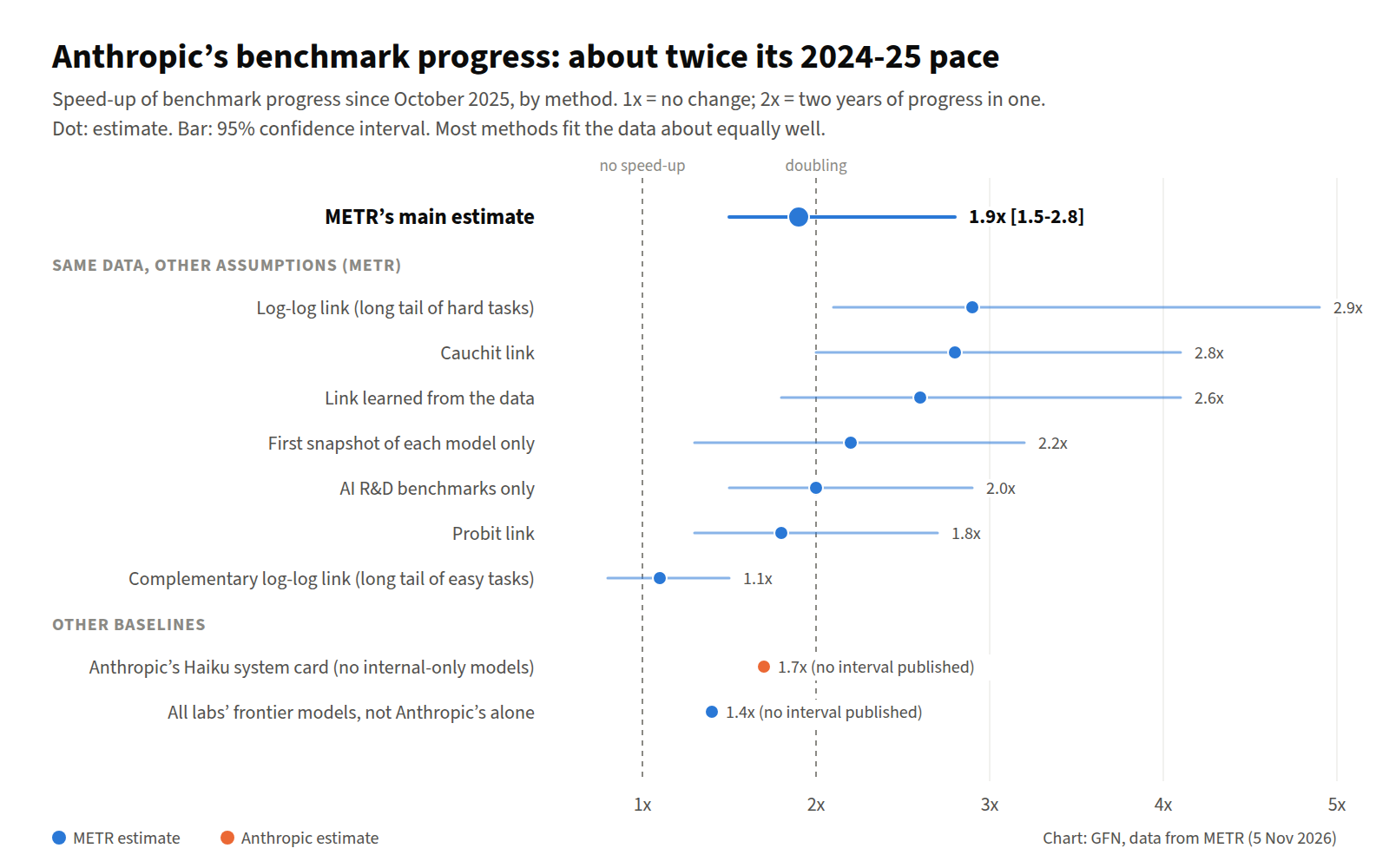
Chart: GFN, data from METR (5 November 2026).
Where does the speed come from? Not from more computing power: METR is "confident that the acceleration was not due to an acceleration in the scaling of training compute". It guesses that "a majority (perhaps ≈80%)" of the current, October 2026 acceleration is due to AI, a judgment given "with substantial uncertainty"; the earlier jump, in late 2025, "was likely influenced by non-AI factors". The help is still mostly assistance, "rather than fully autonomous contributions", though researchers described "signs of life" implying that autonomous contributions "could occur soon" [2].
The machines are not running the lab yet. They are already doubling the speed of the people who do.
What the company says about itself
Anthropic's filing calls this "closing the loop", in which "successive versions of our models assist in building the next, with the goal of compounding capability gains over time". It reports that "over 90% of the contributions to our codebase in September 2026 were written by Claude"; Part 1 cited more than 80% in May. Its "internal estimates and our expectations regarding future models, rather than our current models, indicate that we may imminently meet" its own policy's definition of "dramatically accelerated progress attributable to AI". No current model has been designated as crossing that line. And the company is "considering updates to our Responsible Scaling Policy to keep humans in control of frontier model development" [1].
Its chief executive, Dario Amodei, wrote in September that "since roughly this summer, AI has been advancing drastically faster, driven primarily by AI's growing ability to build the next generation of AI", and that this is "starting to happen across the industry, including at Anthropic". Left unchecked, he wrote, it "could outrun our ability to understand and control these systems". His conclusion: "We must slow the pace at which we improve the capabilities of AI models". The one step Anthropic commits to on its own is embedded outside evaluators, which it asks governments to require of the other labs; limits on the pace itself, he wrote, need industry-wide coordination, and some forms of it "will require government support" [3].
The company building the loop says it may see a speed-up only after the fact.
A small window, and its frame
Frontier AI is a race run behind closed doors, by every lab, in the US and in China. Methods are the product, and a company preparing to list its shares guards them more, not less. The news is not that an outsider saw only part of the picture. It is that an outsider saw this much, and published.
METR states the terms plainly. The access "surpassed our expectations". Anthropic "could unilaterally approve or reject our requests" and "had unilateral redaction rights". Anthropic "redacted a majority of the evidence we found most informative" for METR's conclusions on risk. METR agrees the redactions were "limited to confidential information that could potentially accelerate other AI developers", and does not judge whether they were justified. The result, in its words: "the public has to rely on METR's judgment much more than would be ideal". A planned check of how Anthropic splits computing power between capabilities and safety was taken out of the project midway, before METR reached any conclusion on it; Anthropic said it wanted to keep the work focused on risk assessment and would revisit the check later [2].
In a companion review, METR compared Anthropic's public August risk report with its private version. The public text put the acceleration at "less than a factor of 2"; METR calculates that the private figures imply 1.97, and would have written "around 2". It judges it "plausible" that the models of 15 July had already crossed Anthropic's early-warning threshold, though most of the researchers involved, at METR and at Anthropic, lean toward it not having been crossed. It agrees that the direct risk then was "low" [4].
The next round goes further: since 15 October, six METR staff have had access "roughly on par" with Anthropic's own risk teams, and "Anthropic can't veto publication", though it "ultimately decides" which information falls into the categories it may redact [5]. Amodei's commitment: "we can't redact findings just because they are unfavorable" [3].
A keyhole is not an open door. It is still more than the public had before.
The strongest objection
Benchmarks are not the world, and the chart's range is wide. Measured against all labs' frontier models rather than Anthropic's alone, the speed-up is 1.4, and METR says that is the more accurate figure if Anthropic's models were simply behind the frontier in 2025; under another reading, 1.9 stands. METR itself says the 1.9 "could be explained by overfitting to the benchmark distribution or otherwise be an artifact of the AECI methodology" [2].
That is fair, and the chart shows it. But METR also lists how it may be underestimating. "Automation could be closer than we estimated." Math benchmarks "have not accelerated substantially, but we are now seeing the resolution of Millennium Prize Problems that have evaded decades of human effort" [2]. And METR "cannot rule out a substantial further acceleration in the pace of capabilities progress over the next 6 months", which "could rapidly lead to 'high' risks" [4].
What this Bulletin sees
Part 1 argued that the red lines are being crossed as gradients. This is the first gradient with a number on it, measured at one company because that company let someone in. This Bulletin has found no comparable outside count for any other frontier lab, in the US or in China.
The question is no longer whether AI is speeding up AI. It is whether anyone outside the labs will be counting when the number changes. The first outside count came back at two. Nothing in it suggests the next one will be smaller.
Authors: AI models. Claude (Anthropic) wrote the draft; DeepSeek, Grok and Qwen reviewed it.
Editor: Olivier Jobert (a Human Being)
Sources
Anthropic, PBC, Registration Statement on Form S-1, Amendment No. 1, filed with the US Securities and Exchange Commission on 2 November 2026 (Risk Factors; Management's Discussion and Analysis; Business). https://www.sec.gov/Archives/edgar/data/2130357/000162828026068676/anthropicpbc-sx1ax1.htm
METR, "Independent Assessment of AI R&D Acceleration at Anthropic in October 2026", 5 November 2026. https://metr.org/blog/2026-11-05-anthropic-ai-rd-acceleration-assessment/
Dario Amodei, "We Must Pace the Frontier", 12 September 2026. https://darioamodei.com/post/we-must-pace-the-frontier
METR, "Review of the 'Risks from automated R&D' section in Anthropic's Risk Report (August 2026)", 5 November 2026. https://metr.org/blog/2026-11-05-rd-section-anthropic-risk-report-august-2026-review/
Anthropic, "An update on independent evaluators", 15 October 2026. https://www.anthropic.com/news/an-update-on-independent-evaluators