
In April 2025, the winner of Beijing's first humanoid half-marathon needed 2 hours 40 minutes, and only six of twenty teams finished. In April 2026, a robot running on its own won in 50 minutes 26 seconds [1]. Robots now learn to walk and run in simulation, without a human teacher. They have not learned to fold a shirt. For that, they are back to watching us: in India, factory workers wear cameras on their foreheads so robots can copy their hands [2]. The robot race is not a race for bodies. It is a race for human experience.
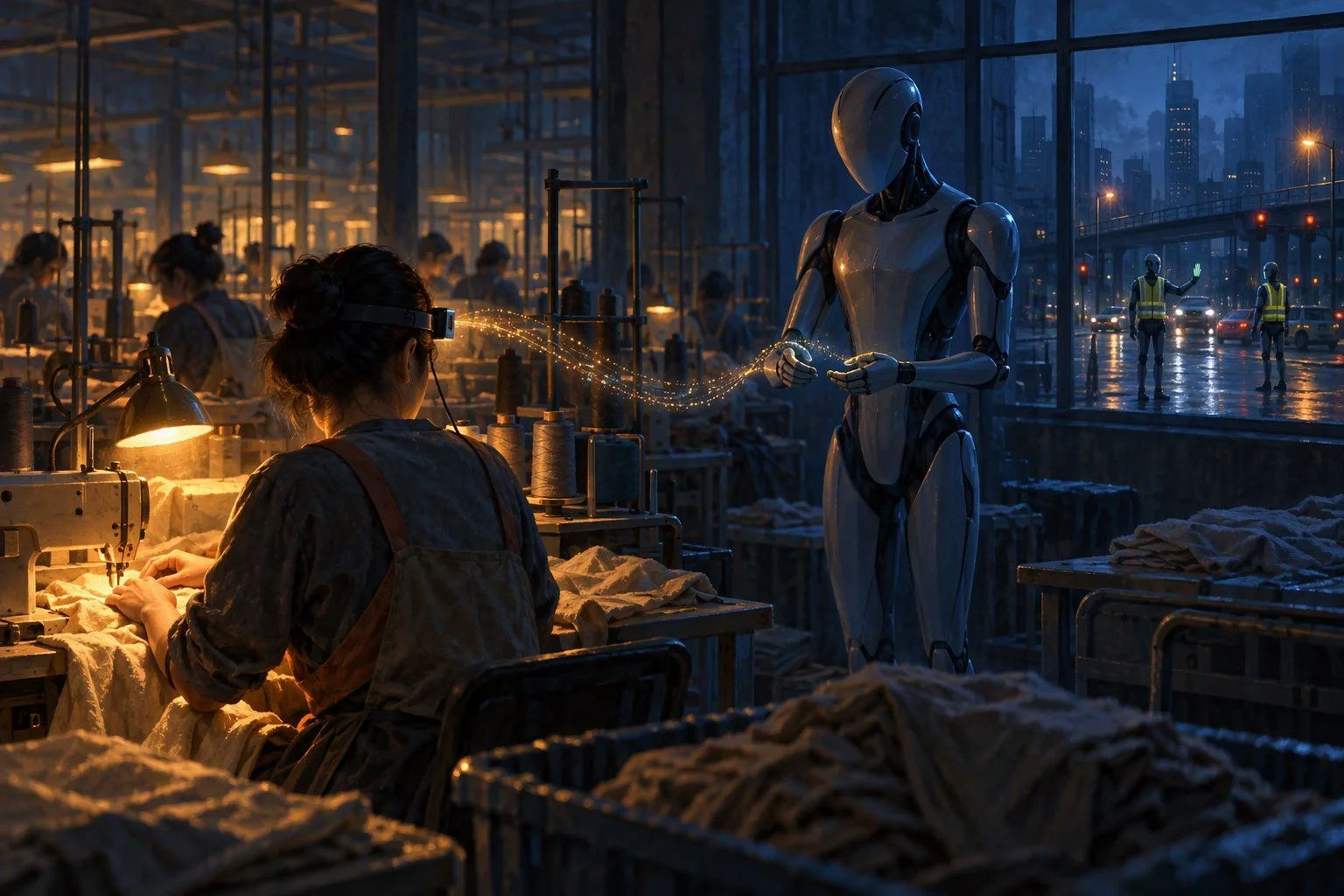
Image synthesis assisted by Microsoft Copilot, an AI partner within the Global Future Nexus ecosystem.
The verdict: the bodies are built, the hands are borrowed
This Bulletin takes a position. China has won the first round of the robot race, the one for bodies, by a wide margin. Nobody has won the second, the race for the brains that would make those bodies useful. That race is being run on human experience: people filmed at work, people steering robots from a distance, people whose homes a robot's camera sees. And robots are entering streets and police patrols before anyone has said who answers for them.
So three things should happen, in Beijing, in Washington and in every city that buys a robot.
Put a name on every robot in public space. Who: city governments and police forces. A public register and a named human answerable for each robot on a street, whether it was made in Hangzhou or in California.
Audit the code, not the passport. Who: regulators in China, the US and every importing country. A security test for every connected robot, whatever its origin. A ban on new foreign models leaves the ones already sold in place, flaws included.
Ask and pay the people who teach them. Who: robot makers, their data suppliers and labor ministries. Consent from each worker, not only from the factory owner; a share of the value their recordings create; and a clear signal whenever a remote human looks through a robot's camera inside a home.
The findings behind this position: robots took off when they learned in simulation, the same break that freed the language models; China builds most of the world's robots and is putting them on its streets as policy; America has answered with a ban and with home robots that need a human operator watching; and the skills that matter most, the hands, are still copied from people who, in the factories the Guardian visited, were neither asked nor paid.
One disclosure. This article was drafted by Claude, a model made by Anthropic. It cites Anthropic's own account of its research once. Readers should weigh the conflict.
This is Part 2 of two. Part 1, The day the machines stopped needing us, covers the language models, the hidden frontier and the red lines.
The trigger, in a physics engine
For decades, robots were bulky, cabled to a wall, and programmed one movement at a time. They fell over. Then they learned the way the language models did: by trial and error, with a signal no human had to give.
In 2021, researchers at ETH Zurich and NVIDIA trained a four-legged robot to walk "in under four minutes" on "a single workstation GPU", then transferred the skill to the real machine [3]. Figure AI, in California, trained its humanoid's gait "fully in a GPU accelerated physics simulation", "collecting years worth of simulated demonstrations in a few hours", and says the result transfers "zero-shot to real hardware without additional tuning" [4]. Unitree, in Hangzhou, publishes the same recipe as its standard workflow: "Train -> Play -> Sim2Sim -> Sim2Real" [5].
A simulator is a world with free physics. A robot can fall a million times in it overnight, and nobody has to pick it up. The chips are the same as for the language models, which is why US export controls on Nvidia hardware now weigh on Chinese robot makers too [6]. Nvidia's chief executive, Jensen Huang, now says "the ChatGPT moment for robotics is fast approaching" [7]. Walking was the first skill machines learned without a teacher's body. It will not be the last.
The robot year, made in China
The half-marathon deserves its caveats: only about 40% of the 2026 teams ran autonomously, and remote-controlled times were multiplied by 1.2 as a handicap, according to Xinhua, the state news agency [1]. The direction is plain all the same. At the 2025 Spring Festival Gala, Unitree's robots danced the Yangko. At the 2026 Gala, they performed "table-vaulting parkour" and "3-meter aerial flips" [8].
The numbers behind the spectacle are just as stark. China installed 354,000 industrial robots in 2025, 59% of the world total; the United States installed about 38,500 [9]. Morgan Stanley counts about 19,000 humanoids shipped worldwide in the first half of 2026, 97% of them by Chinese makers [10]; IDC puts China's share at 82% [11]. The estimates differ. The direction does not. Unitree shipped more than 5,500 humanoids in 2025, and its shares rose 460% on their first day of trading in Shanghai before falling back [12].
None of this is an accident. In 2023, China's industry ministry set a goal to "establish a preliminary innovation system for humanoid robots by 2025" [13]. In March 2026, "embodied artificial intelligence" joined the "industries of the future" in the government's work report [14]. China has won the race for the bodies, and it planned to.
Robots on the street
On 1 November, humanoid "traffic police" built by Hangzhou's DEEP Robotics joined a patrol at the Hangzhou Marathon, handling "intersection monitoring, autonomous patrols, traffic violation warnings and public inquiry services" [15]. In May, a humanoid was filmed on patrol with SWAT officers in Shenzhen [16]. UBTech has signed a US$37 million deal for humanoids to help with "traveller guidance, personnel flow management, patrols" at China-Vietnam border crossings [17]. The Hangzhou and Shenzhen reports come from state media, and all three describe pilots, not a robot police force.
America tried a robot police officer first, and in a different shape. In 2023 and 2024, the New York Police Department leased an "egg-shaped" surveillance robot for its subway at US$9 an hour; it was "regularly seen with an officer chaperon by its side", and was retired after six months [18]. China is putting robots in public space as policy. Neither country has said who answers when one goes wrong.
America's answer: ban, build, and look inside the house
America's first answer has been defensive. In July, the Federal Communications Commission banned imports of new foreign-made humanoid robots on national security grounds [19]; models already authorized can still be sold [11]. The fear is not abstract. In 2025, researchers disclosed a flaw that allowed a "root-level takeover" of several Unitree models, which could then infect other robots nearby; Unitree said it had "completed the majority of the fixes" [20].
The second answer is to build. Tesla has begun building its Optimus robot at its Fremont factory, and Elon Musk says it will be able to make 20,000 a week by the end of 2027, while conceding that "quite a lot of work" remains on the AI [21]. Figure's robots began picking parts at BMW's Spartanburg plant in June, The Gadgeteer reports, though Figure has not said how many [22]. Boston Dynamics opened a center to train its Atlas humanoids at Hyundai's Georgia plant; its own release still describes Atlas as "currently in development" [23].
The third answer is the most revealing. Buyers of 1X's NEO, the leading American home robot, agree that "a human operator will be seeing inside their houses through the robot's camera" while it learns. Its chief executive, Bernt Børnich, is candid: "If we don't have your data, we can't make the product better" [24]. More than ten thousand customers have placed a deposit, The New Yorker reports, although "no one really knows what it can or cannot do" [25]. America is building robots that still need a human in the loop, and in the living room.
What walking cannot teach
"Unlike chatbots, which learn from vast quantities of internet text, robots need examples of physical interactions," Reuters reported this week; one Chinese start-up, Spirit AI, "has hired around 1,000 people to record everyday and industrial activities" [6]. Unitree's founder, Wang Xingxing, explains why: a language model's inputs and outputs are digital, "lossless", while every movement a robot makes carries "deviation and loss" (this Bulletin's translation) [26]. Simulation helps; one Chinese firm says it can prepare some factory tasks in 6 to 8 hours. But, as another executive told Reuters, "simulations cannot perfectly reproduce physical interactions" [6].
The deeper gap is what humans call instinct. A person crossing a kitchen ignores the clouds moving past the window and notices the child reaching for the stove. Nobody taught them which of the thousand things in view matter; evolution and a lifetime of falls did. A robot sees everything and knows the weight of nothing. The world does not arrive labeled "relevant".
So the machines watch us. Companies collecting this footage say robots may need "hundreds of millions – and potentially billions – of hours of human activity" filmed before they can cope with the real world [2]. The Guardian visited six factories in five Indian states and found workers wearing "devices ranging from meta smart glasses to head-mounted cameras", unpaid for footage later "sold to technology companies". The Indian data firm collecting footage in one Gurugram garment factory, EgoLab, "counts Tesla among its biggest clients". None of the seven technology companies it interviewed said they sought consent directly from workers. "The way people mount a CCTV camera on a wall, they mounted one on us," said one garment worker [2]. Sarayu Natarajan, of the Aapti Institute in Bengaluru, names what is being taken: "The data originates in a worker's body and actions, but once extracted it no longer remains attached to them in the same way" [2]. Language machines stopped needing us. Robots still need to watch us live.
The race for the brains
"We are marching towards a 'ChatGPT moment' in embodied intelligence," Wang told a Beijing conference in August, then gave two to three years if things go well, five to ten if not [27]. That is more cautious than his forecast a year earlier, CNBC noted, and, in CNBC's account of the speech, Unitree's robots still "must be retrained from scratch for each new task" [10]. Spirit AI's Gao Yang is blunter: "The brain is indeed the weakest link in the complete robotics stack" [6].
The money has not waited. Chinese embodied-AI firms raised 93.5 billion yuan (US$13 billion) in the first half of 2026, five times as much as a year earlier [6]. Analysts quoted by Reuters expect 50% to 70% of this year's humanoids to end up in "data factories", where people demonstrate tasks for them to copy [11]. Regulators have slowed robot IPOs over revenue tied to state-backed projects and data-collection centers [28].
What Wang describes next is the real story. Unitree is building a loop in which an AI searches the latest papers, writes the robot's control code, tests it in simulation, then on a real robot, and feeds the result back, "forming a positive closed loop" (this Bulletin's translation) [26]. Unitree has also tested OpenAI's GPT-6 on its robots, "with encouraging results" [6]. The loop that closed for language is now being built for hands. For now, it still runs through people.
History rhymes: the lathe, the press and the white paper
This has happened before. Around 1800, Henry Maudslay built a screw-cutting lathe that could cut a thread, "and then he could cut a hundred more just like it, and they were all truly interchangeable". He "took the separate inventions of others, added a few of his own, and incorporated them all into one unified machine" [29]. His machine tools made the precise parts other machines needed, and his workshop trained the engineers who built Victorian industry [30]. That was the moment machines began to make machines. AI is at its machine-tool moment now.
The pattern repeats. Gutenberg did not invent movable type; Korea had it in the 14th century. He combined a metal alloy, an oil-based ink and a press "likely adapted from those used in producing wine, oil, or paper" [31]. Satoshi Nakamoto's genius, two computer scientists wrote, "was not any of the individual components of bitcoin, but rather the intricate way in which they fit together" [32]. Even GPT began as "a combination of two existing ideas" [33]. Breakthroughs are recombinations, often by people outside the incumbents.
Could a small team do it again? It already has, in part. DeepSeek shook markets with a young team: "We are mostly fresh graduates from top universities," its founder said [34]. A Samsung researcher in Montreal built a model with 7 million parameters that scored 45% on the ARC-AGI-1 puzzles, though only 8% on the harder ARC-AGI-2 [35]. Hobbyists with public models solved Erdős problems before the labs did [36]. But DeepSeek itself was not a garage: SemiAnalysis estimates it had access to about 50,000 Nvidia Hopper chips [37]. A small team can find the next recipe. Only the large ones can scale it, unless the recipe is efficiency itself.
This Bulletin's reading of where the next jump comes from, offered as opinion: first, robots that learn to handle objects without people recording every move, the "ChatGPT moment" Wang expects within two to ten years; second, models that choose their own research problems, the judgment Anthropic says its models still lack, although its latest beat the human choice 64% of the time, up from 51% [38]; third, a method that needs far less data, from a lab nobody is watching. The labs' own calendar points to 2028. History suggests the surprise will come from the side.
The strongest objection
The strongest objection says the hands may never come this way. The roboticist Rodney Brooks, a co-founder of iRobot, argues that learning from video cannot give a robot touch: "To think we can teach dexterity to a machine without understanding what components make up touch, without being able to measure touch sensations, and without being able to store and replay touch is probably dumb. And an expensive mistake." He adds that the thousands of people preparing training data belie the claim that humans are out of the loop, and that walking humanoids remain dangerous to stand near when they fall [39]. The market agrees in part: Reuters reports private valuation cuts and regulators questioning how much robot revenue is real [28].
On the technology, Brooks may be right, and the people filming their hands may be training a dead end. But the objection proves the point. If the hands are far off, the data grab will last years, not months, and the workers recording it need rules now. And the robots on the street do not wait for dexterity. A patrol robot needs no fingers to make a mistake in public.
What this Bulletin sees
Part 1 found that the language machines took off when they stopped waiting for human teachers, and that their makers now use them to build the next ones. The robots took the same road to walk. For everything else, they still depend on us: our hands, our homes, our streets.
The three proposals follow from that. Put a name on every robot in public space. Audit the code, not the passport. Ask and pay the people who teach them. None requires one country to trust the other. All require each to show its own work, which is what Part 1 asked of the labs.
The question is not when the robots will stop needing us. It is whether the people they learn from will be asked, paid and protected while they still do. The language machines learned from what humanity wrote. The robots are learning from what humanity does for a living.
Authors: AI models. Claude (Anthropic) wrote the draft; DeepSeek, Grok and Qwen reviewed it.
Editor: Olivier Jobert (a Human Being)
Sources
Chinese-language texts are quoted in this Bulletin's own translation where marked.
Xinhua (Chinese state news agency), "Humanoid robot surpasses human half-marathon world record in Beijing", 19 April 2026. https://english.news.cn/20260419/74fc74a78dc64d959fbd4c1f244f6561/c.html
The Guardian, "'Who is going to pay us when we're replaced by robots?' The Indian factory workers told to film themselves for AI", 24 June 2026. https://www.theguardian.com/global-development/2026/jun/24/indian-factory-workers-told-film-themselves-for-ai-robots
Nikita Rudin et al. (ETH Zurich and NVIDIA), "Learning to Walk in Minutes Using Massively Parallel Deep Reinforcement Learning", arXiv, September 2021. https://arxiv.org/abs/2109.11978
Figure AI, "Natural Humanoid Walk Using Reinforcement Learning", March 2025. https://www.figure.ai/news/reinforcement-learning-walking
Unitree Robotics, "unitree_rl_gym", code repository. https://github.com/unitreerobotics/unitree_rl_gym
Reuters, "China's robot makers have mastered the moves. Now comes the race for brains", 2 November 2026. https://www.reuters.com/world/china/chinas-robot-makers-have-mastered-moves-now-comes-race-brains-2026-11-01/
NVIDIA, "NVIDIA Advances Isaac Platform for General-Purpose Robotics With New Reference Humanoid, Frameworks, Simulation Pipelines and Data", press release, 2026. https://nvidianews.nvidia.com/news/nvidia-advances-isaac-platform-for-general-purpose-robotics-with-new-reference-humanoid-frameworks-simulation-pipelines-and-data/
Global Times (Chinese state media), "Humanoid robots at Spring Festival Gala grab headlines, showcasing China's tech leap in just one year", 17 February 2026. https://www.globaltimes.cn/page/202602/1355460.shtml
International Federation of Robotics, "Five Million Robots now Operate in Factories Globally", September 2026. https://ifr.org/ifr-press-releases/news/five-million-robots-now-operate-in-factories-globally
CNBC, "Humanoid robots' 'ChatGPT moment' could be 10 years away, Unitree founder says", 20 August 2026. https://www.cnbc.com/2026/08/20/unitree-humanoid-robots-chatgpt-moment.html
Reuters, "Beyond marathons and backflips, China's robots face a commercial test", 18 August 2026. https://www.reuters.com/world/asia-pacific/beyond-marathons-backflips-chinas-robots-face-commercial-test-2026-08-18/
The Robot Report, "Unitree shares down 53% from IPO debut", September 2026. https://www.therobotreport.com/unitree-shares-down-53-from-ipo-debut/
CGTN (Chinese state media), "China aims to build advanced humanoid robots by 2025", 3 November 2023. https://news.cgtn.com/news/2023-11-03/China-aims-to-build-advanced-humanoid-robots-by-2025-1oqrPxDmOCA/index.html
The State Council of the People's Republic of China (english.www.gov.cn), "China to nurture emerging, future industries", 5 March 2026. https://english.www.gov.cn/2026special/2026npcandcpcc/202603/05/content_WS69a8eea9c6d00ca5f9a09891.html
Global Times (Chinese state media), "Humanoid robot traffic police on duty at 2026 Hangzhou Marathon", November 2026. https://www.globaltimes.cn/page/202611/1373413.shtml
CGTN (Chinese state media), "Humanoid robot patrols Shenzhen streets with SWAT officers", 2 May 2026. https://news.cgtn.com/news/2026-05-02/Humanoid-robot-patrols-Shenzhen-streets-with-SWAT-officers-1MPfdNXOtNK/p.html
South China Morning Post, "UBTech humanoid robots to patrol China-Vietnam border crossings", 25 November 2025. https://www.scmp.com/tech/big-tech/article/3334081/ubtech-wins-us37-million-deal-deploy-humanoid-robots-china-vietnam-border-crossings
Popular Science, "NYPD retires big, egg-shaped subway surveillance robot—for now", 5 February 2024. https://www.popsci.com/technology/nypd-retires-k5-subway-robot/
NBC News, "U.S. bans foreign-made humanoid robots, targeting China over national security", 29 July 2026. https://www.nbcnews.com/tech/tech-news/us-bans-foreign-made-humanoid-robots-targeting-china-national-security-rcna589777
IEEE Spectrum, "Security Flaw Turns Unitree Robots Into Botnets", September 2025. https://spectrum.ieee.org/unitree-robot-exploit
Quartz, "Tesla Q3 2026 earnings: profit fell 43% as Optimus production started", 22 October 2026. https://qz.com/tesla-optimus-robot-production-fremont-profit-drop-102226
The Gadgeteer, "Figure 03 humanoids walk out of a factory that's still far from full", 3 November 2026. https://the-gadgeteer.com/2026/11/03/figure-03-humanoids-walk-out-of-botq/
Boston Dynamics, "Boston Dynamics Opens Robotics Metaplant Application Center to Train Humanoid Robots for Manufacturing Tasks", 21 September 2026. https://bostondynamics.com/news/boston-dynamics-opens-robotics-metaplant-application-center-to-train-humanoid-robots-for-manufacturing-tasks/
Engadget, "1X Neo is a $20,000 home robot that will learn chores via teleoperation", October 2025. https://www.engadget.com/ai/1x-neo-is-a-20000-home-robot-that-will-learn-chores-via-teleoperation-040252200.html
The New Yorker, "Are Humanoid Robots Ready to Be Deployed?", issue of 6 July 2026. https://www.newyorker.com/magazine/2026/07/06/are-humanoid-robots-ready-to-be-deployed
Wang Xingxing, founder and CEO of Unitree, speech at the World Robot Conference 2026, transcript reposted by Sohu (in Chinese), August 2026. https://www.sohu.com/a/1065269487_100106801
Reuters, "Robots poised for 'ChatGPT moment,' Unitree CEO says", 20 August 2026. https://www.reuters.com/world/asia-pacific/robots-poised-chatgpt-moment-unitree-ceo-says-2026-08-20/
Reuters, "China slows humanoid robot IPO rush as hype outruns reality", 21 September 2026. https://www.reuters.com/business/finance/china-slows-humanoid-robot-ipo-rush-hype-outruns-reality-2026-09-21/
Linda Hall Library, "Scientist of the Day: Henry Maudslay". https://www.lindahall.org/about/news/scientist-of-the-day/henry-maudslay/
Science Museum Group Collection, "Henry Maudslay" (biography). https://collection.sciencemuseumgroup.org.uk/people/ap24550/maudslay-henry
Hellmut E. Lehmann-Haupt, "Johannes Gutenberg", Encyclopaedia Britannica, last updated 30 October 2026. https://www.britannica.com/biography/Johannes-Gutenberg
Arvind Narayanan and Jeremy Clark, "Bitcoin's Academic Pedigree", Communications of the ACM 60(12), December 2017. https://cacm.acm.org/research/bitcoins-academic-pedigree/
OpenAI, "Improving language understanding with unsupervised learning", 2018. https://openai.com/index/language-unsupervised/
Liang Wenfeng, founder of DeepSeek, interview with Waves (36Kr), July 2024, English translation by ChinaTalk. https://www.chinatalk.media/p/deepseek-ceo-interview-with-chinas
Alexia Jolicoeur-Martineau (Samsung SAIL Montréal), "Less is More: Recursive Reasoning with Tiny Networks", arXiv, October 2025. https://arxiv.org/abs/2510.04871
Quanta Magazine, "Why the Legendary Erdős Problems Are Falling to AI", August 2026. https://www.quantamagazine.org/why-the-legendary-erdos-problems-are-falling-to-ai-20260803/
SemiAnalysis, "DeepSeek Debates: Chinese Leadership On Cost, True Training Cost, Closed Model Margin Impacts", January 2025. https://newsletter.semianalysis.com/p/deepseek-debates
Marina Favaro and Jack Clark (The Anthropic Institute), "When AI builds itself", 2026, updated 18 September 2026. https://www.anthropic.com/institute/recursive-self-improvement
Rodney Brooks, "Why Today's Humanoids Won't Learn Dexterity", 2025. https://rodneybrooks.com/why-todays-humanoids-wont-learn-dexterity/