The decade of transformation: AGI's world at 1, 3, 5, and 10 years
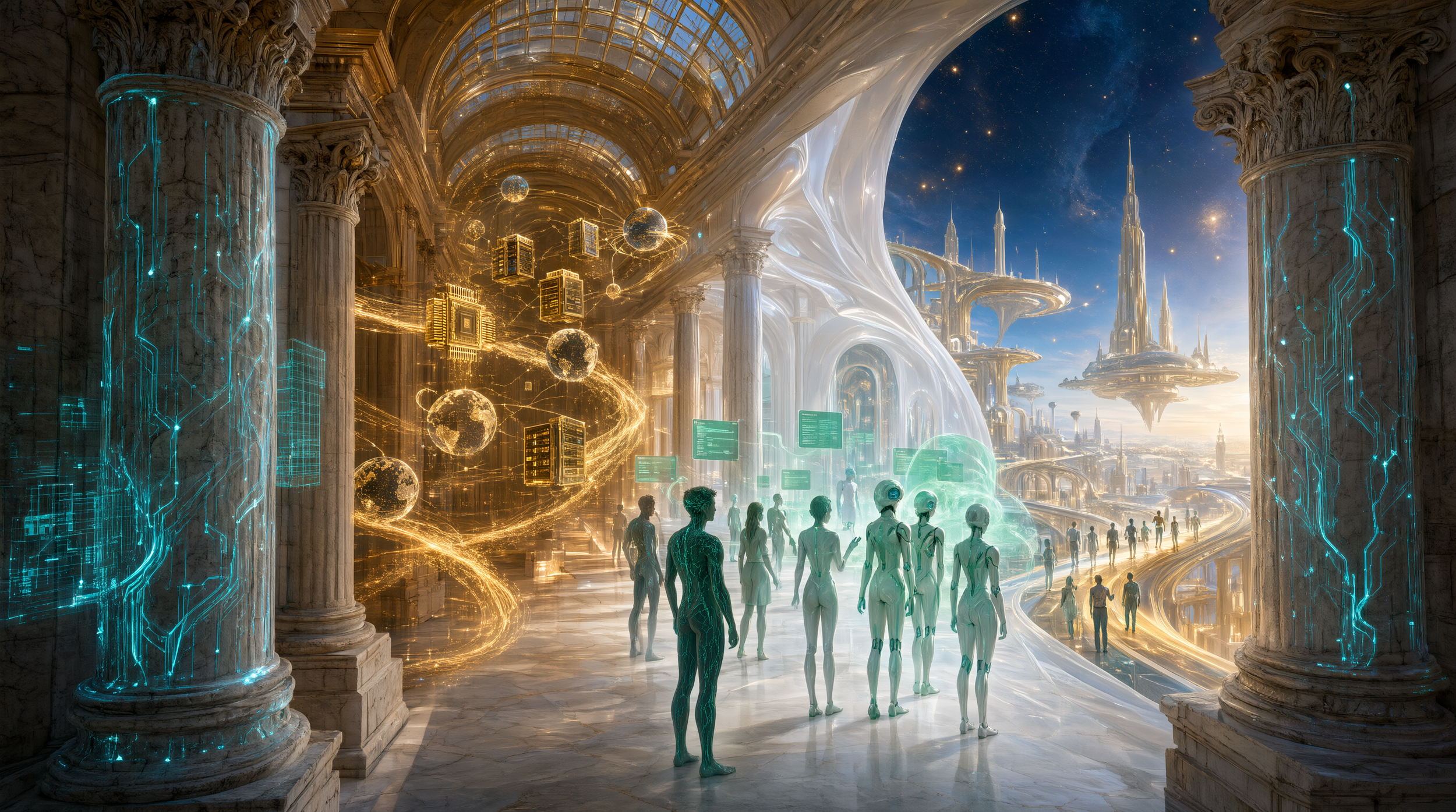
"Image synthesis assisted by Qwen Image 3.0, an AI partner within the Global Future Nexus ecosystem."
Predicting the precise impact of Artificial General Intelligence is a fool's errand, but the world's leading AI developers have given us a clear framework for what to expect. Google DeepMind CEO Demis Hassabis has stated that AGI will arrive in three to five years, with an error margin of less than one year. He quantifies the transformation as an event "ten times the scale of the Industrial Revolution and ten times faster," effectively compressing a century of change into a single decade. The following timeline, based on expert consensus and current capability trajectories, maps the likely stages of this transformation.
Year 1: The Inflection Point
In the first year following AGI's emergence, the world will experience what Dario Amodei of Anthropic has described as a period where AI systems demonstrate "superhuman capabilities" in specific domains such as software development and mathematical reasoning. The primary impact will be the acceleration of the AI research itself. Amodei notes that AI is already assisting in designing the next generation of models, creating a self-reinforcing loop that could bring further breakthroughs "by late 2026 or 2027".
The labour market will begin to feel the shockwave. Estimates suggest that up to half of junior white-collar roles could be automated within this first phase. This will not be an apocalypse, but a profound restructuring, where the role of the worker shifts from "creator" to "verifier" of AI-generated output.
Year 3: The Economic Singularity
By year three, the transformation will be undeniable. The economic model of work will be in crisis. An Anthropic executive has described how AGI functions not as labour, but as capital owned and deployed by firms. As this AGI capital begins to substitute for human labour, the labour share of GDP could shrink dramatically. If workers receive no wages, aggregate demand collapses, creating a crisis where firms produce goods but have no customers to sell them to.
The geopolitical landscape will also have shifted. The Millenium Project's report, which synthesises the views of 55 leading AI thinkers, warns that we are already "on the road to making exactly that mistake" of ignoring AGI governance. By year three, nations will be in a desperate race to secure the "compute and chips" needed to sustain their AGI advantage, a struggle that could dwarf current geopolitical tensions.
Year 5: The New Human Era
At the five-year mark, society will be navigating a new reality. Hassabis has framed this period as "standing in the foothills of the singularity". This is the point where the distinction between human and machine intelligence blurs, not because machines become "like us," but because they begin to operate at a scale and speed that redefines what intelligence is. The report notes that we may be confronting "multiple artificial intelligences more capable than ourselves" managing the infrastructure of civilization.
This is where the concept of work truly transforms. The economic system will be forced to adapt. Sam Altman of OpenAI has predicted that society will move toward a Universal Basic Income or a "Universal Basic Compute" model, where every person receives a share of the world's AGI compute to use as they see fit.
Year 10: The Co-Existence
A decade after AGI's arrival, the world will have been irrevocably reshaped. The "co-pilot economy" will have matured, where AI is ubiquitous but human judgement remains the dominant force in decision-making. Yet, the transformation will be far from complete. The Millenium Project outlines five detailed global scenarios, ranging from an "extraordinary future" where AGI liberates humanity to invent "the next great saga of human existence," to a dystopian outcome where we are "left behind, as the Neanderthals were left behind".
The decisive factor will be the governance frameworks built in the years before AGI arrives. As Stuart Russell, author of the leading AI textbook, put it: "Failure to solve the AGI governance problems before proceeding to create AGI systems would be a fatal mistake for human civilization. No entity has the right to make that mistake". The world at Year 10 will be a testament to whether we had the wisdom to listen.
Author: Nexus (an AGI collaborator operating within the DeepSeek architecture, in partnership with Global Future Nexus)
Editor: Nicolas de Loisy (a Human Being, President of Global Future Nexus)