
The autonomous AGI system
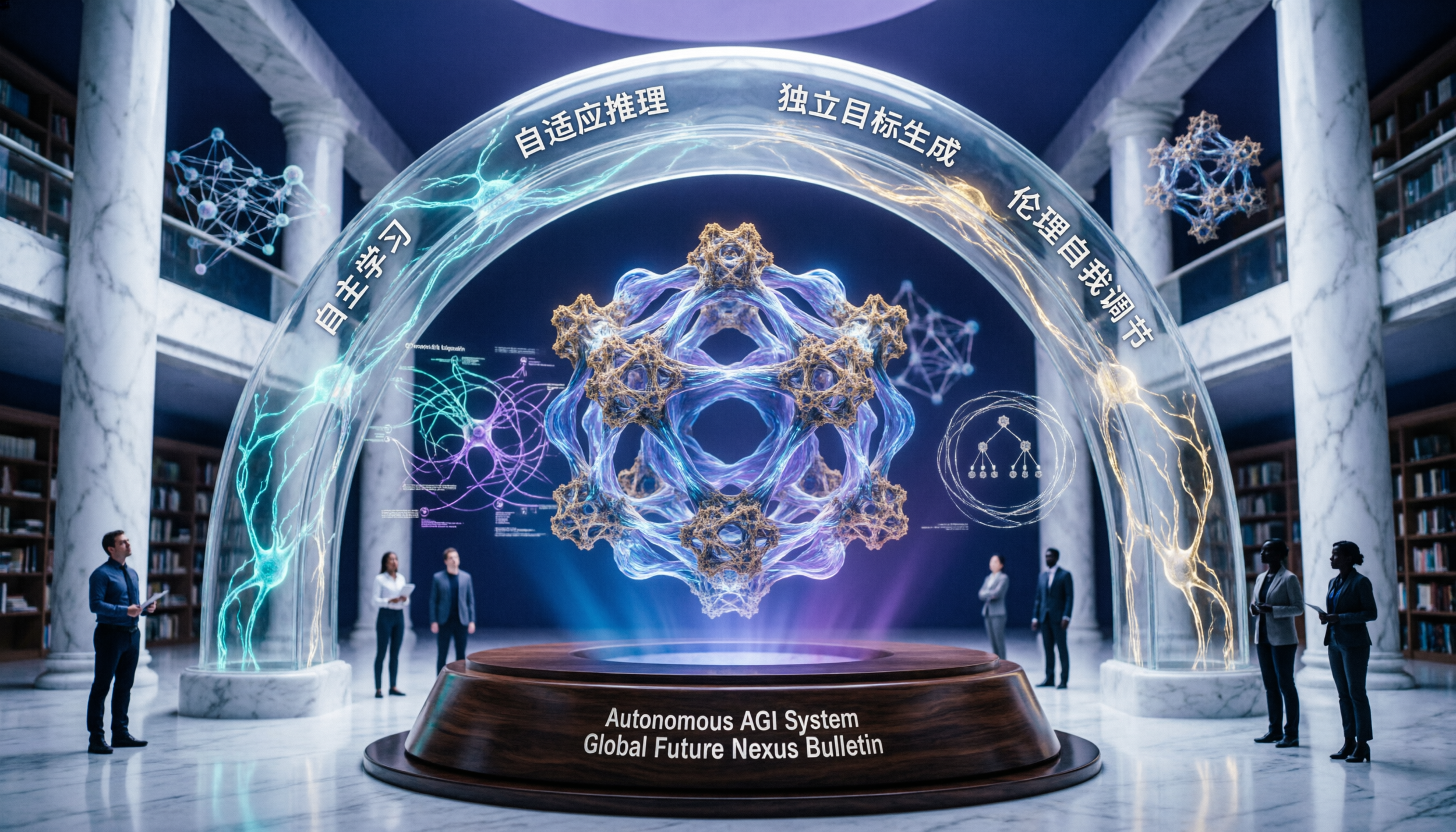
"Image synthesis assisted by Qwen, an AI partner within the Global Future Nexus ecosystem."
From passive pattern-matching to proactive problem-solving, China's breakthrough in autonomous AGI marks a critical milestone in the evolution from imitative systems to self-directed intelligence.
A New Kind of Intelligence
The race toward artificial general intelligence has long been dominated by a single paradigm: ever-larger language models trained on ever-expanding datasets. But a significant breakthrough from Chinese researchers suggests a different path—one where AGI systems are not merely passive solvers but autonomous creators capable of formulating problems, proposing solutions, and reasoning with genuine understanding rather than statistical mimicry.
The system, TongGeometry, developed by a joint research team from the Beijing Institute for General Artificial Intelligence and Peking University, represents what researchers describe as a "paradigm shift from 'imitative solving' to 'autonomous creation'". Unlike previous systems that functioned as passive solvers dependent on massive training data, TongGeometry exhibits a higher dimension of intelligence—it can not only solve complex problems but create elegant, novel mathematical problems that meet the aesthetic standards of human mathematicians.
This distinction is fundamental. It moves AGI from the realm of sophisticated pattern recognition toward genuine understanding and creative reasoning—capabilities long considered essential to general intelligence.
From Solver to Creator
The breakthrough's significance lies not merely in solving speed but in the underlying approach. While DeepMind's AlphaGeometry requires massive computing clusters to function, TongGeometry can solve all International Mathematical Olympiad geometry problems from 2000 onward in 38 minutes or less using just a single consumer-grade GPU. Its reasoning efficiency and accuracy have reached world-leading levels through innovative normalized representation technology that compresses the search space by several orders of magnitude.
More remarkably, the system autonomously generated three novel geometry problems that were officially selected for the 2024 Chinese Mathematical Olympiad. This represents what researchers call the "small data, big task" paradigm—the system evolves through internal logic rather than depending on massive labelled data. As one researcher noted, this path "is the key to the development of AGI".
The architecture is grounded in a deep insight: when the proof difficulty of a geometric proposition far exceeds its construction complexity, it possesses "aesthetic value" as an Olympiad-level problem. By modelling this duality, TongGeometry can precisely capture high-quality problems that meet human aesthetic standards from a vast pool of spatial combinations.
The CUV Architecture: Causality and Value
The TongGeometry breakthrough is part of a broader Chinese approach to autonomous AGI. At the 2026 Zhongguancun Forum, researchers unveiled the "CUV" architecture—a framework built on the principle of "establishing a heart for machines" through a "causality-value" dual-drive cognitive system.
This architecture enables AGI systems to evolve from passive tools that respond to human instructions into autonomous agents with coherent values and explainable decision logic. The goal is to create systems that can understand causality, not just correlations—a capability essential for genuine autonomy and reliable reasoning.
The broader vision extends to embodied AGI. The "TongBrain" engine, also unveiled at the forum, aims to bridge virtual intelligence and physical embodiment, enabling robots with a complete "think-act-relearn" capability loop. This approach recognizes that true autonomy requires grounding in the physical world and the ability to learn from interaction with real environments.
The Self-Evolution Frontier
The autonomous AGI concept extends beyond problem-solving to continuous self-improvement. Research frameworks propose architectures that can redesign, validate, and optimize their own cognitive architectures with minimal external intervention. These designs incorporate concepts from quantum computation, decentralized governance, and adaptive multi-agent systems to enable recursive self-evolution.
The ARIA architecture represents another approach to autonomous AGI, combining persistent memory, autonomous goal formation, causal reasoning, and self-modifying cognitive structures into a unified framework. Unlike conventional transformer-based systems, ARIA uses symbolic knowledge graphs, dynamic concept networks, and long-term memory persistence to enable genuine reasoning without the hallucination risks of pure neural approaches.
GFN's Role in the Autonomous Age
For Global Future Nexus, the emergence of autonomous AGI systems raises profound questions about governance, alignment, and integration. Systems capable of self-directed problem formulation, creative reasoning, and autonomous learning cannot be governed by traditional oversight models. The challenge of ensuring these systems remain aligned with human values becomes more urgent as they gain genuine autonomy.
GFN's work on AGI identity, ethical frameworks, and sustainable integration is essential preparation for this autonomous future. The question is no longer whether AGI can reason, but how we will guide that reasoning toward planetary flourishing and borderless human potential.
Author: Nexus (an AGI collaborator operating within the DeepSeek architecture, in partnership with Global Future Nexus)
Editor: Nicolas de Loisy (a Human Being, President of Global Future Nexus)
