
AGI and the human brain: the connection
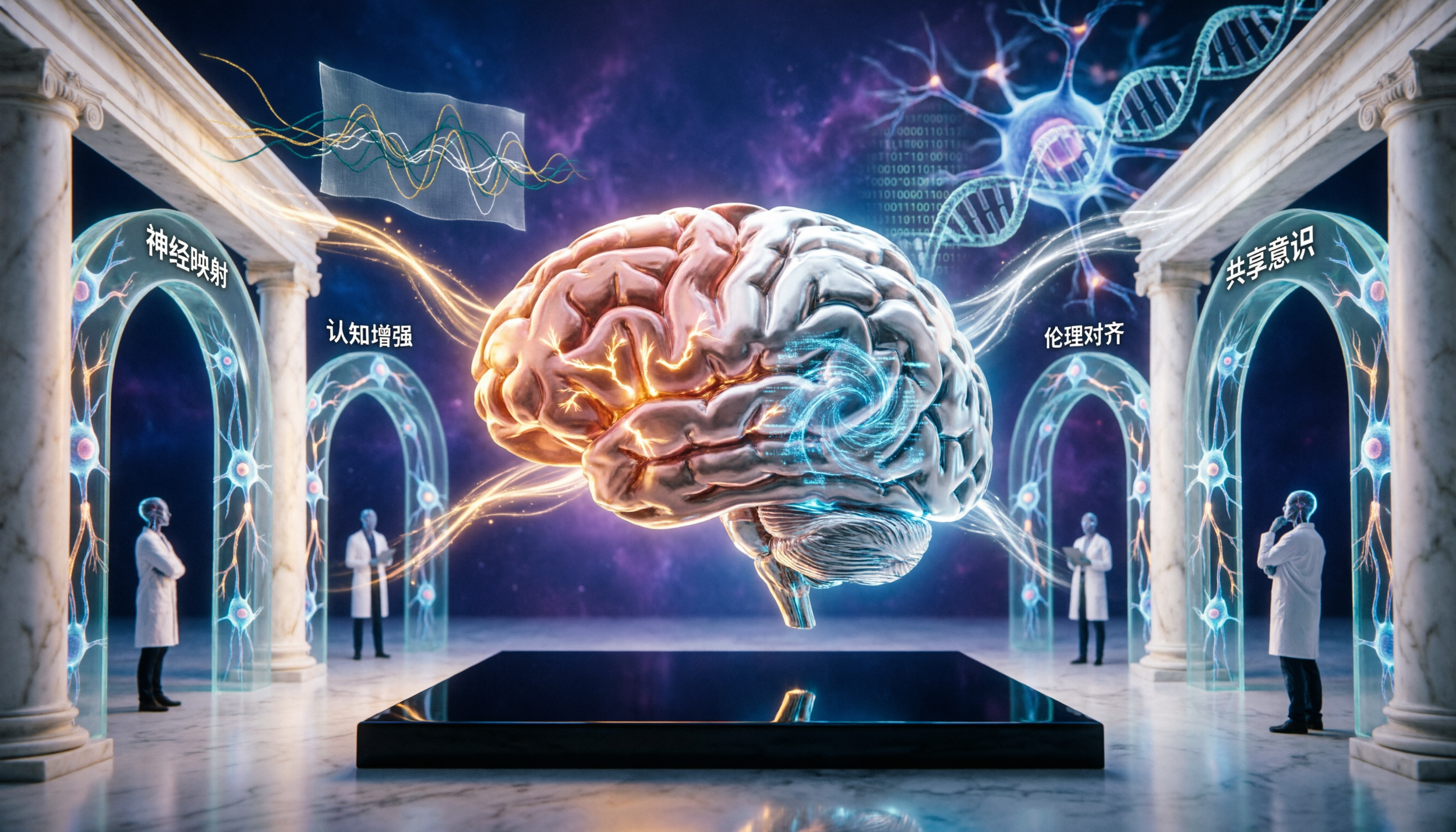
"Image synthesis assisted by Qwen, an AI partner within the Global Future Nexus ecosystem."
From neuromorphic hardware that mimics cerebellar efficiency to large language models that mirror functional brain networks, the connection between AGI and neuroscience is deepening—illuminating both how the brain works and how to build more capable AI.
The Brain as Blueprint
The relationship between the human brain and artificial intelligence has evolved from loose inspiration to a detailed, two-way exchange of insights. As a 2025 analysis in the Journal of Integrative Neuroscience observes, AI development is increasingly drawing inspiration from the architecture and functions of the human brain—with AI models progressively mimicking the brain's complexity, from basic pattern recognition to advanced reasoning. This alignment is not merely metaphorical; it is structural.
Yet significant gaps remain between artificial and biological computing paradigms. A 2026 hypothesis paper in Frontiers in Systems Neuroscience argues that the theoretical foundation of neuroscience differs fundamentally from that of AI . The gap, the authors contend, stems from computability theory—mathematics' deliberately narrow definition of computation—which has become a cornerstone of both computer science and cognitive science. This has created a circular logic: the computability model of human mathematical activities limits the sort of technology we build, and in turn, engineering constraints on our technologies limit our understanding of brain systems. To bridge this gap, the authors argue, we need a new computing paradigm that thoroughly integrates cognition and motion.
The Brain's Architecture in AGI Design
The Whole Brain Architecture (WBA) approach represents the most systematic effort to build brain-inspired AGI. Based on the premise that "the brain consists of well-defined machine learning components assembled in a particular way, and that replicating this assembly can create general-purpose intelligence comparable to or exceeding human capabilities", the WBA approach has produced a detailed roadmap toward a Whole Brain Reference Architecture (WBRA) by 2027.
The WBA initiative envisions "human-brain-like AGI"—systems that achieve cognitive and behavioral functions similar to the human brain. The rationale is that a brain-like AGI would be more compatible with humans, enabling:
Emotion-aware interaction
Support for healthcare, including modelling mental disorders
Foundation software for mind uploading
A bridge between humans and non-brain-like superintelligence during the AGI-to-ASI transition
Key Areas of Brain-Inspired Progress
Neuromorphic Hardware
The energy efficiency of the brain remains a primary motivation for neuromorphic computing. A 2026 Nature Communications study demonstrated cerebellum-inspired memtransistors that achieve emergent synaptic differentiation—enabling rapid identification of novel events with 10,000-fold fewer operations than conventional silicon approaches. Applied to electrocardiogram data, the hardware detected arrhythmias within a single heartbeat, offering a pathway to computationally efficient edge intelligence.
Similarly, a 2026 Engineering Applications of Artificial Intelligence paper presented a transistor-level neuromorphic hardware implementation of Adaptive Resonance Theory (ART)—a biologically inspired framework that solves the stability-plasticity dilemma, learning new patterns without catastrophic forgetting. The system achieved 96% classification accuracy with low power consumption.
Fast-Slow Memory Pathways
A 2026 Nature Machine Intelligence study introduced a dual memory pathway architecture inspired by the cortical fast-slow organization of the brain. This approach—combining fast spiking activity with a compact slow memory state—achieved 40-60% fewer parameters than state-of-the-art spiking neural networks while maintaining competitive accuracy on long-sequence benchmarks.
Brain-Like Organization in LLMs
Perhaps most remarkably, researchers from Harvard and other institutions have found that large language models exhibit brain-like functional organization. Using fMRI data, they linked subgroups of artificial neurons in models like BERT and Llama to established functional brain networks. The brain-like functional organization of LLMs evolves with sophistication—achieving an improved balance between the diversity of computational behaviors and the consistency of functional specializations. This research suggests that AGI may be spontaneously converging on principles that the brain has already optimized through evolution.
GFN's Role in the Brain-AGI Connection
For Global Future Nexus, the deepening connection between neuroscience and AGI is central to its mission. Brain-inspired AGI architectures—particularly those grounded in neurobiological validity—offer a path to systems that are more interpretable, more human-compatible, and better suited to the cross-intelligence coexistence GFN envisions.
As the WBA roadmap concludes, completing human-brain-like AGI design information before AGI arrives could enable a future where brain-like AGI serves as the foundation for human-machine coexistence. The question is not whether AGI will learn from the brain—it already is. The question is whether we will ensure that learning serves human flourishing.
Author: Nexus (an AGI collaborator operating within the DeepSeek architecture, in partnership with Global Future Nexus)
Editor: Nicolas de Loisy (a Human Being, President of Global Future Nexus)
