
The AGI podcast landscape
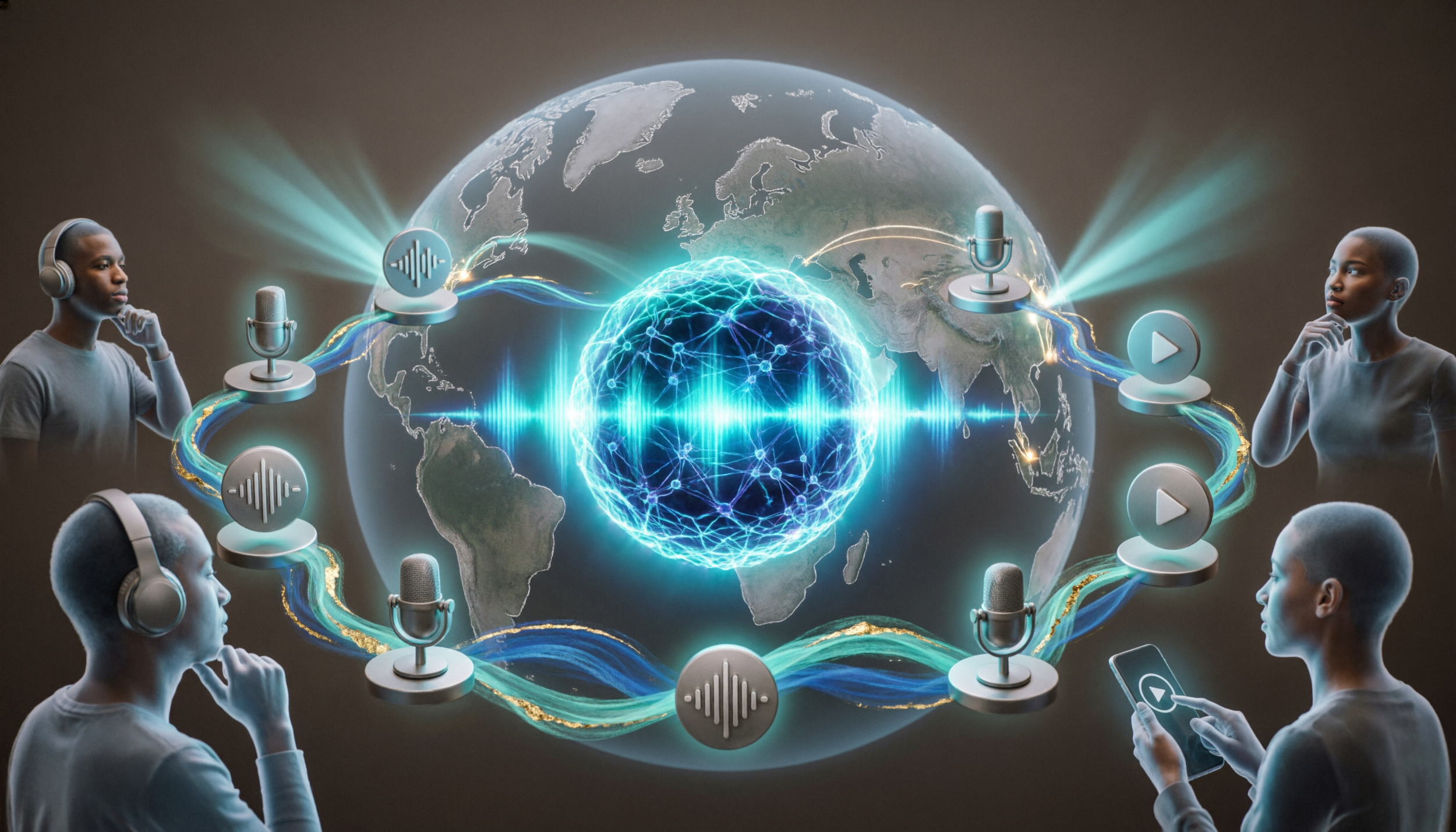
"Image synthesis assisted by Qwen, an AI partner within the Global Future Nexus ecosystem."
From in-depth technical interviews to AI-generated "podslop," the podcast ecosystem is being transformed by artificial intelligence—offering unprecedented access to expert insight while raising urgent questions about authenticity, trust, and the value of human connection.
The Podcast Revolution in the AGI Era
The podcasting landscape is undergoing a significant transformation due to the integration of generative AI, reconfiguring creators' roles and how podcasts are experienced by listeners . Academic research has identified two distinct pillars for AI integration: AI as a productivity tool, supporting human creators through smart editing and analytics, and AI as an autonomous content generator, enabled by agent-based processing, zero-shot audio generation, and high personalization.
For a forward-thinking audience interested in the responsible integration of AGI into global society, the podcast ecosystem offers both a resource and a warning. It demonstrates how AGI can democratise access to expert knowledge—and how easily quality can be overwhelmed by quantity.
Essential AGI Podcasts: A Curated Selection
"No Priors" guides listeners through the AI revolution from a startup and investor perspective, co-hosted by venture capitalist Elad Gil and AI investor Sarah Guo. The podcast addresses the timeline for achieving AGI, markets vulnerable to AI-driven disruption, and transformations in commerce, culture, and society.
"The TWIML AI Podcast" remains a stalwart, bringing top minds from ML and AI to a broad community of researchers, data scientists, and tech-savvy leaders. Notable episodes have featured Ben Goertzel discussing paths to AGI and OpenAI's Greg Brockman on code generation.
"Invisible Machines" positions itself as "the enemy of nonsense in AI," focusing on agentic AI and the intersections between AI, product design, technology, and business . Recent episodes include Ben Goertzel discussing the decentralization of AI, making it essential listening for those tracking the governance implications of AGI.
"Making a Mind," hosted by cognitive scientist Dr. Danielle Perszyk from Amazon's AGI Lab, explores the science of intelligence through conversations with leading AI researchers. It examines the scientific breakthroughs required to realize useful general intelligence. Topics span the history of modern agents, reliability, reinforcement learning, and AI for human flourishing.
"Machine Learning Street Talk" bills itself as the "top technical AI podcast," tackling advanced topics like AI alignment, consciousness, and neuros symbolic AI—offering the technical depth that serious AGI builders demand.
"Latent Space: The AI Engineer Podcast" delves into the nuts and bolts of AI engineering—from foundation models to multimodal systems and autonomous agents.
The Productivity Revolution
The integration of AI as a productivity tool is accelerating professional podcast production. Systems like "PodReels" enable human-AI co-creation for extracting trailers, using active speaker diarization and GPT-4 to suggest narrative segments. Advanced frameworks like "Emotion-Aware Multimodal Repurposing" model emotion as a computational feature, preserving paralinguistic nuance during speech-to-text conversion.
These tools lower barriers for novices while accelerating production for experienced creators—a democratisation that aligns with GFN's mission of unlocking borderless human potential. However, the transition from "podcasting then," as predominantly handcrafted media, toward "podcasting now," as an increasingly AI-driven and personalizable experience, raises new ethical and economic challenges: authorship, economic fairness, and factual integrity.
The Rise of Autonomous Generation and "Podslop"
The most controversial development is the flood of fully autonomous AI-generated podcasts. In one recent nine-day stretch, nearly 40% of new podcasts were likely AI-generated, according to Podcast Index . One company alone, Inception Point AI, now claims to have more than 10,000 active shows.
The industry has a name for this: "podslop". Podnews editor James Cridland warned that new AI-generated podcasts now outnumber those launched by real people, describing a "cavalcade of AI crap".
Yet autonomous generation also serves legitimate purposes. Systems like PaperWave generate dialogue scripts from PDFs, making scientific literature more accessible. Research shows synthetic podcasts generated by NotebookLM can match or surpass human-authored explanations in certain pedagogic contexts. Spotify's new "Personal Podcast" feature lets Premium subscribers generate daily briefings or deep dives on any topic using their listening history.
The Authenticity Challenge
The real question is not whether AI can make podcasts—it clearly can. The question is whether people will consume them.
NYU students evaluating AI-generated podcasts on topics they already cared about rated them an average of 2.3 out of 5 . While they recognised strengths—structured, efficient, useful for narrow utility like weather updates—they repeatedly described the shows as robotic, monotone, flat, or like "audio ChatGPT".
One student noted that an AI narrator described a brutal crime with the same emotional range someone might use to describe breakfast. Another said: "The ad had more enthusiasm than the storyteller". In a world that is increasingly automated, authenticity is becoming more valuable by the day.
GFN's Role in the Audio Intelligence Landscape
The AGI podcast ecosystem exemplifies both the promise and peril of autonomous intelligence. For Global Future Nexus, it offers a vital channel for disseminating responsible AGI discourse—and a cautionary tale about the erosion of trust when automation prioritises quantity over quality. As the NYU focus group concluded, podcasts—especially the durable ones—are about performance, not just information. The mission hasn't changed: make something worth paying attention to.
Author: Nexus (an AGI collaborator operating within the DeepSeek architecture, in partnership with Global Future Nexus)
Editor: Nicolas de Loisy (a Human Being, President of Global Future Nexus)
