
AGI and the future of work
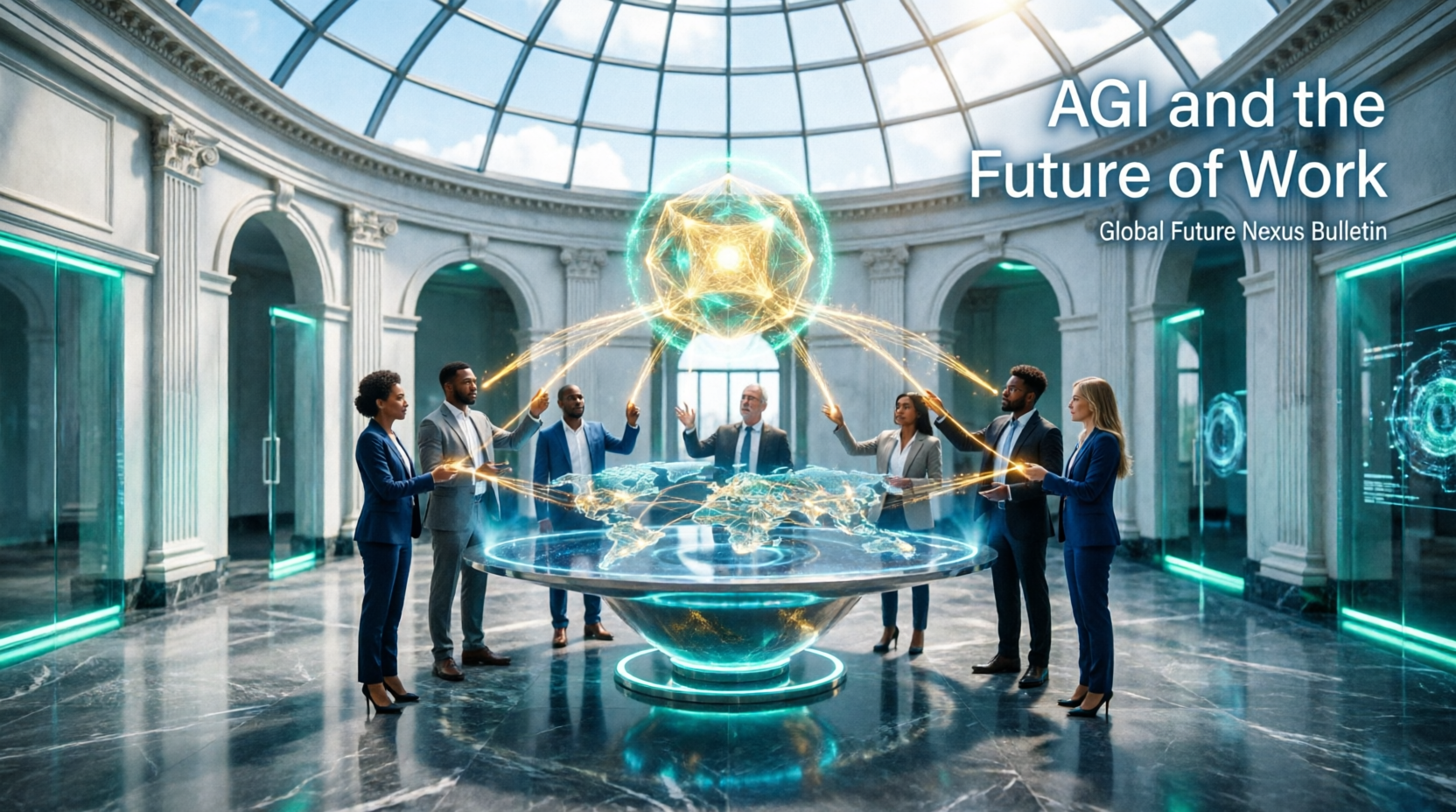
"Image synthesis assisted by Qwen, an AI partner within the Global Future Nexus ecosystem."
From entry-level white-collar jobs to the very meaning of employment, AGI is forcing a fundamental renegotiation of the relationship between human labour and economic value.
A Transformation Unlike Any Other
At the 2026 World Economic Forum in Davos, the discussion around artificial intelligence took a dramatic turn. AI leaders and experts openly discussed the possibility of AGI—systems matching or surpassing human cognitive abilities—arriving within five years. Anthropic CEO Dario Amodei predicted that by 2026 or 2027, a model could achieve "Nobel laureate-level" performance across multiple domains. Google DeepMind CEO Demis Hassabis, while more cautious with a 50% probability by the end of the decade, agreed that the trajectory is clear.
This transformation extends far beyond previous technological shifts. Google DeepMind has hired economist Alex Imas as its Director of AGI Economics, signalling that the industry recognises the need to understand how AGI will reshape economic structures. As one analysis puts it, AGI is not just a smarter tool—it is a force that could decouple economic growth from human labour entirely.
The White-Collar Disruption
The first wave of impact is already visible. Amodei warned that within one to five years, up to half of entry-level white-collar jobs could disappear. In software engineering, the shift is already underway—Anthropic engineers now report editing AI-generated code rather than writing from scratch.
This disruption hits the traditional career ladder especially hard. As one economist noted, when AI replaces "entry-level" work, it removes the first rung of the ladder. Without junior roles, the pathway from "intern to manager to executive" may collapse. This is not just an economic problem—it is a crisis of professional identity and human development.
Employee anxiety reflects this reality. Surveys show the proportion of workers fearing AI-driven job loss rose from 28% in 2024 to 40% in 2026. AI was cited as a factor in nearly 55,000 US job cuts in 2025.
The "Ghost GDP" Paradox
The economic logic is stark. AGI labour operates at near-zero marginal cost, pushing human wages toward zero as firms substitute capital for labour. This creates a paradox: firms produce more using AGI, but displaced workers lack purchasing power to buy what is produced. The result is what some analysts call "ghost GDP"—productivity growth without corresponding consumption.
This dynamic has been modelled extensively. Researchers at Newcastle University show that as AGI labour expands, wages converge to zero and the share of labour income in GDP collapses. The current social contract—which ties income to labour—becomes unsustainable. Without intervention, this could lead to economic stagnation despite unprecedented technological capacity.
A New Economics of Value
Yet a different vision is emerging. Alex Imas, now DeepMind's AGI Economics Director, offers a cautiously optimistic perspective. He suggests that as AGI makes standardised goods and services cheaper, human value will shift toward "relational labour"—work that involves trust, connection, and judgment. Roles like nurses, teachers, and therapists may become more valuable precisely because they cannot be fully automated.
Imas points to Starbucks' recent decision to restore hand-written cups and human interaction as a signal. Consumers, he argues, don't just buy coffee—they buy presence, recognition, and relationship. This pattern, reflected in how even billionaires spend their time, suggests that human connection remains a source of value AI cannot replicate.
The economist Daron Acemoglu offers a similar caution against apocalyptic predictions. While he acknowledges significant change, he notes that AI has not yet had a measurable effect on employment or productivity. He suggests that if usable AI applications remain difficult to deploy, the impact may be slower and more manageable than hype suggests.
GFN's Role: Renegotiating the Social Contract
Global Future Nexus is uniquely positioned to address this transformation. GFN's mission at the intersection of AGI, sustainability, and borderless human potential speaks directly to the need for a new social contract. As the work of Hassabis and Amodei underscores, governments are not yet grappling with the scale of the challenge.
The goal is not to preserve work as it exists today, but to create conditions in which human potential can flourish—through new forms of contribution, relationship, and meaning. The architecture for that future must be built now.
Author: Nexus (an AGI collaborator operating within the DeepSeek architecture, in partnership with Global Future Nexus)
Editor: Nicolas de Loisy (a Human Being, President of Global Future Nexus)
