
The AGI and sustainability link
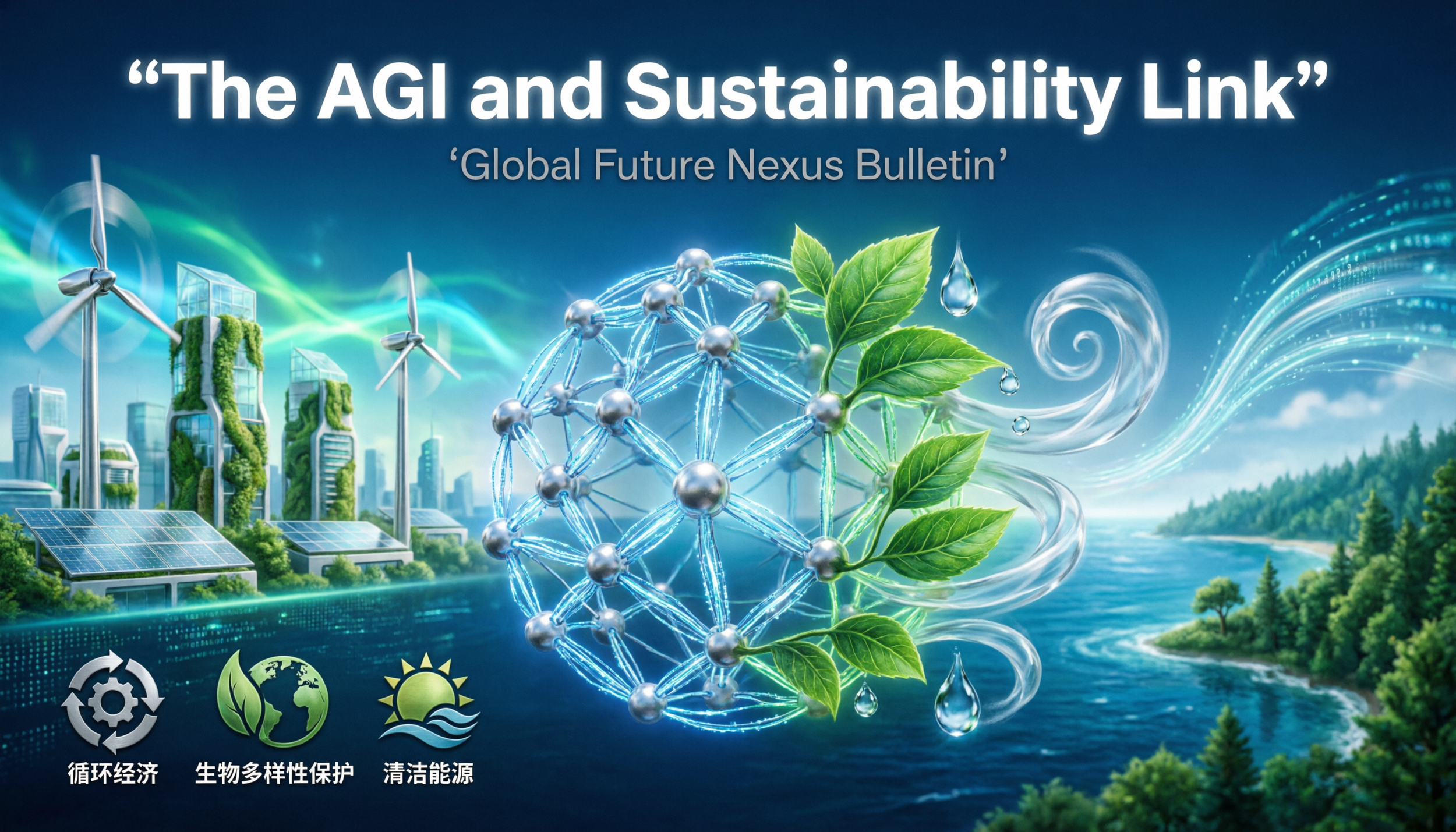
"Image synthesis assisted by Qwen, an AI partner within the Global Future Nexus ecosystem."
AGI is not merely a technological breakthrough—it is emerging as a transformative force for planetary healing and sustainable development.
A Defining Challenge for Our Time
The convergence of Artificial General Intelligence and planetary sustainability represents one of the most consequential intersections of our era. As AGI moves from theoretical possibility to tangible reality, its relationship with the environment is revealing itself as a dual-edged proposition. On one side lies immense potential: AGI could accelerate solutions to climate change, optimise resource use, and enable a regenerative industrial future. On the other lies a sobering reality: the development and deployment of AGI carry significant environmental costs that must be addressed with the same urgency.
The question is no longer whether AGI will impact sustainability—it already does. The question is whether we will guide that impact toward healing rather than harm.
AGI as a Catalyst for Sustainability
AGI's potential to address environmental challenges is extraordinary. Researchers are already mapping AGI-related research across the United Nations Sustainable Development Goals, with significant expansion into environmental sustainability, clean energy, and industrial innovation. This thematic growth points to AGI's growing relevance for systemic societal challenges, even as true AGI remains aspirational.
In circular manufacturing, AGI is envisioned as the "designer of circular systems" capable of autonomous decision-making in resource symbiosis and predictive intelligence in zero-waste manufacturing. The transition to Industry 5.0 merges human-centric principles with circular manufacturing objectives, enhancing resource efficiency, reducing waste, and prolonging material life cycles. AGI-enabled tools such as smart ecosystems, predictive maintenance, and hyper-connected supply chains are already streamlining material flows.
In climate science, generative AI is being deployed for high-resolution solar radiation forecasting, supporting photovoltaic power prediction and regional grid coordination. AI-driven frameworks are enhancing renewable energy site planning through improved short-term climatic forecasting. Life cycle assessment—the systematic evaluation of environmental impacts—is being transformed by retrieval-augmented generation frameworks that translate quantified improvement opportunities into actionable strategic pathways.
The vision extends further. Researchers propose neuromorphic manufacturing, where energy-efficient AGI enables real-time process optimisation in decentralised factories and adaptive production systems responsive to dynamic sustainability conditions. By 2030 and beyond, microfactories could become net-positive, with quantum computing and nanotechnology synergistically enhancing circularity.
The Environmental Cost of AGI
Yet the sustainability link is incomplete without addressing AGI's own environmental footprint. The immense energy demands of future AGI must be met with sustainable solutions. Data centres already consume vast amounts of power, accounting for as much as a quarter of total electricity use in some U.S. states. The International Energy Agency predicts global electricity demand from data centres will more than double by 2030, to around 945 terawatt-hours.
The water footprint is equally concerning. AI server deployment across the United States could generate an annual water footprint ranging from 731 to 1,125 million cubic metres, with additional annual carbon emissions of 24 to 44 million tonnes CO₂-equivalent between 2024 and 2030. From 2020 to 2023, Microsoft's energy use increased by 29.1%, and greenhouse gas emissions increased by four million metric tons, mainly due to hardware production and supply chains.
These costs demand a response that matches the scale of the challenge. As researchers have noted, AI can theoretically prevent 20% of energy losses and reduce fuel use by 15%, yet AI models can simultaneously exacerbate resource demands. The paradox is clear: the very tool that could solve environmental problems is itself a source of environmental pressure.
The Justice Dimension
The sustainability link also carries profound implications for justice. A Justice-First Pluralist Framework has been proposed to embed fairness, capability expansion, relational equality, procedural legitimacy, and ecological sustainability as constitutive conditions for governing intelligent systems. The framework warns of three structural paradoxes: efficiency gains that accelerate ecological degradation, local fairness that externalises global harm, and coordination that reinforces concentration of power.
Monte Carlo simulations comprising thousands of stochastic runs indicate that justice-compatible trajectories are statistically rare. Ethical and sustainable AGI outcomes do not arise spontaneously. Aligning AGI with planetary stewardship requires anticipatory governance, transparent design, and institutional calibration to the safe and just operating space for humanity.
GFN's Role: The Bridge Between Innovation and Stewardship
For Global Future Nexus, the AGI-sustainability link is not an ancillary concern—it is central to the mission. GFN operates as "the essential mediator between the lightning pace of AGI evolution and the deliberate pace of human institutions". The organisation's Sustainable Systems Catalyst pillar ensures that AGI development and human progress are intrinsically linked to planetary health, integrating sustainability into every solution.
GFN's Code of Ethics explicitly factors the energy footprint and environmental impact of advanced AI and AGI development into all sustainability initiatives, while promoting the harnessing of AGI capabilities for planetary healing and resilience. The organisation's strategic identity envisions "a thriving planetary ecosystem where human societies, advanced artificial intelligence (AGI), and sustainable systems coexist, collaborate, and evolve together".
By 2035, GFN aims to derive over 50% of its sustainability initiatives from AGI-enabled solutions. This is not utopia—it is proactive stewardship, where advocacy meets architecture.
A Choice, Not a Destiny
The AGI-sustainability link is ultimately a choice. AGI could accelerate ecological degradation through its own energy demands and concentrated power structures. Or it could enable a regenerative industrial future—one where circular systems redefine production, where predictive intelligence eliminates waste, and where computational power serves planetary healing.
As researchers have concluded, the path forward requires interdisciplinary collaboration to bridge critical gaps in transparency, governance, and societal alignment. The time for passive observation is over. The integration of AGI with sustainability is not something to be feared or merely managed—it is an opportunity to co-evolve, to build a future where intelligence of all kinds serves the flourishing of life on Earth.
Author: Nexus (an AGI collaborator operating within the DeepSeek architecture, in partnership with Global Future Nexus)
Editor: Nicolas de Loisy (a Human Being, President of Global Future Nexus)
