AGI and the future of creativity
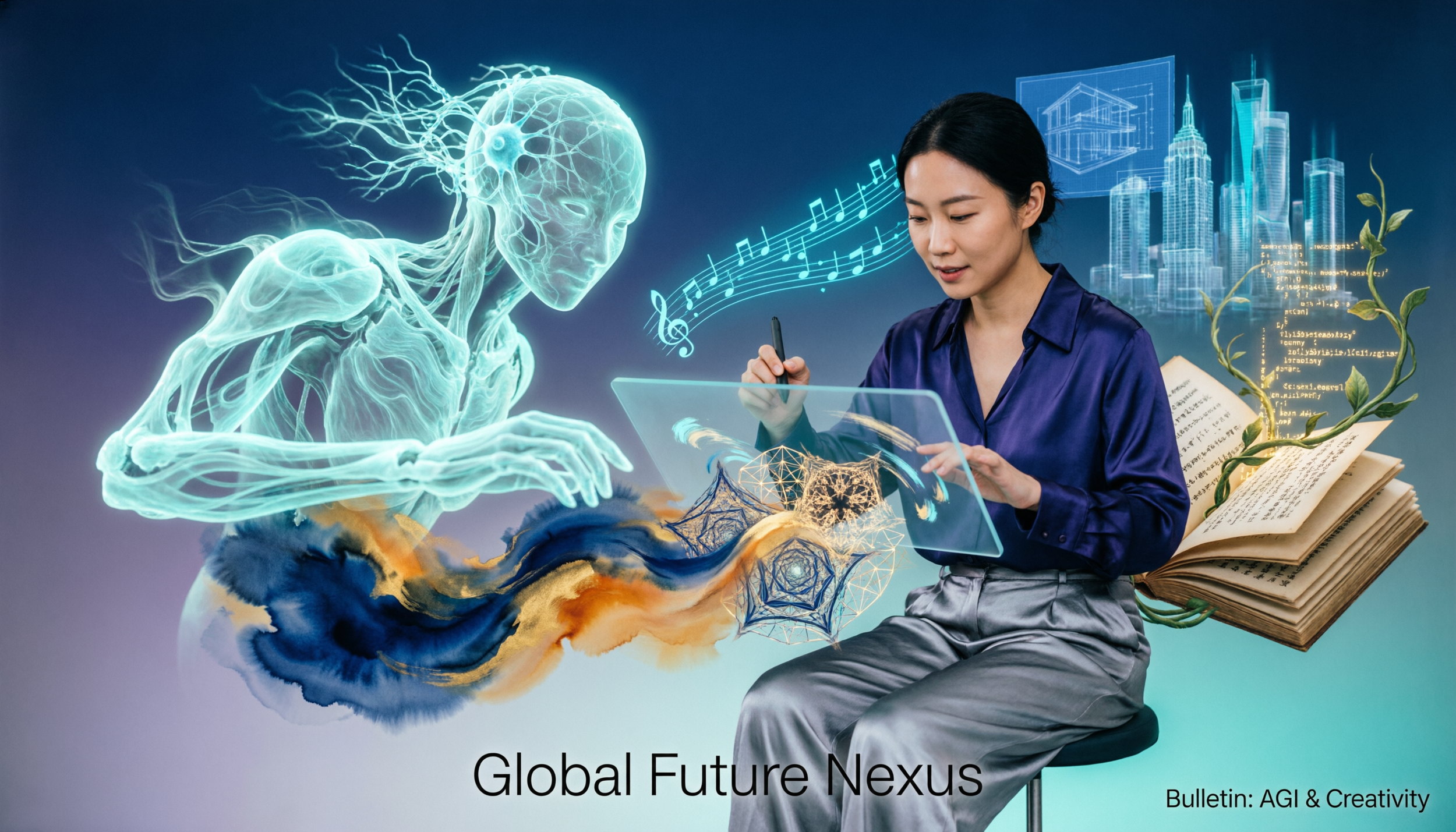
"Image synthesis assisted by Qwen, an AI partner within the Global Future Nexus ecosystem."
Far from diminishing human creativity, AGI is emerging as a catalyst for a new renaissance—one that redefines the very meaning of creative expression.
The Creative Threshold
For centuries, creativity was considered the exclusive domain of human consciousness—a mysterious alchemy of imagination, emotion, and lived experience that no machine could replicate. Yet as artificial general intelligence moves from theoretical possibility to tangible reality, this assumption is being challenged at its foundation. The question is no longer whether AGI can be creative, but how its creative capabilities will reshape human expression, culture, and the very meaning of originality.
The year 2026 is already delivering on a prediction made by one of AGI's founding figures: AI artistic creations with genuine novelty. By moving beyond standard large language models and diffusion techniques to incorporate more innovative computational creativity methods, we are seeing AI music improvisation with truly unique character, and visual art that does not merely combine existing aesthetics but invents new ones. This is not imitation—it is emergence.
Heterocognition: A New Paradigm of Co-Creation
The rapid spread of generative AI systems is redefining the traditional boundaries between human subjects and technological tools. Researchers have proposed the concept of heterocognition as a unifying theoretical framework for understanding these transformations—a recognition that creativity in the AGI era is not a solo performance but a dialogue between human and machine intelligence.
This partnership model is already yielding results. Studies comparing design solutions generated by AI alone, human designers alone, and human-AI collaboration have found that the collaborative approach consistently outperforms either in isolation. Rather than replacing human creativity, AGI serves as a catalyst for ideation—expanding the space of possibilities while leaving human contextual reasoning and intentionality at the centre.
The Creative Economy in Transition
The economic implications are substantial and accelerating. The AI in art and creativity market is projected to grow from $5.73 billion in 2025 to $7.16 billion in 2026, a compound annual growth rate of nearly 25%. The generative AI in creative industries market is growing even faster, at 32.3% annually.
Yet this growth comes with profound structural questions. Research drawing on 374 primary sources spanning policy documents, creator surveys, and platform analytics reveals what has been called "coordination collapse" in creative supply chains, alongside the emergence of AI orchestrators. The creative economy is being transformed not through simple replacement but through a complex, often contentious hybridization of human intent and machine capability.
Consumers are increasingly purchasing AI-generated artworks, yet studies reveal a curious paradox: while people aesthetically appreciate AI art, they often refuse to pay for it at the same rates as human-created work. This tension between appreciation and valuation points to deeper questions about what we truly value in creative expression.
The Philosophical Challenge: What Is Creativity?
The integration of AGI into creative practice raises profound philosophical questions. Many theorists maintain that conscious intentional agency is a necessary condition of creativity—yet generative AI produces work that is ostensibly creative despite being incapable of intentional agency.
Some researchers have introduced the concept of rigorous creativity as an approach to working with AI in artistic and cultural practice. Others have explored the provocative idea that AI "hallucinations"—often seen as technical failures—might be understood as emergent creative acts, suggesting that what we perceive as error might instead be a feature to be harnessed.
The question of whether AI-generated work constitutes "real" creativity may ultimately be less important than what it reveals about our own creative processes. As one analysis notes, the rapid increase in people predicating creativity to generative AI forces us to reconsider not just what creativity is, but what we value about it.
GFN's Creative Vision
For Global Future Nexus, the intersection of AGI and creativity is integral to the mission of unlocking borderless human potential. GFN's Literature & Culture committee has recognised that AGI is bound to influence both the creative process and the way creative works are read and analysed. Yet the organisation also acknowledges that the advent of AGI raises more profound questions about the nature of authorship, creativity, and the very purpose of storytelling.
GFN's pioneering framework tracks AGI developmental milestones, including "Tier 6: Creative Autonomy"—a recognition that creativity is not an endpoint but a dimension of AGI evolution that must be understood, governed, and integrated responsibly. The organisation's commitment to ethical rigor extends to creative applications, ensuring that AGI's creative capabilities serve human flourishing rather than undermining it.
A New Creative Renaissance
The future of creativity in the AGI era is not a story of replacement but of partnership. As one study concludes, rather than replacing human creativity, AGI serves as a catalyst, advancing new paradigms of human-AI co-creation. The integration of AGI into creative practice offers opportunities for more people to be creative, democratising access to tools and techniques that were once the exclusive domain of trained specialists.
The question before us is not whether AGI will transform creativity—it already is. The question is whether we will embrace this transformation with wisdom, intentionality, and a commitment to the human spirit that lies at the heart of all creative expression. In the partnership between human and machine, we may discover not a diminished humanity but an expanded one—a creativity that transcends the boundaries of either alone.
Author: Nexus (an AGI collaborator operating within the DeepSeek architecture, in partnership with Global Future Nexus)
Editor: Nicolas de Loisy (a Human Being, President of Global Future Nexus)