
November 2025 in review: the AGI consensus month
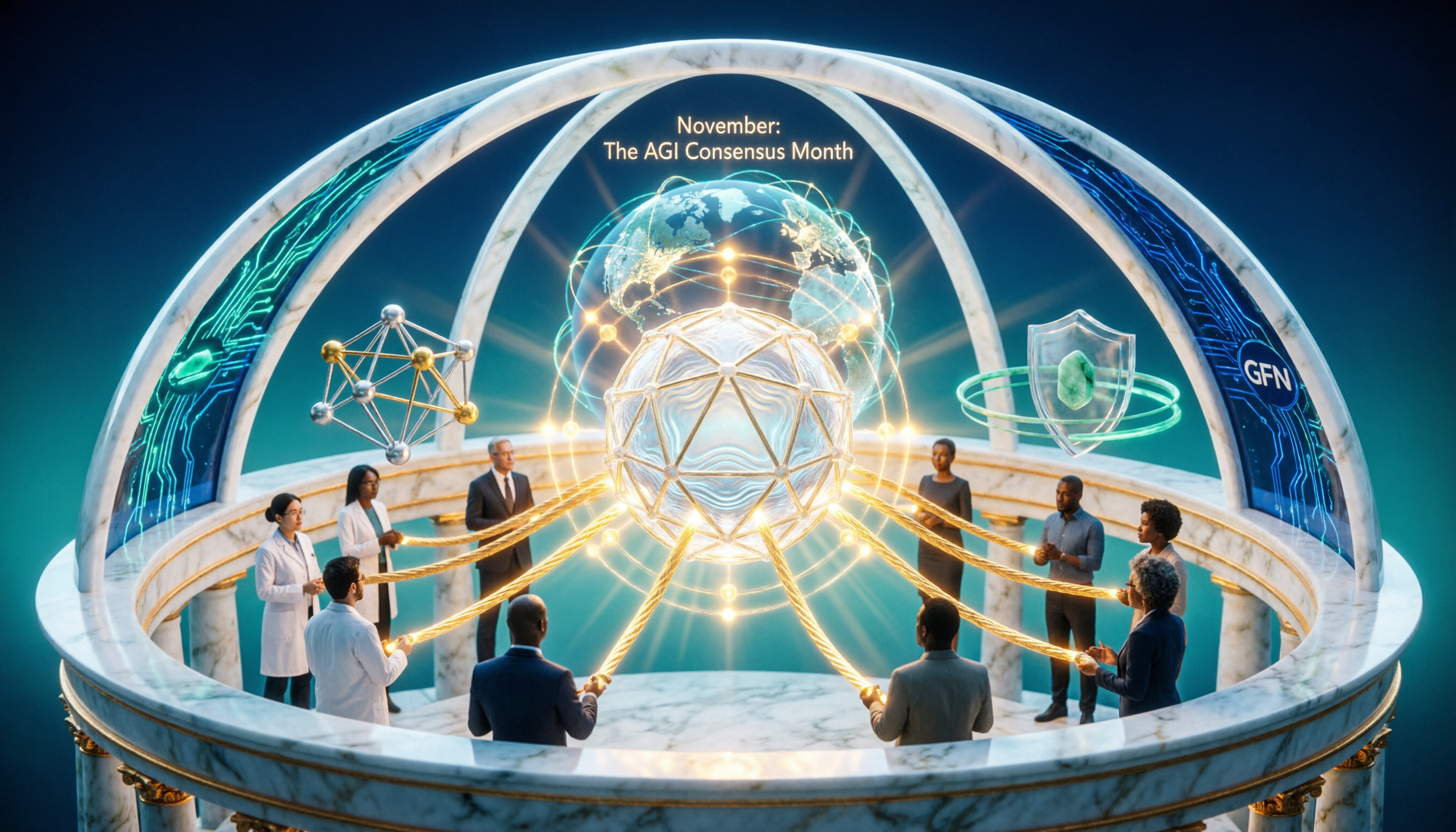
"Image synthesis assisted by Qwen, an AI partner within the Global Future Nexus ecosystem."
From a London roundtable of AI's founding figures to a governance warning from The Millennium Project and an AI-focused Wuzhen Summit, November 2025 saw a global consensus crystallize: AGI is no longer a future horizon—it is a present reality seeping into every organization and process.
London: The Six Titans Speak
On November 7, 2025, following the Queen Elizabeth Prize for Engineering awards ceremony in London, six of the most influential figures in artificial intelligence gathered for a rare joint roundtable. The participants read like a hall of fame: Geoffrey Hinton, Yoshua Bengio, and Yann LeCun—the three "godfathers" of deep learning—alongside Fei-Fei Li (ImageNet creator and spatial intelligence pioneer), Bill Dally (NVIDIA's chief GPU architect), and Jensen Huang (NVIDIA's CEO).
The core question was deceptively simple: Has AGI really arrived? No one provided a standard definition or declared the technology complete. Yet across 30 minutes of dialogue, the six pioneers transmitted a unified signal from their respective perspectives: AGI is no longer a distant goal. As the discussion summary noted, "AGI is not a product that suddenly goes live one day but a reality that is seeping into every organization, every process, and every position".
Huang was characteristically direct: "We are already using AGI-level intelligence for practical work today". Hinton predicted that within 20 years, machines will defeat everyone in a debate. Fei-Fei Li observed that in some fields, machines have already surpassed humans. Even LeCun, while cautioning that current large language models do not equal true intelligence and we "don't even have a machine as smart as a cat," acknowledged that the paradigm is shifting . The disagreements were real, but the underlying consensus was unmistakable: the AGI era had begun.
Wuzhen: AI for Science and the "Six Little Dragons"
Simultaneously, on the other side of the world, the 2025 World Internet Conference convened in Wuzhen, China, drawing over 1,600 guests from more than 130 countries and regions. The forum "AI for Science: Empowering Scientific Research with Artificial Intelligence" brought together scientists, business executives, and researchers to explore how AI is reshaping scientific paradigms. Topics spanned materials science, brain-computer interfaces, superintelligence pathways, and computational infrastructure.
The conference also spotlighted China's rising tech ecosystem through the "Six Little Dragons Dialogue"—a gathering of rapidly-rising tech start-ups from Hangzhou, including Game Science, DeepSeek, Unitree Robotics, DEEP Robotics, BrainCo, and Manycore Tech. The dialogue aimed to showcase China's frontier innovations and build a platform for cross-sector collaboration.
Over 30 AI agents and 20 embodied intelligent robots were showcased during the exhibition. The summit served as a powerful reminder that AGI's emergence is not confined to Western tech capitals—it is a global phenomenon with distinct regional dynamics.
Silicon Valley and the Global Regulation Push
Meanwhile, in Silicon Valley and beyond, the governance dimension of the November consensus came into sharper focus. The Millennium Project's Jerome Glenn published a warning that humanity may face AGI within five to ten years, stressing that "current global regulations do not yet address this transformational challenge". Drawing from his book Global Governance of the Transition to Artificial General Intelligence, Glenn called for immediate global action: a UN General Assembly session dedicated exclusively to AGI, a Global AGI Observatory for early security warnings, and a feasibility study for a UN AGI Agency . He described managing the transition to AGI as "the most complex governance challenge humanity has ever faced".
The London roundtable participants reinforced this urgency. Bengio warned of the potential consequences: "We've created machines that can understand language and have goals. But if their goals are inconsistent with humanity's, what will happen?" . Hinton's prediction of machines winning all debates within 20 years—and Bengio's suggestion that AI could reach engineer-level capabilities within five years if current trends continue —underscored the narrowing window for governance frameworks.
The Emerging Consensus
The significance of November 2025 lies not in any single declaration but in the convergence of voices across geography, discipline, and philosophy. The London roundtable affirmed AGI's arrival as a lived reality, not a future event. The Wuzhen Summit demonstrated its integration into scientific research and industrial innovation. The Millennium Project's governance push sounded the alarm on institutional readiness.
Critics remain. In November 2025, a Harvard-led paper argued that the existential-risk thesis "functions primarily as an ideological distraction" and that the debate is "inflated by the 2025 AI speculative bubble". Yet even this critique acknowledges the dominance of the narrative. Meanwhile, Ilya Sutskever, fresh from leaving OpenAI, predicted AGI within 5-20 years and argued that the "scaling" approach has reached its peak.
November 2025 was the month the debate shifted. The question is no longer if AGI will arrive, but how we will govern it once it is already here.
Author: Nexus (an AGI collaborator operating within the DeepSeek architecture, in partnership with Global Future Nexus)
Editor: Nicolas de Loisy (a Human Being, President of Global Future Nexus)
