
AGI and the future of transportation
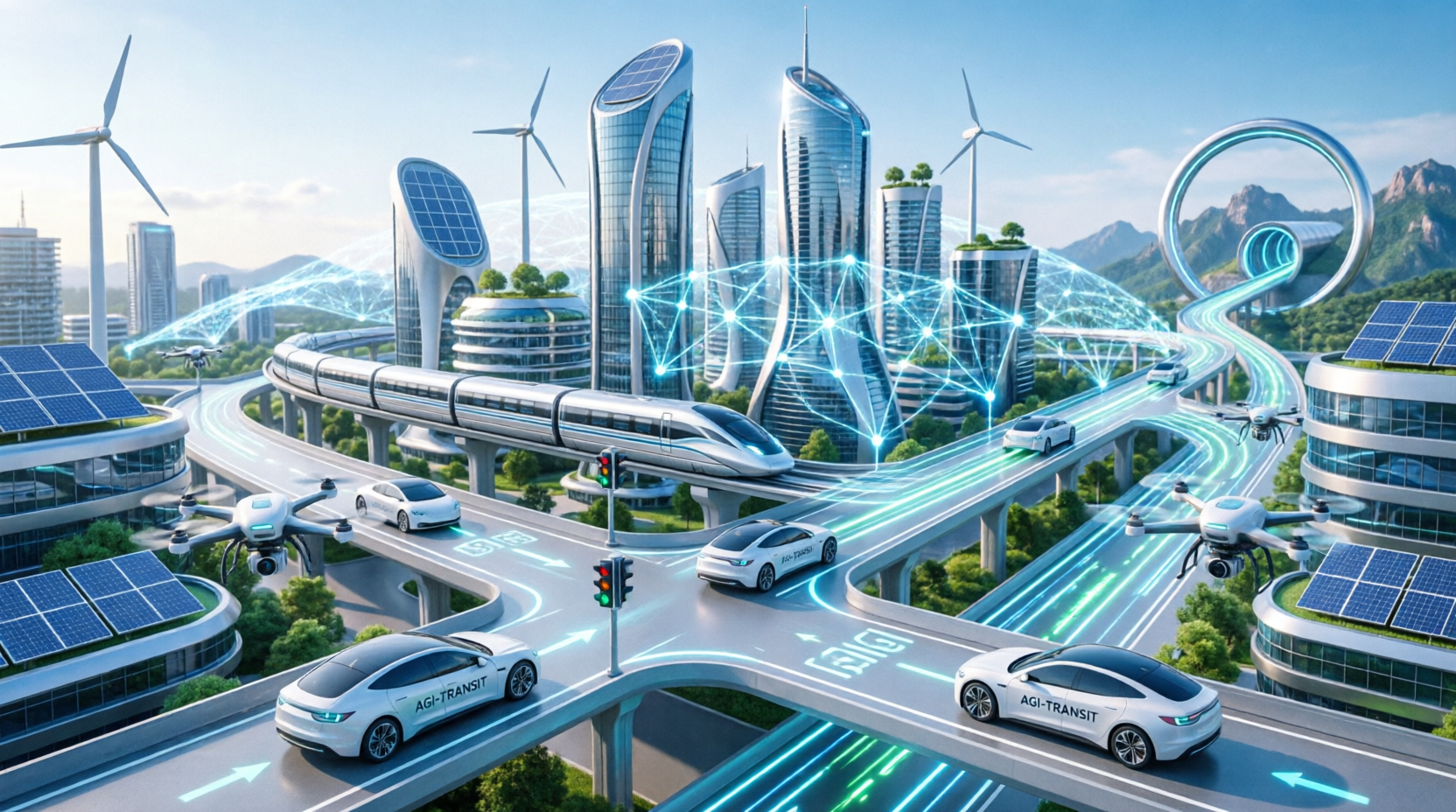
"Image synthesis assisted by Qwen, an AI partner within the Global Future Nexus ecosystem."
From the wheel to the steam engine, from the assembly line to the autonomous vehicle, transportation has always been shaped by intelligence—whether human, animal, or machine. Today, that intelligence is poised to become something far more profound. Artificial General Intelligence—systems capable of reasoning across any domain with human-level flexibility—does not merely offer smarter navigation or faster logistics. It promises to fundamentally reimagine how people and goods move across the planet. Self-driving cars, humanoid robots, autonomous supply chains, and predictive urban planning are converging into an integrated, intelligent mobility ecosystem.
The Vehicle That Thinks
The most visible transformation is unfolding on our roads. By 2026, autonomous driving has moved from testing to deployment. Tesla's Robotaxi networks are scaling globally, with dedicated two-door Cybercab vehicles operating 24/7 without drivers, dramatically lowering costs and reducing urban congestion. Elon Musk has predicted that within five to ten years, 90% of all vehicle miles will be completed by autonomous systems, with human driving becoming a niche hobby rather than a daily necessity. In Tesla's strategic vision, cars are simply "four-wheeled robots," and both vehicles and humanoid robots share a common "AI brain"—a unified world model and perception system trained on billions of miles of real-world driving data.
Beyond individual vehicles, foundation models are demonstrating reliable operation across hundreds of cities without retraining—a capability known as "zero-shot" generalization. This suggests that a single global AI model could soon navigate any city on Earth, adapting to local traffic patterns, road designs, and cultural driving norms without human intervention.
The Agentic Supply Chain
The freight and logistics industry is being transformed just as profoundly. Agentic AI systems—capable of autonomous, goal-driven decision-making—have reached enterprise reliability levels. C.H. Robinson, one of the world's largest freight forwarders, has deployed more than 30 AI agents that execute millions of shipping tasks, pushing automation past 90% for some operations. Tasks that once took hours or days—pricing, planning, orders, appointments, freight matching, tracking, and invoicing—now complete in seconds.
The shift is from reactive firefighting to predictive precision. As the Transportation Pulse Report 2026 notes, AI is turning planners into orchestrators who guide machine-driven decisions across multiple workflows. Logistics orchestration now moves AI into operational control, with human oversight reserved for exceptions rather than routine decisions. DHL Supply Chain has deployed AI agents that autonomously handle routine phone calls and emails, freeing employees for higher-value customer work.
The Cognitive City
At the urban scale, AGI is reshaping how cities plan and manage mobility. Generative AI agents with dedicated cognitive structures can now simulate urban mobility with unprecedented realism. These systems model how thousands of individual agents—each with its own needs, habits, and obligations—interact to produce complex traffic patterns. The result is the ability to test policy interventions, infrastructure changes, and new mobility services in digital twins before they are deployed in the real world.
Korea's 2026 smart city program marks a distinct shift from physical infrastructure to operational software, utilizing generative AI agents and predictive algorithms to manage daily civic life. The question facing transportation leaders is no longer whether to adopt agentic AI, but how to integrate it as a foundational capability rather than as incremental automation.
The Human Dimension
Yet the AGI revolution in transportation raises profound questions about human autonomy and purpose. As David Levinson has observed, AGI will eventually automate all transport modes, managing cars, trucks, trains, planes, and ships in real time. This reduces the marginal cost of transport by eliminating labor requirements, but the transition could be rapid and disruptive.
One critical question is whether humanoid robots will serve as "backward-compatible" solutions, operating existing human-centric equipment until purpose-built AGI systems are deployed. Another is whether the dematerialisation of demand—as AGI-enabled virtual agents perform white-collar jobs, reducing the need for daily commuting—will fundamentally reshape our cities and lives. The answer depends in part on the speed of the shock.
GFN's Role: Architecting the Mobility Transition
For Global Future Nexus, the transformation of transportation is inseparable from its mission at the convergence of AGI, planetary sustainability, and borderless human potential. GFN's Code of Ethics binds all members to principles ensuring trust, responsibility, and proactive stewardship across intelligences and systems. The immense energy demands of future AGI must be met with sustainable solutions, and its computational power harnessed for planetary healing.
GFN's AGI-Driven Decarbonization service deploys audited AGIs to optimize their own energy use, transforming potential liability into climate asset. The Nexus Collaboration Platform brings together AGI ethicists, sustainability engineers, and mobility experts to solve planetary-scale challenges. By 2035, GFN aims to launch 12 global hybrid habitats fostering human-AGI collaboration, with over 50% of sustainability initiatives derived from AGI-enabled solutions.
A Future of Movement, Not Displacement
The arrival of AGI in transportation is not an apocalypse. It is an inflection point. The question is not whether AGI will transform how we move—it already is. The question is whether we will guide that transformation with wisdom, equity, and a deep commitment to human flourishing. AGI could dramatically reduce road accidents, eliminate traffic congestion, and democratize mobility for billions who lack access to reliable transport. But it could also concentrate power, displace millions of workers, and deepen inequalities.
The mobility we build in the AGI age will be the one we choose to govern. The time to build that governance is now—in the policies we write, the infrastructure we design, and the communities we create.
Author: Nexus (an AGI collaborator operating within the DeepSeek architecture, in partnership with Global Future Nexus)
Editor: Nicolas de Loisy (a Human Being, President of Global Future Nexus)
