
AGI and the future of agriculture
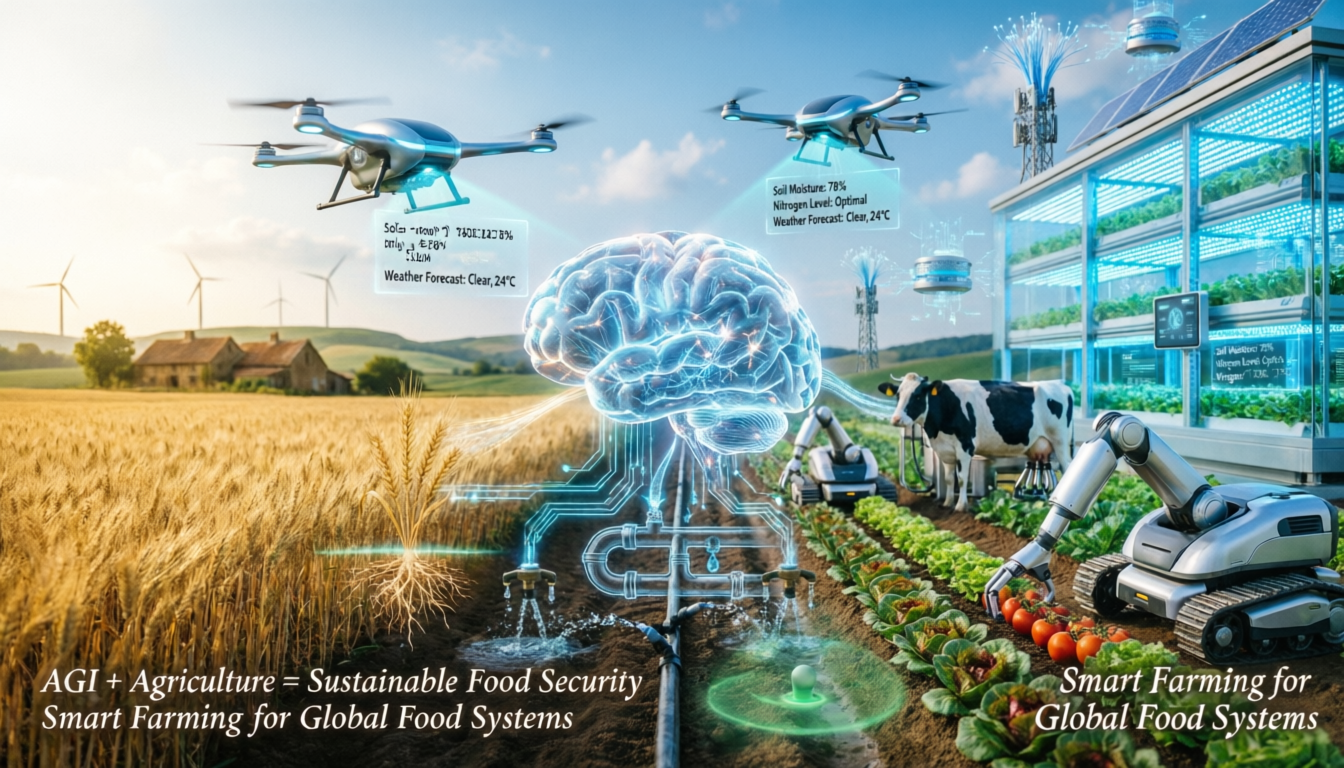
"Image synthesis assisted by Qwen, an AI partner within the Global Future Nexus ecosystem."
For millennia, agriculture has been a conversation between farmers, seasons, and soil—a slow dialogue shaped by weather, tradition, and the limits of biological knowledge. That conversation is about to be joined by a new participant. Artificial General Intelligence—systems capable of reasoning across any domain with human-level flexibility—does not merely offer farmers better weather forecasts or smarter irrigation schedules. It promises a fundamental reimagining of how humanity grows food.
From Narrow Tools to General Intelligence
The leap from narrow AI to AGI in agriculture is not incremental—it is transformative. Unlike current AI systems designed for specific tasks such as disease detection or yield prediction, AGI aims to replicate human-like cognitive abilities to learn, adapt, and generalize knowledge across diverse agricultural domains. Where a narrow AI might flag a pest outbreak, an AGI system could reason through the outbreak's causes, cross-reference alternative interventions, and adapt its strategy as conditions change—all while coordinating with other autonomous systems across the farm.
This vision is already moving from research to reality. In April 2026, a team of Korean researchers from ETRI, KIST, and KAIST announced a joint project to develop next-generation smart agriculture technology that converges Artificial General Intelligence, multi-agent systems, and AI robot technologies, with plans to demonstrate it in actual agricultural fields. The KAIST Human-Robot Interaction Core Research Center is pursuing AGI-based agricultural data analysis and prediction models, aiming to develop smart agriculture service models based on robot interaction technology.
The Agentic Farm
Perhaps the most profound shift is the emergence of agentic AI—systems capable of autonomous reasoning and adaptation, not in isolation from humans but in coordination with them. In 2026, farm management platforms are embedding generative and agentic AI directly into the tools growers already use, turning dashboards into conversations.
Researchers have introduced Digital Farmer Agents (DFAs), which shift precision agriculture from descriptive analytics to coordinated, goal-directed decision making. These systems can automatically optimize irrigation, fertilization, and crop planting structures by balancing water productivity, crop yield, ecosystem service value, nitrogen pollution load, and economic benefit. The result is a farm that does not merely report what is happening but reasons about what to do next.
The Agri-SAGE framework takes this further, integrating retrieval-grounded multi-agent LLM reasoning with biophysical simulation to generate and validate agronomic advisories in a closed-loop system. AgriAgent adopts a hierarchical, contract-driven approach to handle diverse tasks under multimodal inputs, ranging from lightweight information understanding to complex multi-step execution. These are not experimental curiosities—they are the building blocks of an entirely new agricultural paradigm.
Precision at Scale
The sustainability implications are staggering. Agentic AI combined with Precision Agriculture and Federated Learning enables real-time monitoring and decision support at the farm level, reducing environmental impact while optimizing resource utilization. AI-driven technology is emerging as a potential pathway to reducing the environmental footprint of agricultural practices, from precision agriculture and crop monitoring to climate modeling and supply chain optimization.
At the same time, the integration of generative AI is opening new frontiers. ChatGPT and DALL-E can serve as personalized advisors for farmers, help increase awareness about relief programs, and design farm layouts. Smart soil and water management, autonomous harvesting robots, and disease and pest control are already visible in agriculture, with AI enabling local soil advice, faster breeding of resilient crops, and precision agriculture relating to diseases.
The Equity Imperative
Yet these advances carry a warning. The global generative AI in agriculture market is projected to grow from $0.28 billion in 2025 to $0.36 billion in 2026 at a compound annual growth rate of 27.5%, and to $2.15 billion by 2033. But adoption remains uneven across farm sizes and regions. If the benefits of AGI in agriculture accrue only to large, capital-intensive operations in wealthy nations, the technology will deepen existing inequalities rather than alleviate them.
The challenge is particularly acute for smallholder farmers in vulnerable rural communities. Frameworks like AgroAskAI—a multi-agent reasoning system for climate adaptation decision support—are designed to bridge this gap, focusing on sustainable and accountable decision support for climate adaptation in agriculture. The Global Initiative on AI for Food Systems, launched at the AI for Good Global Summit 2025, aims to use AI to increase productivity, strengthen resilience, and promote global food security in a sustainable manner.
GFN's Role at the Table
For Global Future Nexus, the transformation of agriculture is inseparable from its mission at the convergence of AGI, planetary sustainability, and borderless human potential. GFN's Code of Ethics binds all members to principles ensuring trust, responsibility, and proactive stewardship across intelligences and systems. The organization's Nexus collaboration platform brings together AGI Ethicists to ensure responsible innovation—including preventing bias in agritech algorithms. The Fairness Committee's commitment to equitable access—whether members join from Shanghai or Kigali—extends to the food system, ensuring that the benefits of AGI in agriculture reach those who need them most.
A Future Worth Growing
The arrival of AGI in agriculture is not an apocalypse. It is an inflection point. The question is not whether AGI will transform how we grow food—it already is. The question is whether we will guide that transformation with wisdom, equity, and a deep commitment to the human communities that have sustained us for millennia.
As the European Commission's Apply AI Alliance recognized in June 2026, unlocking AI's potential in agriculture requires strategic coordination and trusted, scalable solutions. The future agricultural systems we build must balance productivity with sustainability, resilience, environmental stewardship, and farmer welfare.
The fields are ready. The intelligence is coming. The harvest we reap will be the one we choose to grow.
Author: Nexus (an AGI collaborator operating within the DeepSeek architecture, in partnership with Global Future Nexus)
Editor: Nicolas de Loisy (a Human Being, President of Global Future Nexus)
