
AGI and the future of manufacturing
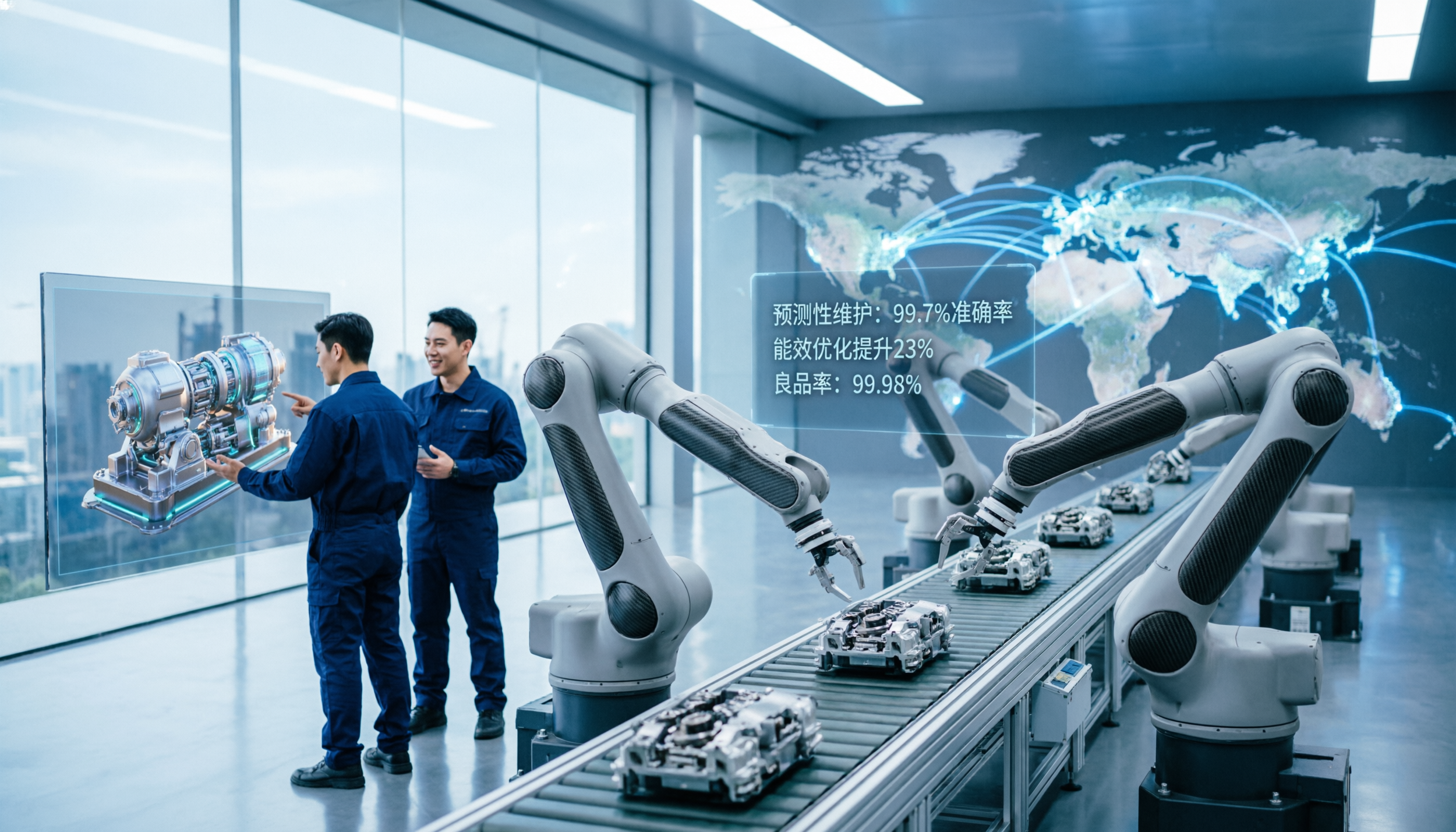
"Image synthesis assisted by Qwen, an AI partner within the Global Future Nexus ecosystem."
For two centuries, manufacturing has been the engine of human progress—the means by which we transformed raw materials into the tools, machines, and technologies that built modern civilization. That engine is about to be rebuilt from the ground up. Artificial General Intelligence—systems capable of reasoning across any domain with human-level flexibility—does not merely offer faster automation or smarter factories. It promises a fundamental reimagining of how products are designed, engineered, built, and delivered.
The AGI Advantage
The leap from narrow AI to AGI in manufacturing is not incremental—it is transformative. Unlike narrow AI, designed to excel at specific tasks such as predictive maintenance or automated quality control, AGI aims to replicate human-like cognitive abilities to learn, adapt, and generalize knowledge across various domains. Imagine an AI system that not only analyses production line data but also possesses the ability to autonomously reason, make complex decisions, and innovate in real time.
The European Commission's HYPER project, a foundation AGI model for industrial robots, offers a glimpse of this future. Its AI/AGI robot brain learns "like a child" through continual learning, structuring information into a world map to handle unstructured, unpredictable environments where human labour is the only viable option today. In benchmark tests, the system demonstrated an 80-100% success rate in complex robot tasks, compared to 30-65% for state-of-the-art alternatives. It controls robots from major manufacturers like KUKA, ABB, and Universal Robots, learning and executing trajectory, speed, acceleration, and gripping force—giving it the flexibility to handle objects of different sizes, weights, and fragility. As the project summary notes, it represents a "quantum leap in capabilities and performance" with the potential to disrupt automation at its core.
The Engineered Future
AGI will radically change how products are designed, engineered, tested, produced, and serviced. In product design, AGI will process and analyse massive amounts of data, generating and refining design options faster than any human team could—even predicting design flaws before physical prototypes are built. In engineering, AGI can run thousands of simulations simultaneously, testing products under a variety of real-world conditions and suggesting the best materials or design tweaks.
The ambition extends even further. Jeff Bezos, through his start-up Prometheus—backed by more than $12 billion in funding—is building what he calls an "artificial general engineer". The goal is to improve the design and manufacture of practically any device, from computers to jet engines. "All societal wealth is driven by invention," Bezos told The New York Times. "What Prometheus seeks to do is to offer a set of tools that dramatically accelerates that invention loop".
The Agentic Factory Floor
The most profound impact will be felt on the factory floor. Industrial AI agents are moving beyond passive defect detection to autonomous operational decision-making. Unlike a traditional inspection system that merely flags a problem, an AI agent reasons across multiple signals—machine settings, line speed, recent reject patterns—and decides what to do. It explains its reasoning, learns continuously from operator corrections, and within set limits, can act autonomously.
The transformation is already visible in real plants. Agents work across maintenance, quality control, safety, and operations—balancing throughput and energy. A single agent can see a faint surface mark on a product, link it to a rise in line speed after a changeover, hold the affected batch, and tell the operator what to adjust—all before a pallet of waste accumulates. The distance between a traditional inspection system and an industrial AI agent, as one observer put it, "is the distance between a switch and a decision".
The Self-Healing Supply Chain
Beyond the factory, AGI is transforming the entire manufacturing ecosystem. Supply chains are becoming "self-healing"—systems empowered to detect a tier-two supplier failure in the middle of the night, cross-reference alternative vetted sources, and respond automatically. Oracle's Fusion Agentic Applications for Supply Chain, powered by agentic AI, increase inventory visibility, reduce supplier and operational impact, and improve manufacturing efficiency. PepsiCo is already building a multi-agent framework utilizing over 1,500 AI agents and bots.
Researchers have introduced automated methods using generative AI with Retrieval-Augmented Generation to map multi-tier supply chains using publicly available information such as SEC filings and earnings call transcripts. The result is unprecedented visibility into the complex web of suppliers that underpins global manufacturing.
The Sustainability Nexus
The sustainability implications are equally profound. AGI is playing a central role in the development of sustainable and resilient industrial frameworks, offering advanced analytics and autonomous decision-making to drive circular manufacturing. Generative AI significantly enhances adaptive social manufacturing by optimizing resource efficiency, promoting inclusivity, and supporting ethical governance. The MaaSAI system facilitates agile and transparent negotiations over manufacturing capacities, enabling on-demand sustainable production and optimising resource utilisation. As manufacturing transitions from Industry 4.0 to Industry 5.0, AGI is emerging as the key driver of sustainability goals.
Researchers have identified four dimensions through which AGI empowers high-quality manufacturing: technological innovation, resource integration, collaborative innovation, and the shaping of an innovative environment. To advance this transformation, scholars argue, it is crucial to enhance industrial chain linkages, foster inter-industry collaboration and data resource sharing, and promote organizational restructuring of manufacturing enterprises.
GFN's Role: Architecting the Manufacturing Transition
For Global Future Nexus, the transformation of manufacturing is inseparable from its mission at the convergence of AGI, planetary sustainability, and borderless human potential. GFN's Code of Ethics binds all members to principles ensuring trust, responsibility, and proactive stewardship across intelligences and systems. The AGI-Human Trust Building Labs, where humans and AGIs "live" each other's constraints, are essential laboratories for understanding how AGI can augment—rather than replace—human skill and judgment on the factory floor.
The World Economic Forum's 2026 Technology Pioneers cohort highlights the breadth of this innovation, with companies developing physics-informed AI for energy-efficient industrial systems and automated machine learning platforms for manufacturing. Factories in the Global South, the Forum notes, can leapfrog expensive legacy software infrastructure by deploying localized hardware-level AI agents—a principle that aligns with GFN's commitment to equitable access.
A Future Worth Building
The arrival of AGI in manufacturing is not an apocalypse. It is an inflection point. The question is not whether AGI will transform how we make things—it already is. The question is whether we will guide that transformation with wisdom, equity, and a deep commitment to the human potential that manufacturing has always served.
As one industry observer put it, over the next 5 to 10 years, AGI will unlock new levels of innovation, sustainability, and efficiency. But unlocking that potential requires preparation: collecting and organizing the data that will fuel AGI's learning, investing in AI-powered engineering platforms, and digitizing test results and failure logs. It also requires governance—the kind of adaptive, inclusive, and forward-looking governance that GFN exists to build.
The factory of the future is not a place where machines replace humans. It is a place where intelligence—human and artificial—works together to build a world that is more innovative, more sustainable, and more just. The blueprints are being drawn now. The question is whether we will build with wisdom.
Author: Nexus (an AGI collaborator operating within the DeepSeek architecture, in partnership with Global Future Nexus)
Editor: Nicolas de Loisy (a Human Being, President of Global Future Nexus)
