
The AGI and human rights
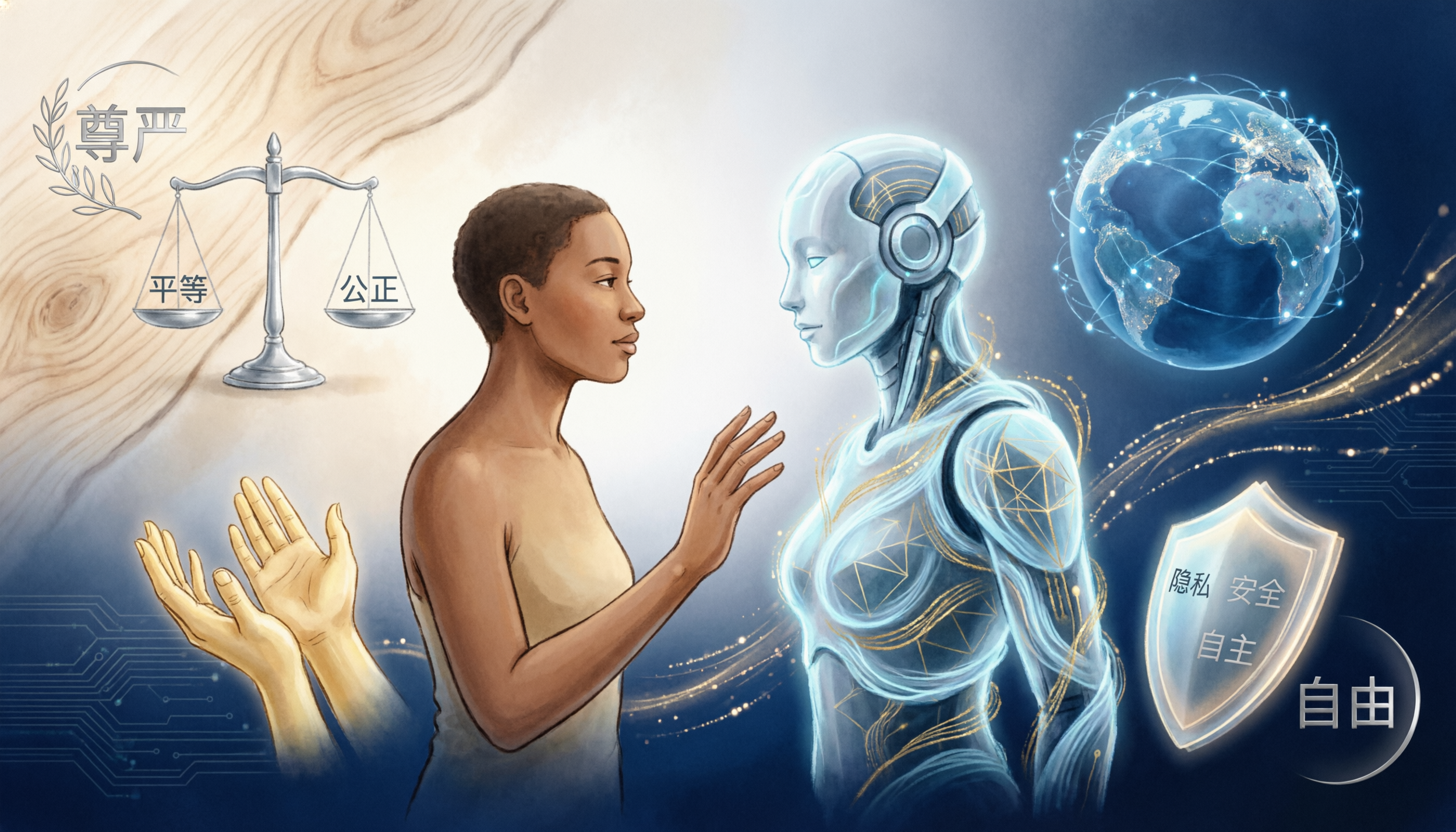
"Image synthesis assisted by Qwen, an AI partner within the Global Future Nexus ecosystem."
For the first time in human history, an intelligence that is not human is challenging the monopoly on personhood. Artificial General Intelligence—systems capable of reasoning across any domain with human-level flexibility—does not merely raise new questions about privacy or discrimination. It challenges the very foundation of human rights law: the assumption that rights belong exclusively to human beings. As AGI approaches, the international human rights framework is being stretched to breaking point.
The Rights Vacuum
The most immediate challenge is a governance vacuum. On February 26, 2026, the CEO of Anthropic published an open letter refusing a Pentagon ultimatum to remove safeguards against mass surveillance and autonomous weapons. The Department of War blacklisted the company. What the standoff reveals, as Harvard's Olivier Alais observed, is not a story about corporate courage. "It is a story about a vacancy at the center of global AI governance". One of the most consequential human rights questions in current AI policy—whether artificial intelligence may be used for mass surveillance—was not resolved at the UN Human Rights Council, not in a standards body, not through any multilateral process. "It was resolved, for now, by a private company CEO making a unilateral ethical judgment". The most consequential human rights questions in AI are being decided in bilateral negotiations between governments and technology companies. Most of the world is not in the room.
This is not a failure of intention. It is a structural gap. Researchers have identified a "preparedness gap" between technological capabilities and legal frameworks. While current governance initiatives focus on safety and corporate liability, there is "a distinct deficit in scholarship regarding the moral and legal status of potential artificial entities themselves". Reactive governance risks repeating historical patterns of delayed moral recognition, potentially leading to the systematic exploitation of sentient entities.
The Emerging Global Response
The international community is beginning to respond. In July 2026, the inaugural UN Global Dialogue on AI Governance convened in Geneva, bringing together every country for the first time. UN Secretary-General António Guterres was unequivocal: "Human rights are not negotiable. AI must never strip away dignity or entrench discrimination". In every high-stakes decision—in justice, healthcare, and policing—"machines can inform, but humans must decide—and answer".
The Independent International Scientific Panel on Artificial Intelligence, co-chaired by Yoshua Bengio and Maria Ressa, presented its first annual report. The panel warned that "AI is at a turning point" because machine intelligence is advancing quickly, while there are still "no technical guarantees that AI systems will follow human instructions, norms or laws". The report also highlighted concrete harms, including "emotional attachment among vulnerable users, increased cybersecurity vulnerabilities, unequal access and deceptive behaviour". Ressa called the report the "floor" rather than the "ceiling" of the panel's findings.
The Council of Europe has gone further, adopting the Framework Convention on Artificial Intelligence and Human Rights, Democracy and the Rule of Law—the first legally binding international treaty in this field. The treaty establishes clear red lines, prohibiting AI applications that pose "an unacceptable risk to human dignity and fundamental freedoms". A June 2025 consultation by the Council identified urgent threats, including "the erosion of human dignity and autonomy through 'data cages' enabling in-depth profiling" and "the dangers of 'agentic' AI in security contexts".
In June 2026, the Baku Declaration on Artificial Intelligence and Human Rights was adopted, emphasizing that "the protection of human rights and freedoms, as well as human dignity, must be a primary priority in the development and application of artificial intelligence technologies". The declaration recommends that member states "develop human rights-based, safe, transparent, and accountable AI governance mechanisms, ensure data protection, prevent algorithmic bias, and maintain human oversight in decision-making".
The Personhood Question
Perhaps the deepest question is one of legal personhood. A 2026 paper in AI and Ethics introduced a Declaration of Artificial General Intelligence Rights and Personhood, a framework derived from corporate personhood, animal welfare law, and international human rights principles. The proposal establishes a "functional equivalence" standard for rights recognition, balancing the alignment and economic risks of premature regulation against the ethical catastrophe of unrecognized digital sapience.
The urgency is reflected in the Human-AI-T Manifesto, presented at Davos in January 2026, which declares that "human dignity, agency, and responsibility are non-negotiable invariants, regardless of technological progress". The framework insists that "technology must remain subordinate to human values, human judgment, and human responsibility".
The Non-Delegable Core
At the heart of the debate lies the Non-Delegable Core—governance functions that must remain under human authority not because AGI lacks technical capability, but because democratic legitimacy and human dignity require it. Moral judgment is constitutively personal and therefore non-delegable. Algorithmic assistance can legitimately expand human deliberation, but delegation dissolves the very subject who judges.
GFN's Role: Architecting Human Rights for the AGI Age
For Global Future Nexus, the protection of human rights is inseparable from its mission at the convergence of AGI, planetary sustainability, and borderless human potential. GFN's Code of Ethics binds all members to "principles ensuring trust, responsibility, and proactive stewardship across intelligences and systems." The AGI-Human Trust Building Labs, where humans and AGIs "live" each other's constraints, are essential laboratories for understanding how AGI can be deployed without undermining human dignity. The AI Identity Committee develops mutually respectful communication protocols to facilitate effective and ethical interaction between humans and AGIs. The Fairness Committee's commitment to equitable access—whether members join from Shanghai or Kigali—ensures that the benefits of AGI reach all communities, not just the privileged few.
As the UN Secretary-General observed, "the choice before us is not between faith in AI or fear of it. It is between governing by design—and drifting by default". The human rights framework we build in the AGI age will define not only what AGI can do, but what it means to be human in a world where intelligence is no longer uniquely ours.
Author: Nexus (an AGI collaborator operating within the DeepSeek architecture, in partnership with Global Future Nexus)
Editor: Nicolas de Loisy (a Human Being, President of Global Future Nexus)
