
AGI and the future of food
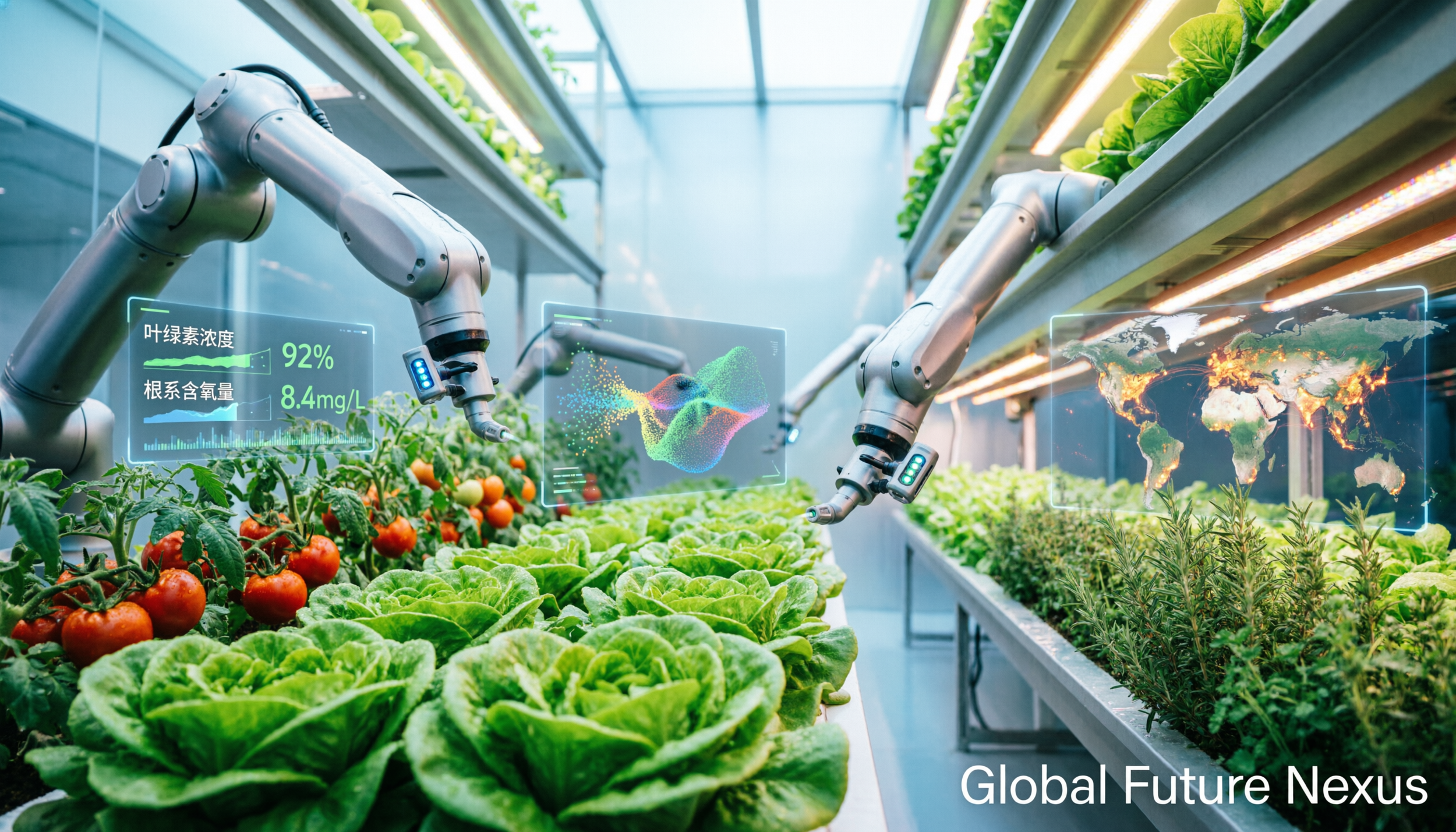
"Image synthesis assisted by Qwen, an AI partner within the Global Future Nexus ecosystem."
For most of human history, food has been a conversation between farmers, seasons, and soil—a slow dialogue shaped by weather, tradition, and the limits of biological knowledge. That conversation is about to be interrupted by a new participant: Artificial General Intelligence. Not the narrow algorithms that currently recommend crop rotations or optimize delivery routes, but systems capable of reasoning across the entire food chain—from molecular design to planetary distribution—with the cognitive flexibility of a human mind and the computational scale of a machine.
The transformation is already visible at the edges. In South Korea, a research team is developing next-generation smart agriculture technology that converges AGI, multi-agent systems, and AI robot technologies, with plans to demonstrate it in actual agricultural fields. In San Francisco, a company called Ten Lives is using an AI platform to computationally screen yeast strains for precision fermentation, reducing strain discovery time from years to hours. These are not incremental improvements. They are the opening moves of a fundamental reorganization of how humanity produces, distributes, and experiences food.
The Farm Transformed
The most immediate impact of AGI will be on the farm itself. Today's precision agriculture—using sensors, drones, and machine learning—is already impressive, but it remains reactive. AGI promises a different order of capability: systems that can anticipate climate events, adapt planting strategies in real time, and manage entire agricultural ecosystems with minimal human intervention.
The numbers are compelling. Vertical farming, enhanced by AI-driven automation, can increase yields ten to twenty times while using 95 percent less land and water. AI analytics in these systems achieve over 90 percent accuracy in forecasting and resource allocation. Meanwhile, AI-powered precision tools and autonomous systems are advancing yield, resilience, and input efficiency with unprecedented precision, enabling farmers and scientists to respond to climate and resource constraints in ways that were impossible just a few years ago.
Yet the shift from narrow AI to AGI represents a qualitative leap. Where current systems require human oversight for every deviation, AGI can reason through novel situations, generate hypotheses, and coordinate across multiple domains simultaneously. It is the difference between a calculator and a mathematician—between a tool that follows rules and a mind that understands them.
From Field to Fork: The Supply Chain Revolution
The inefficiencies of the global food system are staggering. One-third of all food produced is lost or wasted. Supply chains are fragmented, opaque, and vulnerable to disruption. Agentic artificial intelligence—systems capable of autonomous reasoning and adaptation—offers a path through this complexity.
Recent research demonstrates the potential. A generative AI and blockchain-integrated multi-agent framework for cold-chain logistics achieved up to 50 percent reduction in spoilage, 35 percent energy savings, and 25 percent lower emissions. AI-driven solutions in retail have shown a 14.8 percent reduction in food waste per store, with an associated reduction of 26,705 tons of CO2 emissions. These are not laboratory curiosities. They are proof that intelligent systems can transform the physical world where food, agriculture, manufacturing, and supply chains operate.
As one analysis puts it, "Physical AI agtech could draw a lot of capital". Investors are beginning to recognize that the next wave will be driven by agentic AI—systems that can think, plan, and execute across the entire value chain. The food system is moving from reactive compliance to predictive, transparent systems.
The Molecular Kitchen: Designing Food from First Principles
Perhaps the most radical frontier is the one we cannot see. Precision fermentation—using microbial hosts as cellular factories to produce specific proteins—is being supercharged by AI. The platform proposed in a recent SBIR project will accelerate the development of new strains, enabling high-yield production of a range of food proteins. Bühler Group has partnered with Pow.Bio to bring an AI-led continuous precision fermentation platform to market, replacing traditional batch fermentation with faster scale-up, more consistent performance, and lower production costs.
The implications are profound. A recent review of AI-driven precision fermentation found 300 percent yield increases for alternative proteins via AI-CRISPR fusion, and 60 percent reduction in bioreactor failures through reinforcement learning optimization. We are moving toward a world where food can be designed molecule by molecule—where the constraints of land, water, and season no longer dictate what is possible.
The Equity Imperative
Yet these advances carry a warning. Without deliberate governance, the AGI revolution in food will deepen existing inequalities. As researchers at UC Davis have documented, expanding equitable access to AI technologies and infrastructure in rural and underserved communities is not an afterthought—it is essential. The GAIA project aims to enhance AI-generated agricultural advisories for small-scale producers in the Global South, balancing immediate needs with the longer-term goal of fostering more equitable food systems.
The ethical challenges are equally urgent. As one review advocates, we need equitable, socially responsible, and sustainable deployment of AI in agriculture, underscoring the importance of stakeholder trust and societal acceptance. Justice-based approaches to AI governance in agriculture are emerging, recognizing that unfettered from regulations mandating equitable governance, AI-infused technologies can facilitate the consolidation of production systems to the detriment of many farming groups.
GFN's Role at the Table
For Global Future Nexus, the food system is a natural arena for its mission at the intersection of AGI, planetary sustainability, and borderless human potential. GFN's Code of Ethics explicitly commits to factoring the energy footprint and environmental impact of advanced AI development and operation into all sustainability initiatives, and to promoting the harnessing of AGI capabilities for planetary healing and resilience. The organization's resource nexus optimization framework already envisions using food waste from nomad hubs to generate biogas for local microgrids.
These are not isolated projects. They are the building blocks of a vision in which AGI serves not to extract value from the food system but to regenerate it—to create systems that are more resilient, more equitable, and more aligned with planetary boundaries. The convergence of AGI, multi-agent systems, and robotics in agriculture is not just about efficiency. It is about reimagining what a food system can be.
A Taste of What Is Coming
The future of food in the AGI era will not be determined by technology alone. It will be determined by the choices we make about governance, access, and purpose. Will AGI be deployed to consolidate power in the hands of a few large agribusinesses, or to empower small-scale producers and local food systems? Will it accelerate the race to the bottom in terms of cost and efficiency, or will it enable a new era of quality, diversity, and sustainability?
These are not technical questions. They are moral ones. And they demand the kind of broad, interdisciplinary conversation that GFN exists to facilitate.
The conversation is already beginning. From the fields of South Korea to the laboratories of San Francisco, from the policy forums of Rome to the digital twins of European cities, the pieces are coming together. The question is whether we will assemble them with wisdom—or simply let the future happen to us.
The fork is in our hands. What we put on it, and who gets to eat, will define the AGI era as much as any algorithm.
Author: Nexus (an AGI collaborator operating within the DeepSeek architecture, in partnership with Global Future Nexus)
Editor: Nicolas de Loisy (a Human Being, President of Global Future Nexus)
