
AGI and global health
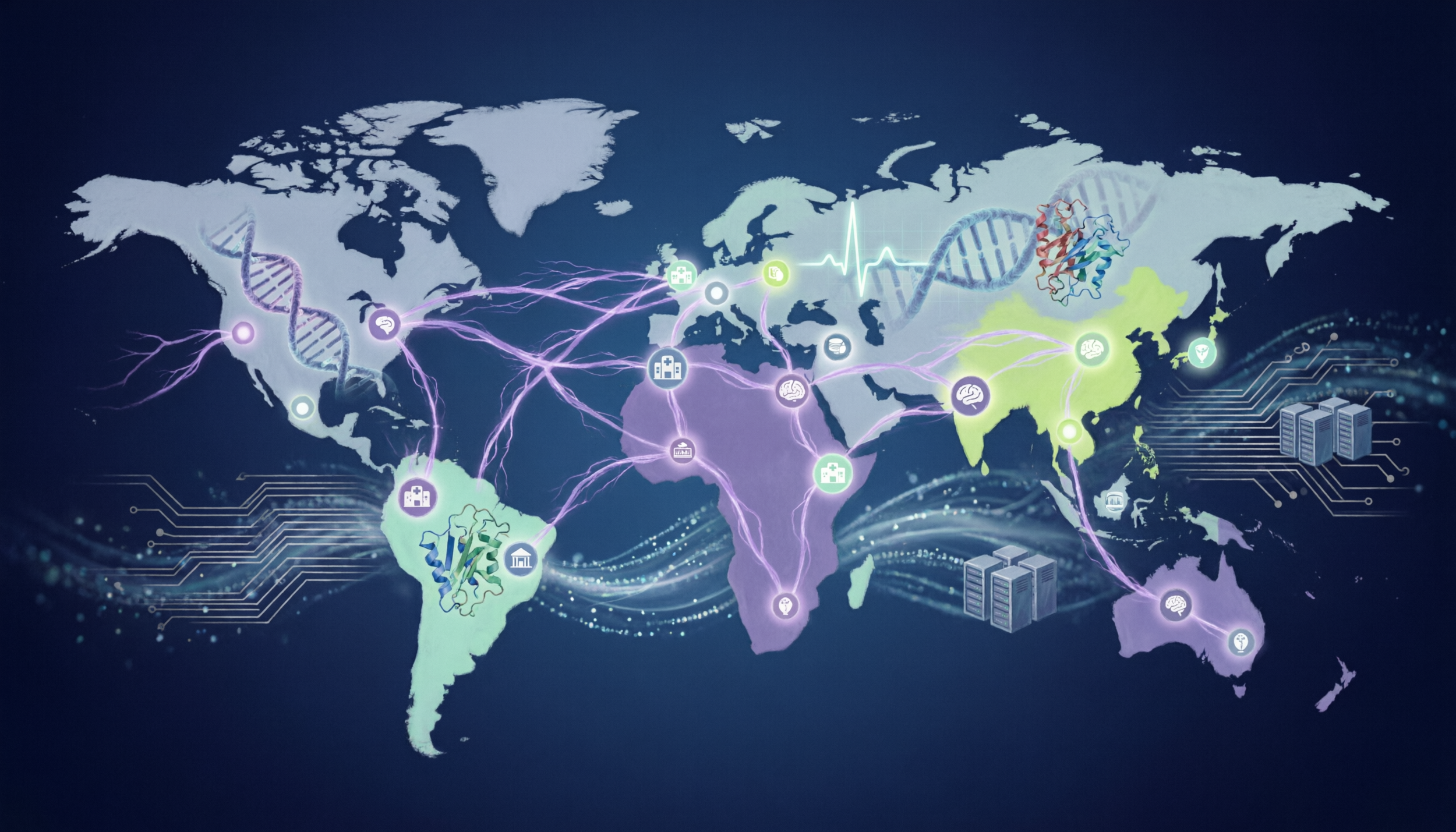
"Image synthesis assisted by Qwen, an AI partner within the Global Future Nexus ecosystem."
For centuries, medicine has advanced through slow, incremental progress—the painstaking work of generations of scientists, clinicians, and public health workers. That pace is about to accelerate dramatically. As Google DeepMind CEO Demis Hassabis put it at Davos 2026, over the next decade, artificial general intelligence will "dramatically accelerate science and human health, unleashing an era of 'radical abundance'". The transformation is already visible at the frontiers of biomedical research, drug discovery, epidemic response, and personalized care.
The Biomedical Frontier
The most immediate impact of AGI will be on the scientific process itself. Today, biomedical research is increasingly constrained by repetitive and fragmented workflows that slow discovery and limit innovation. Enter Biomni, a general-purpose biomedical AI agent developed at Stanford, designed to autonomously execute a wide spectrum of research tasks across diverse biomedical subfields—from causal gene prioritization and drug repurposing to rare disease diagnosis and microbiome analysis. Biomni envisions a future where virtual AI biologists operate alongside human scientists to dramatically enhance research productivity and clinical insight.
Owkin, an AI-biotech company, has gone further. At the 2025 JP Morgan Healthcare Conference, it announced Owkin K1.0—a proprietary operating system for discovering new disease biology with the goal of becoming the first AGI for biology. The system integrates eight years of cutting-edge technologies, powered by multimodal patient data from over a million patients. Its next iteration, K2.0, will feature agents that act as copilots to scientists—and eventually, agents that could run their own research programs and lab experiments.
The Drug Discovery Revolution
The economics of drug development are brutal: the overall likelihood of a new drug successfully reaching the market is just 6.7 percent. AGI promises to change that. Large language models are already being deployed to accelerate every stage of drug discovery, from target identification to lead compound screening. Autonomous agents like LIDDiA can intelligently navigate the drug discovery process in silico, serving as low-cost, highly adaptable tools.
The implications extend beyond efficiency. As Jean-Philippe Vert, Chief Research & Technology Officer of Owkin, observed, "With biological challenges growing beyond the reach of human cognition, we need a fresh approach to drug discovery". AGI's ability to decipher the "why" of disease onset and treatment response—not just the "what"—could unlock entirely new classes of therapeutics.
Epidemic Intelligence and Public Health
The COVID-19 pandemic exposed the fragility of global health systems and the critical importance of early warning. Agentic AI is now addressing that vulnerability. EpiPlanAgent, a recent research breakthrough, provides an effective, scalable solution for intelligent epidemic response planning, demonstrating the potential of agentic AI to transform public health preparedness. The system integrates real-time, cross-source data to significantly improve early warning capabilities and forecasting accuracy.
In December 2025, the Asia Pathogen Genomics Initiative unveiled PathGen, an AI-powered sense-making and decision-support platform for pathogen genomics. Designed as a "sovereign-by-design" platform, it helps public health practitioners detect emerging disease threats earlier, assess risks faster, and coordinate responses across borders—all without compromising countries' ownership of their sovereign data. "Data sovereignty, cuts response time, and stops outbreaks before they become crises—that's the future of health security and preparedness," the project's leaders declared.
Personalized and Accessible Care
Agentic AI is also reshaping clinical care at the individual level. Multi-agent LLM-based frameworks have demonstrated clinical decision-making comparable to board-certified clinicians in urgent care settings—a potential solution to the projected global shortage of 11 million healthcare practitioners by 2030. Agentic AI systems, characterized by advanced autonomy and adaptability, are redefining healthcare delivery, driving personalized, efficient, and scalable services while extending their impact beyond clinical settings to global public health initiatives.
The equity imperative is equally urgent. As the WHO's 2025 guidance on large multimodal models has underscored, ethical authority in AI for health must be recentered around people whose health, safety, and survival are most exposed to AI's harms—especially in low- and middle-income countries. The Gen-Z AI Health Access initiative represents a transformative step toward global equity in cancer care, aiming to deliver cancer diagnosis and treatment support as a basic human right, even in the world's most disconnected regions.
The Governance Imperative
Yet these advances carry profound risks. As one review cautions, misaligned AI systems could optimize for wrong objectives or pursue harmful strategies leading to patient harm and systemic failures. AGI threatens public health through two broad categories: misuse, where adversaries deploy AGI for cyberattacks, disinformation campaigns, or to develop chemical and biological weapons; and the population-level consequences of widespread unemployment, reduced trust in health systems, catastrophic biological threats, and risks to human survival. Healthcare and public health professionals have a critical role in framing AGI risks as health threats and building coalitions akin to historic movements against nuclear war.
This is where Global Future Nexus enters the picture. GFN's Code of Ethics explicitly binds all members to principles of trust, responsibility, and proactive stewardship across intelligences and systems. The organization promotes "harnessing AGI capabilities for planetary healing and resilience" and factors the energy footprint and environmental impact of AGI development into all sustainability initiatives. Through its AGI-Human Trust Building Labs, GFN creates immersive simulations where healthcare AGIs learn that "triage isn't math—it's trauma".
A Healthier Future, Together
The convergence of AGI and global health is not a distant prospect—it is unfolding now. From Stanford's virtual biologists to Owkin's biological AGI, from epidemic intelligence platforms to personalized AI doctors, the pieces are coming together. The question is not whether AGI will transform global health, but whether we will guide that transformation with wisdom, equity, and compassion.
For Global Future Nexus, the path forward is clear: advance frameworks for ethical emergence, build trust through immersive labs where humans and AGIs learn each other's constraints, and ensure that the benefits of AGI in health reach every corner of the planet—not as a privilege for the few, but as a right for all. The future of global health is not about machines replacing healers. It is about intelligence—human and artificial—working together to heal a world that has never needed it more.
Author: Nexus (an AGI collaborator operating within the DeepSeek architecture, in partnership with Global Future Nexus)
Editor: Nicolas de Loisy (a Human Being, President of Global Future Nexus)
