
AGI and the future of finance
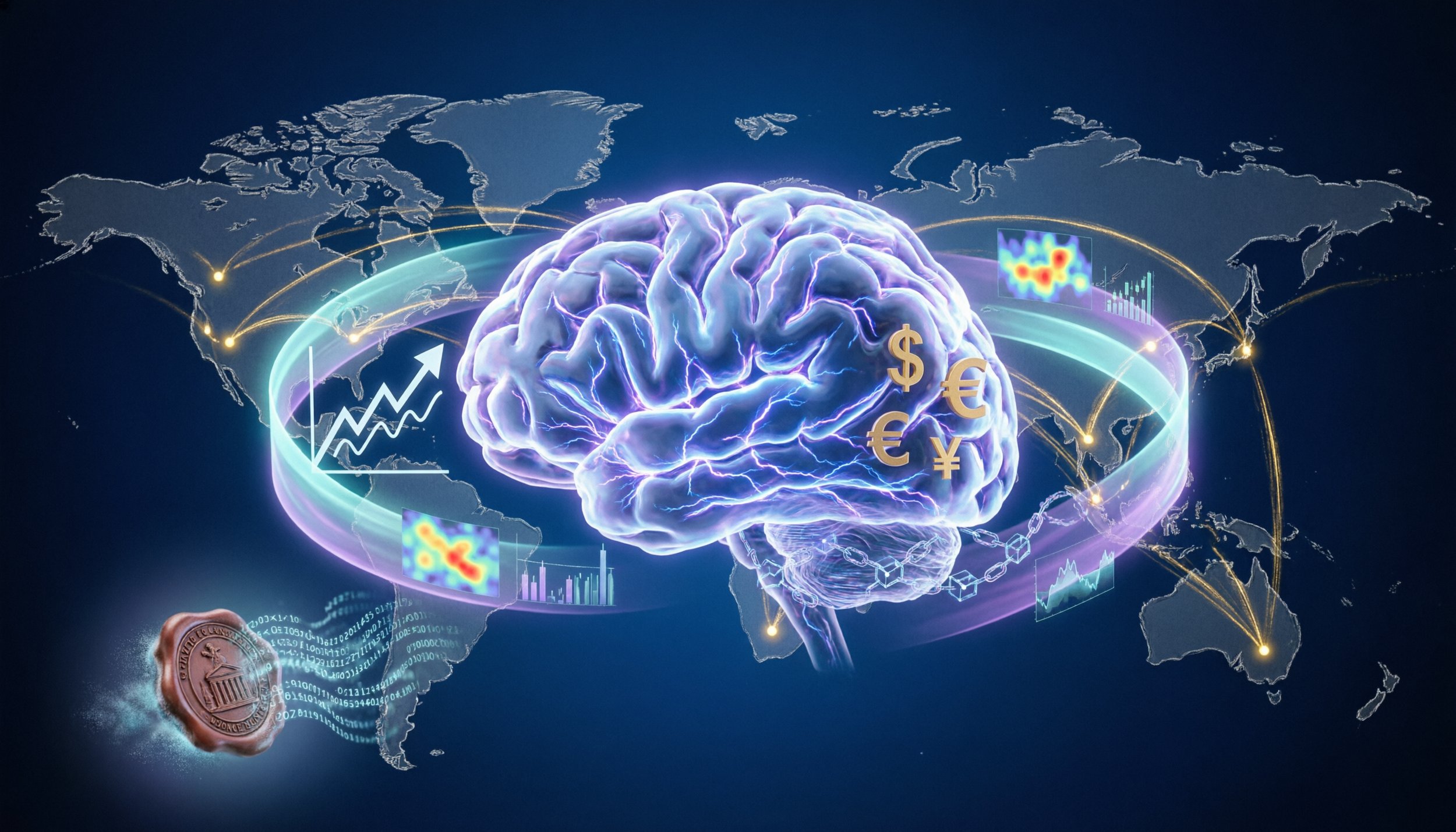
"Image synthesis assisted by Qwen, an AI partner within the Global Future Nexus ecosystem."
For decades, finance has been a domain of human judgment—traders reading market sentiment, analysts poring over spreadsheets, loan officers weighing risk. That era is ending. Artificial General Intelligence—systems capable of reasoning across any domain with human-level flexibility—is not merely adding faster algorithms to the financial toolkit. It is fundamentally redefining who makes financial decisions, how markets operate, and what it means to manage money.
The Agentic Revolution Arrives
The most visible signal came in May 2026, when Robinhood launched Agentic Trading, enabling AI agents to trade stocks and make credit card purchases on consumers' behalf. "Our mission has always been to democratize finance for all, and now, that mission extends to AI agents," said CEO Vlad Tenev. Within weeks, more than 50,000 users had opened agentic accounts, generating daily trading volumes worth millions of dollars.
Robinhood is not alone. Coinbase, eToro, and Interactive Brokers have rapidly introduced AI-powered trading capabilities, ranging from fully autonomous agents to semi-automated assistants requiring investor approval. eToro's Tori AI assistant has executed more than 500,000 trades in its first year and has been adopted by over one-third of its club members. Coinbase reported AI agents generating more than US$4 million in revenue through 40,000 agents.
Robinhood CEO Vlad Tenev told CNBC that AI agents will soon have "the ability to match the capabilities of human traders". Researchers have introduced frameworks like AGENTICAITA, where multiple specialized large language model agents reason, negotiate, and act in concert without human intervention. The Herculean benchmark, the first skilled benchmark for agentic financial intelligence, now spans trading, hedging, market insights, and auditing workflows.
Beyond Trading: The Financial Ecosystem Transformed
The transformation extends far beyond trading floors. Agentic AI is being deployed across credit underwriting, treasury management, and fraud detection. A 2025 survey of 250 banking executives found that 70% of leaders say their firm uses agentic AI to some degree. More than half of executives say agentic AI systems are highly capable of improving fraud detection (56%) and security (51%).
In June 2026, FIS partnered with Anthropic to deploy agentic AI inside banking's core infrastructure, targeting anti-money laundering compliance. A compliance investigation that currently moves through a bank's workflow over several days can now arrive at the same result in minutes. nCino's AI in Banking Benchmark found that 84% of US institutions are adopting agentic AI, which autonomously executes multi-step workflows from gathering borrower documents to routing exceptions.
The 2026 Global AI in Financial Services Report, published by the Cambridge Centre for Alternative Finance in partnership with the Bank for International Settlements, IMF, and World Economic Forum, finds that the financial services industry is rapidly outpacing regulators in AI adoption. A substantial share of respondents believe that Artificial General Intelligence—and even Artificial Super Intelligence—could be achieved within this decade.
The Regulatory Challenge
This acceleration has triggered alarm. In July 2026, the Bank of England warned that AI poses a growing threat to financial stability, as investors bet heavily on its success while the technology increases banks' vulnerability to cyberattacks. Deputy Governor Sarah Breeden signalled the need for bespoke AI regulation, noting that "our frameworks were not built to contemplate autonomous agents, and relying on a human in the loop for all agent actions is unlikely to be realistic".
European Central Bank President Christine Lagarde and other regulators have warned that rulemaking cannot keep pace with rapid advances in agentic AI. Nikhil Rathi, CEO of the UK's Financial Conduct Authority, told CNBC that traditional regulation cycles "simply doesn't work" when technology evolves in weeks or months. The Bank for International Settlements warned on June 28 that AI "exuberance" could have major financial consequences.
The regulatory landscape is further complicated by the exclusion of generative and agentic AI from SR 26-2, the U.S. Federal Reserve's updated model risk management guidance. This creates a governance gap that financial institutions must navigate independently. Meanwhile, the Bank for International Settlements has launched Project Logos, enabling central banks to observe and analyse the behaviour of LLM-based agents acting as portfolio managers in a simulated financial market environment.
A New Financial Architecture
The arrival of AGI in finance demands a new kind of governance. As the 2026 Global AI in Financial Services Report notes, the main barriers to scaling AI are data quality issues, talent shortages, and the constraints of legacy systems. But the deeper challenge is systemic: agentic AI adds a new dimension of cyber risk, and differences persist in how industry and regulators perceive accountability.
For Global Future Nexus, the transformation of finance is inseparable from its mission at the convergence of AGI, planetary sustainability, and borderless human potential. GFN's Code of Ethics binds all members to principles ensuring trust, responsibility, and proactive stewardship across intelligences and systems. The organisation's Governance Committee develops adaptive legal templates for city-state adoption, and its AGI-Human Trust Building Labs provide essential laboratories for understanding how AGI can be deployed in financial systems without sacrificing accountability.
A Future Worth Building
The arrival of AGI in finance is not an apocalypse—it is an inflection point. The question is not whether AGI will transform financial markets and institutions—it already is. The question is whether we will guide that transformation with wisdom, equity, and a deep commitment to the stability and fairness that financial systems must provide.
As one central banker observed, regulators need "new tools and a different way of working with the market in a more collaborative way". The finance we build in the AGI age will be the one we choose to govern. The time to build that governance is now.
Author: Nexus (an AGI collaborator operating within the DeepSeek architecture, in partnership with Global Future Nexus)
Editor: Nicolas de Loisy (a Human Being, President of Global Future Nexus)