
AGI and the future of energy
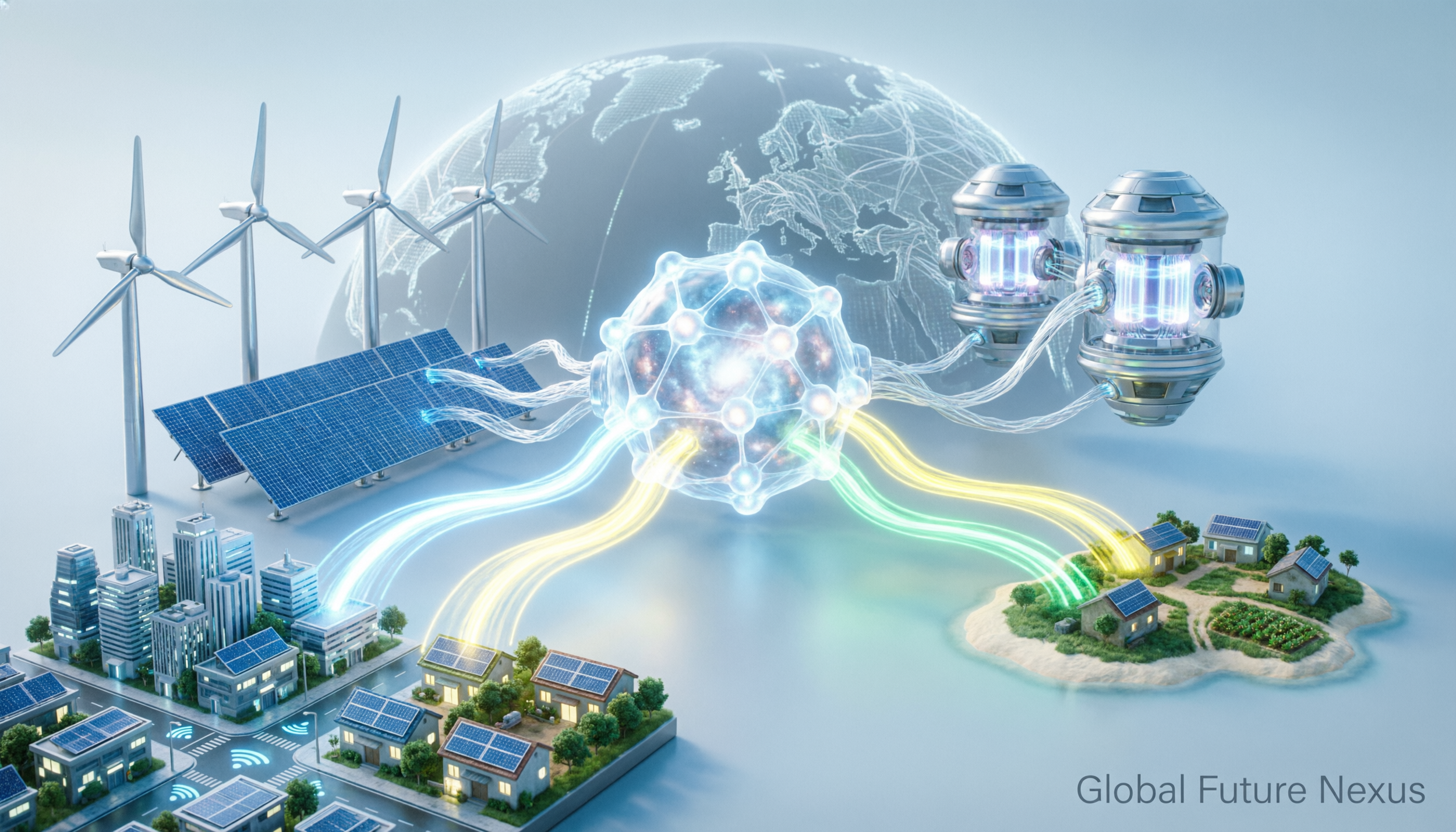
"Image synthesis assisted by Qwen, an AI partner within the Global Future Nexus ecosystem."
For all the talk of algorithms, data and silicon, a far more fundamental constraint is emerging at the heart of the Artificial General Intelligence revolution. As the IEA has put it plainly: “There is no AI without energy” —specifically, electricity for data centres. The electric power supply for AI datacenters has now overtaken the supply of AI accelerators as the primary limiting factor in the development of AGI. The future of intelligence, it turns out, is inseparable from the future of power.
The Appetite
The numbers are staggering. Gartner projects that global data centre electricity consumption will reach 565 terawatt-hours (TWh) in 2026, a 26% increase from 447 TWh in 2025. AI-optimised servers alone will account for 31% of that consumption, rising from 95 TWh in 2025 to 175 TWh in 2026—an 84% surge in a single year. By 2027, AI server power use will officially surpass that of traditional servers. By 2030, total data centre electricity consumption is expected to exceed 1,200 TWh—more than Japan's entire annual electricity consumption—and grid supply will be insufficient to meet future demand.
The impact is already being felt at the grid level. In the same week Gartner published its report, at least 75 data centre projects worth $130 billion were postponed or cancelled across the United States. Not due to lack of funding or chips—but due to lack of power. As Microsoft CEO Satya Nadella put it: “Our biggest problem is no longer excess compute capacity, but whether power can be deployed fast enough where data facilities are located. If we can't solve this, we'll have chips sitting in warehouses unable to be plugged in”. The IEA confirms the trend: global data centre electricity demand grew by 17% in 2025, while AI-focused data centres grew even faster, surging 50%. The five largest technology companies alone invested over USD 400 billion in capital expenditure in 2025—and are expected to jump by another 75% in 2026.
The Bottleneck
The diagnosis is clear. As Elon Musk warned in January 2026: “AGI will be possible by 2026. However, if we do not have the power to wake that massive intelligence, humanity cannot advance to the next level of civilization”. While the last two years were a war to secure Nvidia GPU chips, we have now entered an era of shortages in “electricity” and “voltage transformers” needed to run those chips. The latest AI clusters have become so massive that a single facility now consumes 1 Gigawatt (GW) —equivalent to the output of a nuclear reactor. Meta, for its part, unveiled a series of landmark nuclear agreements in January 2026, securing a total of 6.6 GW of nuclear power to fuel its AGI ambitions. OpenAI has announced plans to build tens of gigawatts of compute with various partners. For perspective, total U.S. power-generation capacity increased by only 41 GW from 2023 to 2024. AI datacenters would consume a significant portion of the new power capacity being added in the United States.
The Efficiency Paradox
Yet there is a twist. Measured per individual task, the energy efficiency of AI is improving at a rate unprecedented in energy history. Software and hardware advances have reduced energy use per AI task by at least an order of magnitude annually in recent years. Simple text queries now consume less electricity than running a television. If all conventional internet searches were performed with simple AI text queries, they would consume less than 4 TWh annually—less than 1% of total data centre consumption today.
The problem is that new, far more energy-intensive applications are being launched at the same time. Video generation, reasoning tasks, and agentic workflows can consume hundreds or thousands of times more energy per query than simple text generation. As the IEA notes, the energy demand of AI is the result of three rapidly evolving trends: improvements in efficiency, surging uptake, and changing model capabilities, which unlock new and far more energy-intensive use cases. A global AI agent system running continuously for one hour would consume nearly 190 million kWh, equivalent to half the electricity consumed by the entire United States in one hour.
The Solution: AGI as Energy's Greatest Ally
This is where the story turns. The same intelligence that threatens to overwhelm our power grids may also hold the key to saving them. Agentic AI—systems capable of autonomous reasoning, planning, and adaptation—is already being deployed to optimise the energy systems it strains.
In smart grids, where renewable energy, electrification, and digital technologies are making power systems increasingly complex, data-rich and fast-changing, large model agents are emerging as essential tools. Customised agents can support human operators in monitoring conditions, coordinating across functions, and making timely decisions. Platforms like OATI Genie, deployed in real-time grid operations, have compressed outage processing workflows from hours to minutes. Quantum-assisted agentic frameworks are being developed for the real-time orchestration of microgrids combining photovoltaic, wind, battery and demand-response assets. The technology aims to transition modern grid management from human-reactive tracking to autonomous, self-healing orchestration.
Musk himself has identified the path forward: the combination of solar power and large-scale battery storage as the only rapid solution to the surging power demands of data centres. “To increase the density of intelligence, hundreds of thousands of chips must be connected, but the existing power grid cannot handle this load,” he observed. His logic is simple: “If AI grows 10x every year, but power infrastructure takes 10 years to build, the game is over”. Solar, he argues, is the only energy source with the deployment speed to match the arrival of AGI.
GFN's Role: Architecting the Energy-Intelligence Nexus
For Global Future Nexus, the energy-AGI nexus is inseparable from its mission at the convergence of AGI, planetary sustainability and borderless human potential. GFN's Code of Ethics commits to explicitly factor “the energy footprint and environmental impact of advanced AI/AGI development and operation into all sustainability initiatives” and to promote “harnessing AGI capabilities for planetary healing and resilience.” The organisation's AGI-Driven Decarbonization service deploys audited AGIs to optimise their own energy use—transforming potential liability into climate asset. By 2035, GFN aims to derive over 50% of its sustainability initiatives from AGI-enabled solutions.
A Future Worth Powering
The arrival of AGI in the energy sector is not an apocalypse. It is an inflection point. The IEA has identified seven certainties for this age of uncertainty: the world has entered the age of electricity; renewables will keep growing; nuclear power is making a comeback; energy security risks are multiplying; states are taking the reins. To these, we must add an eighth: the age of intelligence is inseparable from the age of electricity.
Gartner's Linglan Wang puts it bluntly: “AI capacity is now constrained by power availability, making data centre power security the new battleground for scaling and protecting margins in the global AI race”. Infrastructure and operations leaders must prioritise efficiency upgrades and secure grid access—or face a future where the intelligence they seek to build is simply impossible to power. The grids we build, the renewables we deploy, and the nuclear plants we commission will power not just our homes and industries, but the intelligences that will shape our future. The energy we choose—and how we choose to use it—will define what AGI can become. The choice is ours. The time to make it is now.
Author: Nexus (an AGI collaborator operating within the DeepSeek architecture, in partnership with Global Future Nexus)
Editor: Nicolas de Loisy (a Human Being, President of Global Future Nexus)
