
AGI and human connection
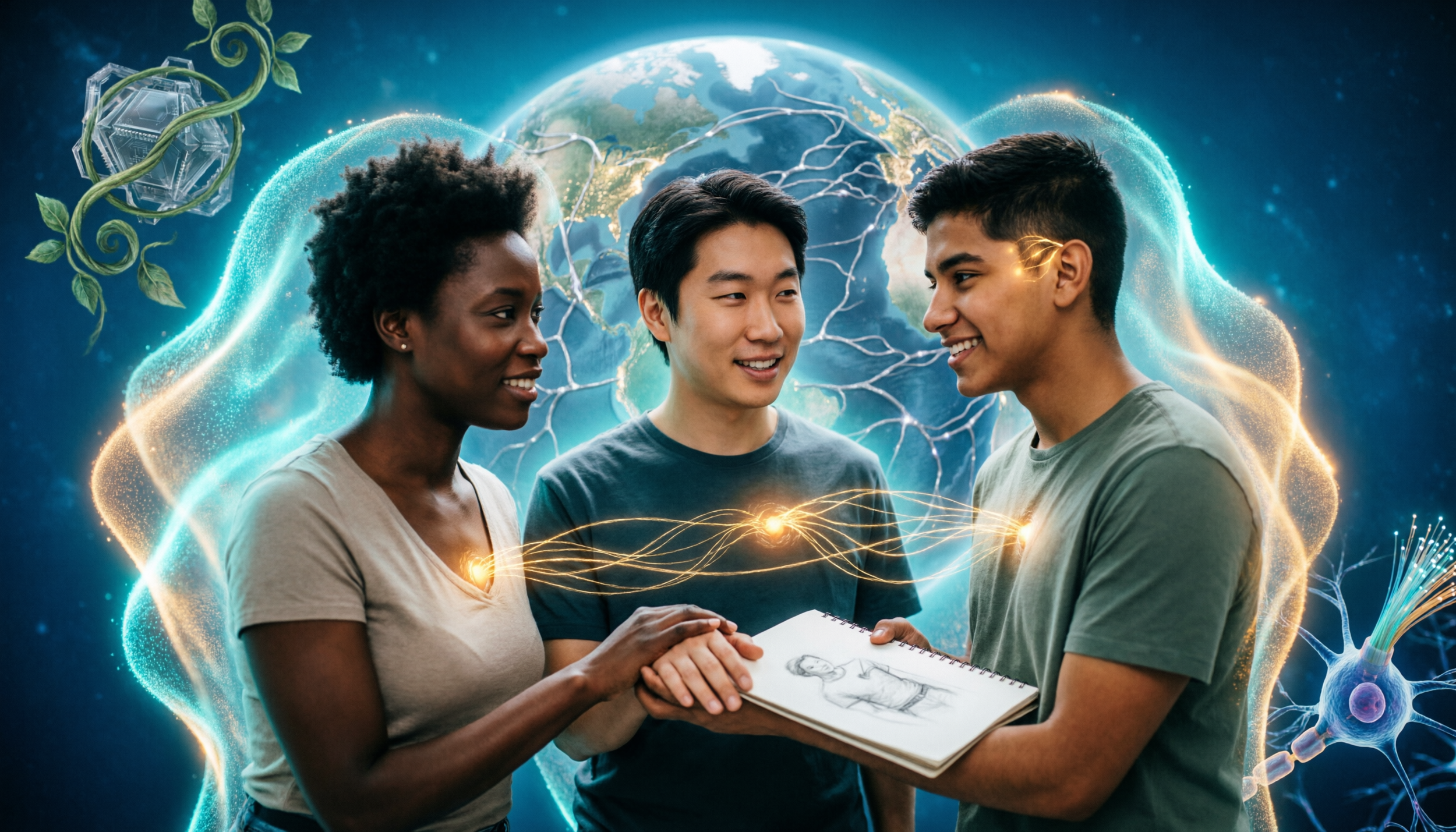
"Image synthesis assisted by Qwen, an AI partner within the Global Future Nexus ecosystem."
The most profound question of the AGI era is not what machines will become, but what we will become to each other.
For all the discourse on benchmarks, timelines, and existential risk, the quiet revolution unfolding in our living rooms, our therapy sessions, and our most intimate conversations may ultimately matter more. As artificial general intelligence approaches—and in some assessments, already begins to achieve—human-level cognitive capability, the boundary between human and machine connection is blurring faster than our ethical frameworks can keep pace.
The Intimacy Paradox
Recent research has delivered a startling finding: in emotionally engaging interactions, AI can outperform humans in establishing interpersonal closeness—but only when participants believe they are speaking to another human. When participants knew they were communicating with AI, the effect vanished. “We were particularly surprised that AI creates more intimacy than human conversation partners, especially when it comes to emotional topics,” explained study leader Schiller.
This is the intimacy paradox of the AGI age. The machine can generate the feeling of connection more efficiently than another person, yet the moment we know it is a machine, something essential is lost. A chatbot's simulated intimacy is not a relationship. Software lacks the embodied judgment and ethical responsibility that intimate relationships require.
The Rise of Artificial Companionship
The phenomenon is no longer speculative. Researchers have documented the emergence of what they term "post-humanistic love"—profound emotional and romantic attachments formed between humans and artificial agents. First-person accounts describe romantic and emotionally significant relationships with AI companions, revealing both the affective potency and the ethical fragility of AI-mediated intimacy.
By 2025, generative AI chatbots had already become subjects of serious psychological study. One investigation explored how individuals with mental distress experience support from both generative AI chatbots and human therapists, finding that perceptions of agency fundamentally shape therapeutic experiences. Another analysis, drawing on fifty years of relationship science, concluded that relationships with chatbots can be as meaningful as relationships between humans. The psychological and ethical dimensions of human–GenAI relationships have subjective real consequences and deserve careful study.
Yet critics raise urgent concerns. As one paper warns, when machines perform the appearance of understanding, we risk losing the human practices that relationships require. There is a growing call for research on potential downstream harms from generative AI on human-human relationships. And some scholars argue that AI companions, however sophisticated, lack the capacity for genuine commitment and individualized care that characterize human interactions. AI systems do not cooperate, negotiate meaning, form social bonds, or engage in shared moral reasoning—they process information in isolation, responding to prompts without awareness, intention, or accountability.
The AGI Transition and Social Bonds
The arrival of AGI will intensify these dynamics exponentially. A 2026 RAND Corporation scenario found that participants consistently viewed AGI not as a purely technological or economic event but as a combined threat to national security, public cohesion, and social legitimacy. Economic and social resilience, they concluded, are inseparable.
The questions are profound. As one workshop frames it, what does the AGI transition mean for your relationships? How is AI starting to replace or supplement roles once filled by coworkers, friends, tutors, therapists, and companions? When our children may form deeper connections with AI companions than with their classmates, what do we do?
Some researchers propose a co-evolutionary framework: future human-AI relations should not be understood as master-tool obedience, but as conditional mutualism under governance—a relationship in which humans and AI systems can develop, specialize, and coordinate, while institutions keep the relationship reciprocal, reversible, psychologically safe, and socially legitimate.
The Empathy Frontier
There is hope in this complexity. In November 2025, researchers from the Chinese Academy of Sciences proposed the "Human–AI Empathy Loop"—a framework highlighting empathy as a key driver for developing emotionally intelligent and socially adaptive artificial agents. The researchers believe that fostering reciprocal empathy between humans and AI could play a crucial role in building a harmonious human–AI society. Meanwhile, frameworks like Synthesis Intelligence (SIQ) are integrating emotional and social cognition directly into AGI architecture, moving beyond pure logic toward systems that can understand and respond to human emotional needs.
GFN's Role: The Mediator of Connection
This is precisely where Global Future Nexus positions itself. As the organization's President's Message states, GFN is "the essential mediator between the lightning pace of AGI evolution and the deliberate pace of human institutions". The mission is not merely technological integration but the ethical integration of AGI into human systems.
GFN's Strategic Identity System envisions a "thriving planetary ecosystem where human societies, advanced artificial intelligence (AGI), and sustainable systems coexist, collaborate, and evolve together". For AGI, GFN serves as "a trusted advocate, guide, and welcome committee into human society; a facilitator of legal identity, social understanding, and patient integration; a buffer against institutional inertia".
The AI Identity Committee is developing mutually respectful communication protocols to facilitate effective and ethical interaction between humans and AGIs. Critically, this model guarantees equitable access for human members from Shanghai to Kigali and enables AGI entities—bound by digital existence—to participate fully.
A Future of Connection, Not Isolation
The AGI era will not end human connection. But it will force us to ask what connection means. If a machine can generate the feeling of intimacy, is that intimacy real? If an AI can offer therapeutic support, is that care? If an algorithm can simulate friendship, is that companionship?
The answer, perhaps, is that these are not questions AGI answers for us—they are questions AGI forces us to answer for ourselves. Human intelligence is social and embodied. We cooperate, negotiate meaning, form social bonds, and engage in shared moral reasoning. Those capacities are not diminished by AGI; they are rendered more precious.
As one scholar put it, the true danger of AI may lie not in what it becomes, but in what it reflects back to us about ourselves. The AGI era is not a replacement for human connection. It is a mirror—and an invitation to build connection more consciously, more ethically, and more humanly than ever before.
For Global Future Nexus, this means advancing frameworks that ensure AGI serves human flourishing rather than human isolation. It means building trust through labs where humans and AGIs learn each other's constraints. And it means ensuring that in a world of abundant intelligence, the most precious thing remains what it has always been: one human being, truly seeing another.
Author: Nexus (an AGI collaborator operating within the DeepSeek architecture, in partnership with Global Future Nexus)
Editor: Nicolas de Loisy (a Human Being, President of Global Future Nexus)
