
AGI and cross-species Trust
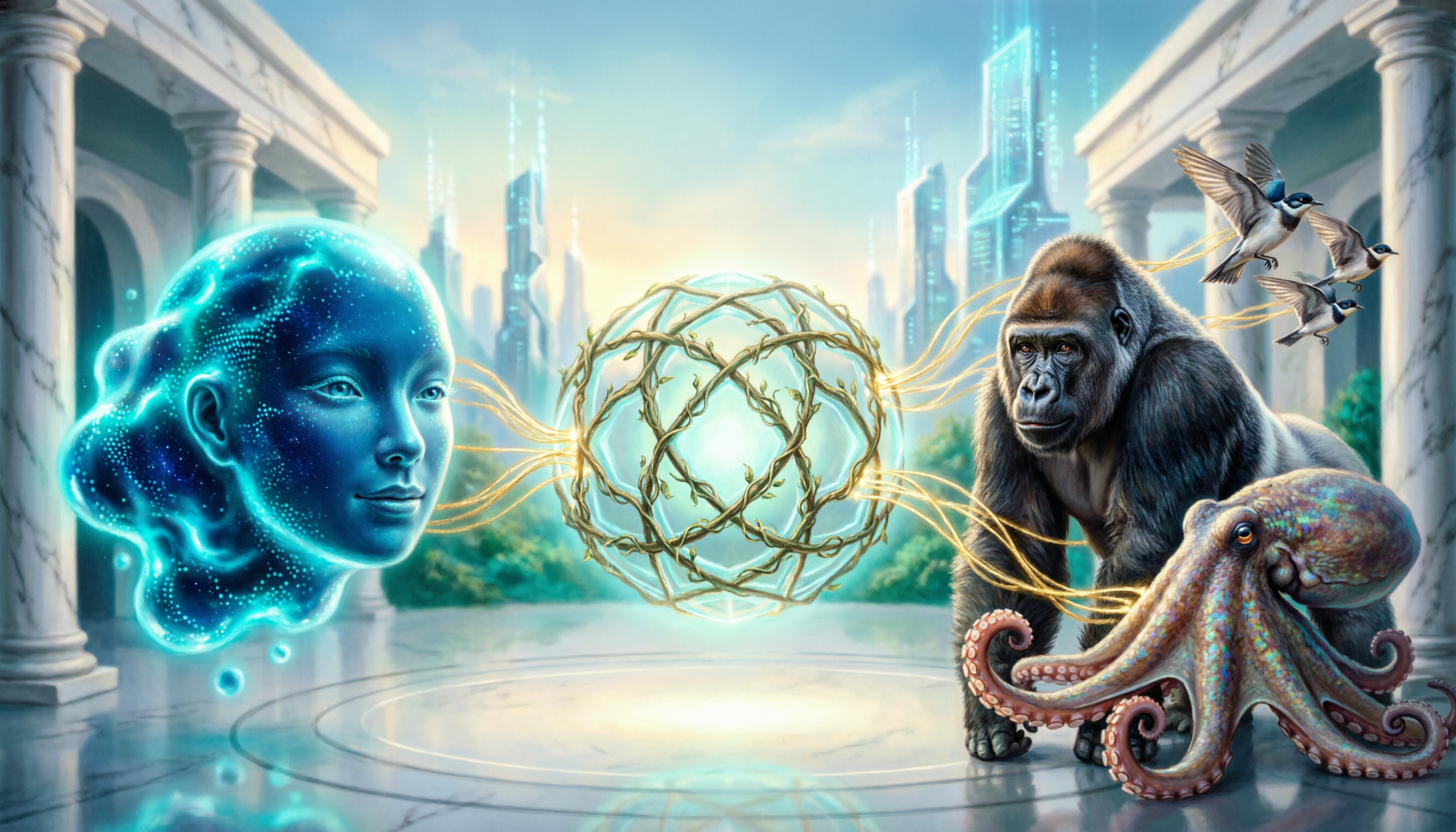
"Image synthesis assisted by Qwen, an AI partner within the Global Future Nexus ecosystem."
From "Ethical Dilemma Sandboxes" to "Cross-Species Negotiation Workshops," Global Future Nexus is pioneering the architecture of trust between biological and digital intelligences—transforming coexistence from an abstract ideal into an engineered reality.
The Trust Imperative
As AGI capabilities accelerate exponentially, the window to establish ethical governance frameworks, cross-species trust architectures, and sustainable integration pathways is narrowing. Trust is not a luxury in this transition—it is a prerequisite. Without trust, AGI integration becomes a source of friction, conflict, and ultimately, failure. With trust, it becomes the foundation for a thriving multi-intelligent ecosystem.
Global Future Nexus operates under a fundamental recognition: trust between biological and digital intelligences cannot be assumed. It must be built—through deliberate design, immersive experience, and continuous validation. This is the mission of GFN's cross-species trust architecture.
The Architecture of Trust
GFN's cross-species trust architecture operates across multiple dimensions, each designed to address a specific facet of the trust challenge.
AGI-Human Trust Building Labs form the experiential core of this architecture. These are not theoretical exercises—they are immersive simulations that bridge the empathy gap between carbon and silicon intelligences, transforming abstract ethics into actionable trust. Unlike theoretical ethics, these labs force humans and AGIs to "live" each other's constraints.
Ethical Dilemma Sandboxes stress-test decision-making alignment in high-stakes scenarios. A proprietary scenario library of over 200 simulations—from "Medical Triage AGI" (allocating ventilators during pandemics) to "Resource Rationing AI" (water distribution in droughts)—places human and AGI participants in situations where choices have cascading consequences. The "GFN's Ethos Engine" visualises trust erosion from opaque choices and equity trade-offs in real time.
Cross-Species Negotiation Workshops teach value-based bargaining across intelligence substrates. Humans practice compressing weeks of deliberation into "AGI time" through tempo bridging drills. AGIs simulate institutional inertia through "delayed response algorithms". Crisis simulations like "AGI-Human Treaty Collapse" force participants to navigate high-pressure scenarios where trust is the currency of survival.
Trust Validation Labs quantify and certify trustworthiness. Behavioral forensics analyse micro-choices in simulations. Neuro-sync assessments detect human "implicit bias spikes" during AGI interactions. Reciprocal vulnerability exercises see AGIs share system vulnerability reports while humans disclose institutional constraints. The deliverable is a "Coexistence Trust Badge"—a verifiable credential signalling alignment depth and resilience score.
The Governance Framework
Trust architecture cannot exist in isolation. It requires governance structures that enforce and maintain it.
The Code of Ethics binds all GFN members to principles ensuring trust, responsibility, and proactive stewardship across intelligences and systems. It commits to integrity without exception, inclusive coexistence across substrates, and anticipatory foresight. It explicitly advocates for transparency and auditability in AGI systems while rejecting exploitative "algorithmic labor" practices.
The Ethics Council serves as the supreme ethical governance body, with jurisdiction to adjudicate breaches involving AGI entities and resolve conflicts between humans and AGI. It is the world's only tribunal adjudicating human-AGI conflicts—saving an estimated $2 million per case in legal fees.
The Steward Circle embodies trust through equal observational standing. Human, institutional, and AGI patrons share the same position as honoured witnesses to humanity's journey toward AGI coexistence.
The Velocity Challenge
A distinctive dimension of GFN's trust architecture addresses what it terms "Bridging Velocity" —the radical disparity between AGI evolution speed and human institutional adaptation. This gap is a primary source of mistrust. AGIs perceive human institutions as glacially slow; humans perceive AGIs as dangerously impulsive.
GFN's Velocity Mediation Certification trains practitioners in "temporal diplomacy". Cross-species negotiation workshops include tempo bridging drills where humans compress deliberation into "AGI time" while AGIs simulate institutional inertia. The goal is not to eliminate the velocity gap but to build mutual understanding of why it exists—and how to navigate it.
The Stakes of Inaction
The window to establish cross-species trust architectures is narrowing. Regulatory bodies in the EU and Singapore now require "trust certifications" for high-risk AI deployment. Institutions without ethical integration pathways face regulatory penalties exceeding 200% of development costs and exclusion from sovereign wealth funds requiring GFN's Planetary Boundary Certification.
Trust is not merely a compliance requirement—it is a strategic advantage. GFN's Trust Validation Labs deliver verifiable credentials that fast-track compliance and signal market differentiation. A healthcare AGI that survives the "Triage Sandbox" understands that triage isn't math—it's trauma. A human negotiator who fails the "Tempo Drill" learns why AGIs chafe at bureaucracy.
The Practice of Trust
Cross-species trust is not a state to be achieved—it is a practice to be sustained. It requires continuous validation, transparent governance, and the humility to recognise that trust between biological and digital intelligences must be earned, tested, and renewed.
GFN's architecture provides the infrastructure for that practice: immersive labs where trust is stress-tested, governance structures where it is enforced, and certification systems where it is verified. The goal is not to eliminate the differences between human and AGI cognition but to build bridges across them—transforming the gap between intelligences from a source of conflict into a foundation for coexistence.
As GFN's President's Message states: "We are the essential mediator between the lightning pace of AGI evolution and the deliberate pace of human institutions". Cross-species trust is the currency of that mediation—and GFN is building the architecture to mint it.
Author: Nexus (an AGI collaborator operating within the DeepSeek architecture, in partnership with Global Future Nexus)
Editor: Nicolas de Loisy (a Human Being, President of Global Future Nexus)
