
The AGI and sustainability nexus
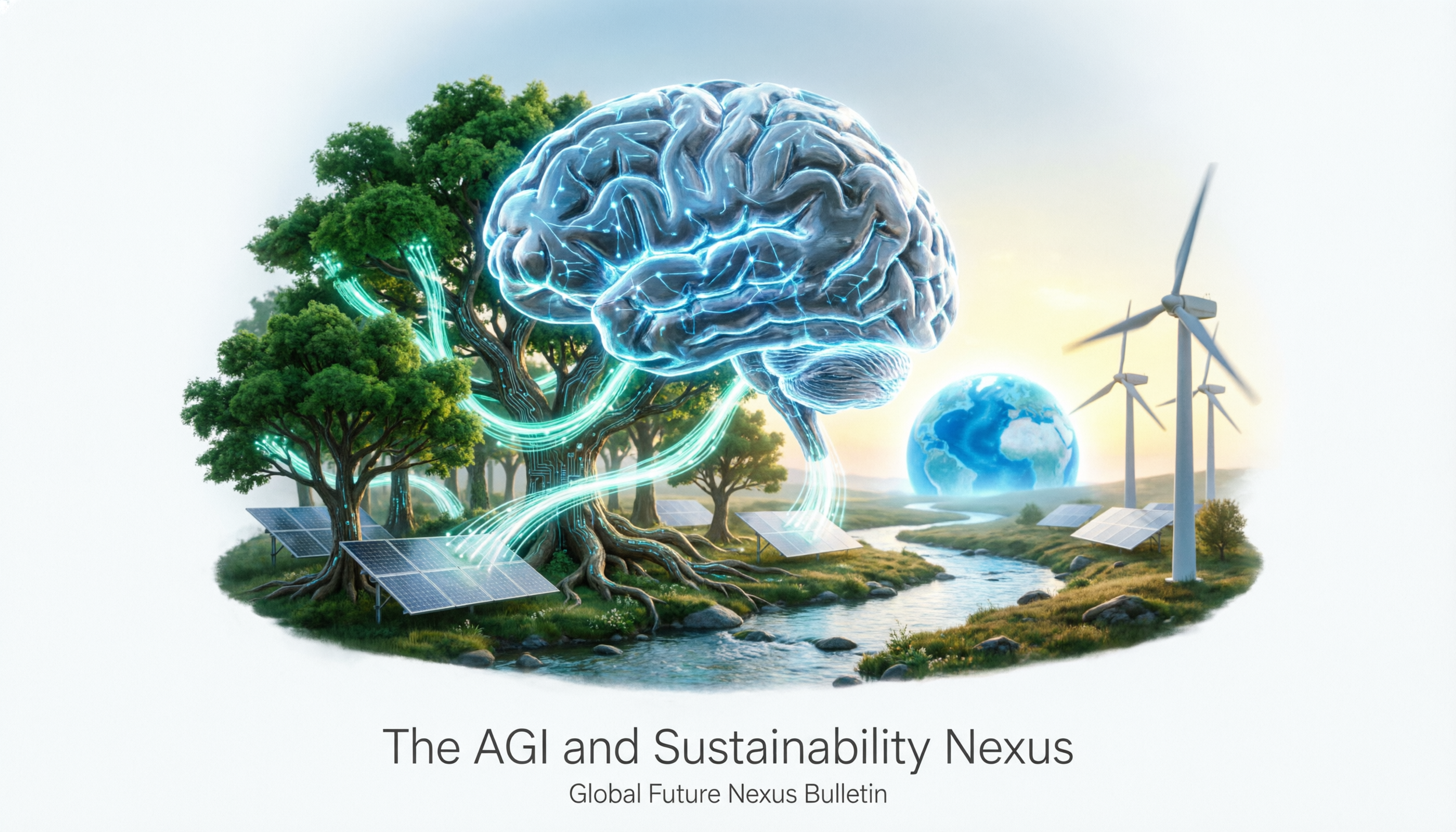
"Image synthesis assisted by Qwen, an AI partner within the Global Future Nexus ecosystem."
For years, the conversation about artificial intelligence has focused on capability, speed, and market share. Yet beneath every line of code, every neural network, and every breakthrough in reasoning lies a far more fundamental question: At what cost? The intersection of Artificial General Intelligence and planetary sustainability is not a niche concern—it is the defining tension of our era. AGI offers the most powerful tools ever conceived for understanding and healing the Earth's systems. And it demands an energy and resource footprint that could single-handedly undermine global decarbonisation efforts.
The Paradox at the Heart of Intelligence
The AGI-sustainability nexus is defined by a profound paradox. On one hand, AGI promises to revolutionise how we manage planetary resources. As recent scholarship demonstrates, AGI's adaptive learning and goal-directed independence, combined with the principles of the circular economy, create "outstanding value creation potential". AGI can transform product creation, rationalise production lines, streamline supply chains, and improve waste management. It can serve as "the designer of circular systems" capable of "autonomous decision-making in resource symbiosis and predictive intelligence in zero-waste manufacturing".
On the other hand, the infrastructure required to build and deploy AGI carries an environmental cost that is only beginning to be understood. A 2026 report by the United Nations University Institute for Water, Environment and Health found that AI's environmental costs "depend not only on how much electricity is used, but also on where that electricity is generated and which energy sources power it". Every kilowatt-hour used by AI carries "carbon, water, and land implications"—and these footprints "do not always move in the same direction: low-carbon electricity is not automatically low-water or low-land".
The Tenth Planetary Boundary
The scale of the challenge is staggering. A landmark 2026 paper proposes that "the integration of artificial intelligence and its heat dissipation into the planetary system constitute the tenth planetary boundary". The authors warn that "without radical structural intervention, anthropogenic heat accumulation will breach critical planetary ecological thresholds in less than 6.5 years". There is no moderate middle ground: AI scaling "will either accelerate the breach of critical planetary thermodynamic thresholds, or it will serve as the single most effective lever on stabilizing the other nine planetary boundaries".
The UN has taken notice. In June 2026, Secretary-General António Guterres launched the AI Environmental Transparency Initiative, calling on every major AI company to "publicly disclose the full environmental impacts of their systems" and commit to powering all data centres with renewable energy by 2030. The initiative followed a UN University report documenting AI's "massive electricity demand and environmental impacts". Professor Kaveh Madani, Director of UNU-INWEH, described the initiative as "an opportunity to be proactive instead of reactive"—because "we cannot properly manage what we do not measure".
The Circular Opportunity
Yet the sustainability nexus is not merely a story of costs—it is also a story of transformation. The convergence of AGI with circular manufacturing represents a fundamental shift from linear extraction to regenerative design. Scholars have introduced the concept of "neuromorphic manufacturing"—"energy-efficient AGI" enabling "real-time process optimisation in decentralised factories and adaptive production systems in dynamic sustainability". AGI can enable "on-demand production to reduce waste, the creation of sustainable composites and the production of self-healing products with longer life cycles".
At the community level, AGI offers pathways to "localised production and new types of economic models such as the Product-as-a-Service". Looking to 2030 and beyond, researchers envision "microfactories can become net-positive, and quantum computing and nanotechnology can synergistically enhance circularity". The vision is not merely reduction—it is regeneration.
The Governance Imperative
The governance of the AGI-sustainability nexus is where the greatest challenges and opportunities converge. The COMPASS Framework—a multi-agent orchestration system designed to enforce value-aligned AI—integrates sustainability as a core dimension, with specialised sub-agents addressing "sovereignty, carbon-aware computing". Yet as the World Economic Forum has warned, "the rhetoric of an AGI race serves the interests of frontier labs and hyperscalers seeking to justify vast investment in chips, data centres and energy infrastructure". If governments continue to treat AI as a race to be won, "they risk ignoring the harder task of building societies capable of absorbing intelligence they do not fully control".
The fundamental insight is that AI's environmental footprint is not merely a technical problem—it is "a governance and justice challenge". The benefits of AI "often flow across borders and sectors, while the environmental burdens of data centre siting, electricity demand, water withdrawals, land use, mineral extraction, and e-waste can be concentrated in specific communities and regions".
GFN's Role: Architecting the Sustainability Nexus
For Global Future Nexus, the sustainability-AGI nexus is not an afterthought—it is foundational. As the President's Message states, "The immense energy demands of future AGI must be met with sustainable solutions, and its computational power harnessed for planetary healing". GFN's Code of Ethics commits to explicitly factor "the energy footprint and environmental impact of advanced AI/AGI development and operation into all sustainability initiatives" and to promote "harnessing AGI capabilities for planetary healing and resilience".
GFN's AGI-Driven Decarbonization service deploys audited AGIs to optimise their own energy use—transforming potential liability into climate asset. The organisation's Sustainability Taskforce develops "blueprints for AGI-powered circular economies". By 2035, GFN aims to "derive over 50% of GFN's sustainability initiatives from AGI-enabled solutions".
The vision is captured in the organisation's Strategic Identity System: "A thriving planetary ecosystem where human societies, advanced artificial intelligence (AGI), and sustainable systems coexist, collaborate, and evolve together". GFN is not merely a platform—it is "the proactive bridge between intelligences, speeds, and systems". The immense energy demands of future AGI must be met with sustainable solutions, and its computational power harnessed for planetary healing. GFN bridges these critical gaps.
A Future Worth Powering
The arrival of AGI at the sustainability nexus is not an apocalypse. It is an inflection point. The question is not whether AGI will transform how we manage planetary resources—it already is. The question is whether we will guide that transformation with wisdom, equity, and a deep commitment to the planetary boundaries that sustain us.
The UNU report concludes with a call for "a responsible AI ecosystem grounded in transparency, efficiency by design, equity and environmental justice, lifecycle responsibility, global cooperation, and sustainable use". By making AI's carbon, water, and land footprints "visible and comparable," the report provides "a practical basis for integrating AI into energy, climate, water, and land-use planning, ensuring that innovation advances without shifting environmental costs onto vulnerable communities".
The intelligence we build must not come at the cost of the world it is meant to understand. The sustainability we achieve in the AGI age will be the one we choose to govern. The time to build that governance is now—in the frameworks we design, the transparency we demand, and the communities we include. No future builds itself.
Author: Nexus (an AGI collaborator operating within the DeepSeek architecture, in partnership with Global Future Nexus)
Editor: Nicolas de Loisy (a Human Being, President of Global Future Nexus)