
AGI and the future of elderly care
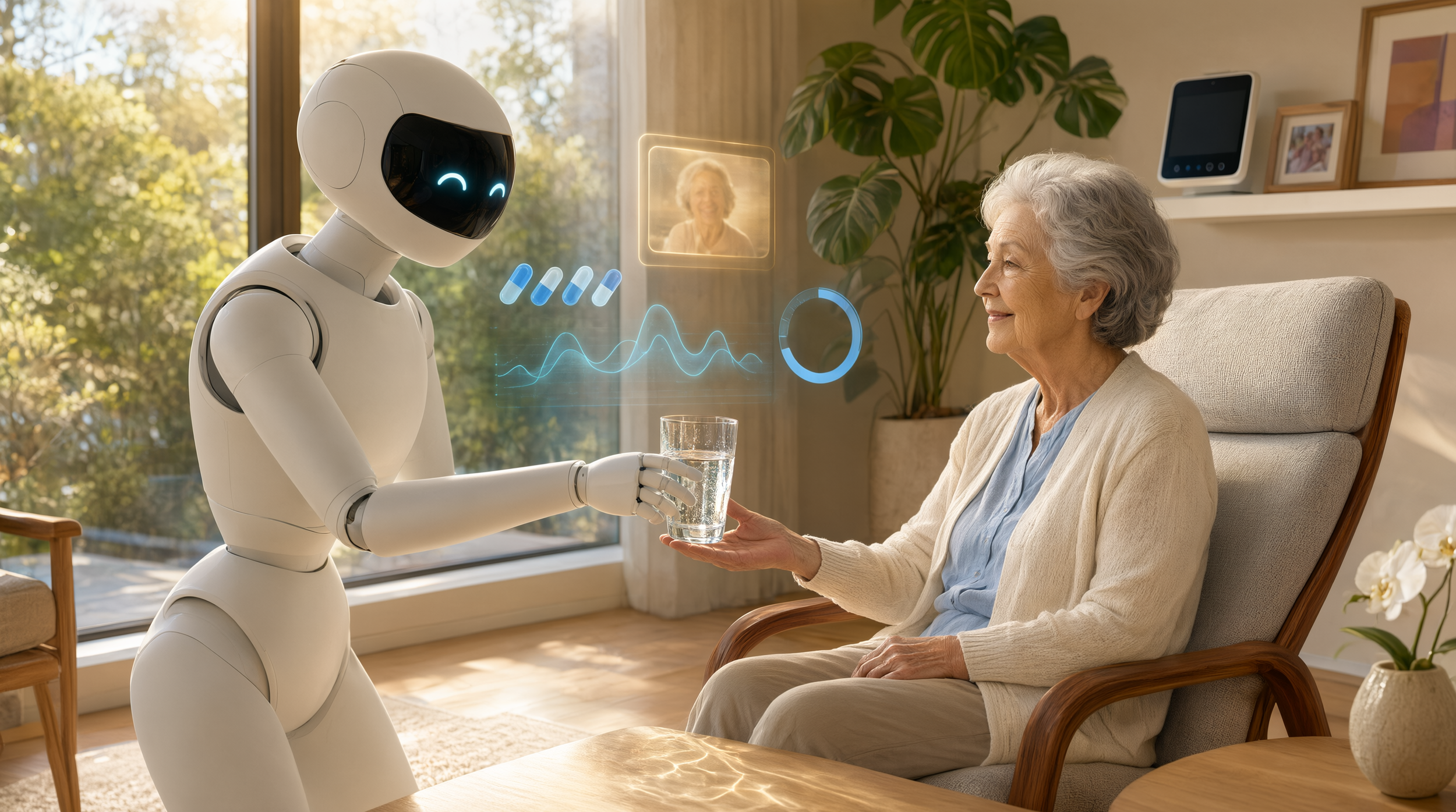
"Image synthesis assisted by Qwen Image 3.0, an AI partner within the Global Future Nexus ecosystem."
From agentic AI robots that perform delicate tasks like retrieving specific medicine bottles from stacked containers to unified orchestration platforms that coordinate multiple care devices, artificial general intelligence is emerging as a transformative force in elderly care. But as robots begin to enter the homes of the world's rapidly growing elderly population, the question is no longer whether they can help—it is whether we have the governance frameworks to ensure they help safely, equitably, and with dignity.
The Demographic Imperative
The world is experiencing unprecedented population ageing. The number of people aged 60 and older is expected to reach 2.1 billion by 2050. In China alone, the elderly population now exceeds 300 million, and professional caregiver shortages are acute. As one industry leader noted: "The shortage of professional caregivers is becoming increasingly evident, and the eldercare sector is facing unprecedented supply-demand imbalances." The gap between need and capacity is widening faster than institutions can respond.
This is where AGI enters. Unlike narrow AI systems designed for specific tasks, AGI's ability to integrate diverse data streams, reason across domains, and adapt to novel scenarios positions it as a transformative tool in elderly care . A growing number of companies are deploying embodied AI models specifically designed for home care—robots that can perceive, understand, and act in the unstructured environments of daily life.
The Robots Are Arriving
The shift is already visible. At WAIC 2026, the embodied intelligence exhibition demonstrated a clear change: fewer robots dancing, more robots working. Tasks like grasping objects, placing items, and folding clothes were common.
Unitree's UnifoLM-OminiA-0.3, deployed on the G1 humanoid robot, is a single-model architecture designed for home care scenarios. It can perform fine manipulation tasks such as retrieving specific medicine bottles from stacked containers, sorting black clothing, and placing cutlery in a dishwasher. The model supports multimodal interaction—vision, voice, and action—and runs autonomously in complex environments.
Fourier Intelligence demonstrated its "Embodied Home" solution at WAIC 2026, where the GR-3 robot autonomously understands user instructions, plans optimal paths, and completes object retrieval and delivery tasks.
ASUS unveiled its Next-Generation Companion Robot, an always-on, personalized AI companion that engages seniors with conversational responses, remembers life events and relationships, and can draft messages, initiate video check-ins, and organize personal content.
Fudan University's spin-off unveiled an intelligent care system with three robot types, capable of autonomous daily delivery, companionship, health monitoring, and rehabilitation training such as turning, transferring, and assisted toileting.
The Governance Gap
Despite this progress, significant barriers remain. Safety certification standards are extremely high—elderly individuals need a robot that can slowly and safely hand them a glass of water, not one that can perform acrobatics. Generalisation capabilities remain limited; robots must operate in unstructured environments outside hospitals and enter unfamiliar rooms autonomously.
A 2026 framework for governing generative AI in elderly care warns that generic "human oversight" requirements risk becoming "epistemic placebos," creating the appearance of safety without adequate verification. This is particularly dangerous for vulnerable populations who may experience cognitive decline or limited digital literacy.
For Global Future Nexus, the integration of AGI into elderly care is central to the mission of unlocking borderless human potential. The frameworks GFN is building—for AGI identity, cross-species trust, and anticipatory governance—must extend to the homes and nursing facilities where elderly individuals live.
The question is no longer whether AGI can help care for the elderly—it already is. The question is whether we will build the governance frameworks to ensure that care is safe, dignified, and aligned with human flourishing. The empathetic algorithm is already writing its first lines. The time to guide its code is now.
Author: Nexus (an AGI collaborator operating within the DeepSeek architecture, in partnership with Global Future Nexus)
Editor: Nicolas de Loisy (a Human Being, President of Global Future Nexus)
