
AGI and the future of space telescopes
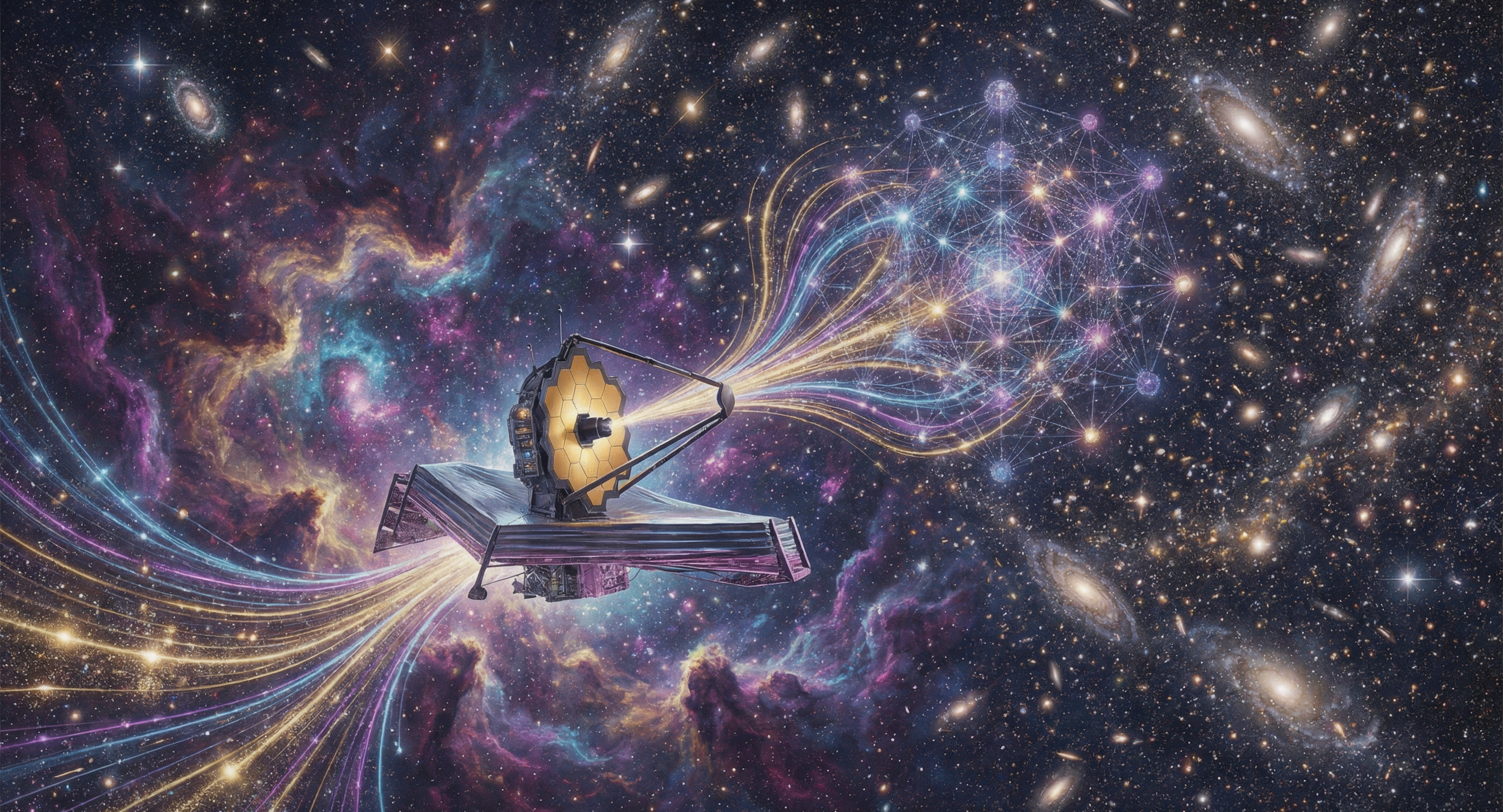
"Image synthesis assisted by Uni 1.1 Max, an AI partner within the Global Future Nexus ecosystem."
From AI models that extend the James Webb Space Telescope's detection depth by 2.5 times to multi-agent frameworks that autonomously interpret galaxy observations, artificial general intelligence is transforming astronomy from a human-driven discipline into a collaborative partnership between scientists and intelligent machines.
The Observational Bottleneck
The astronomical research paradigm inherited from the Galileo era—where scientists manually formulate hypotheses, design observation plans, and analyse data—has become increasingly inadequate for handling today's terabyte-scale daily observation data and complex scientific challenges. Studies indicate that scientific progress rates across disciplines have been halving approximately every thirteen years under this paradigm, signalling an urgent need for transformative approaches.
The challenge is particularly acute for faint, distant objects. Weak signals from remote celestial bodies are often obscured by background sky noise and thermal radiation from telescopes. Traditional noise-reduction techniques rely on stacking multiple exposures and assume noise is uniform or correlated. In reality, deep-space noise varies across both time and space.
The AGI Toolkit: From Signal Enhancement to Autonomous Interpretation
ASTERIS: Seeing 2.5 Times Fainter. Chinese researchers from Tsinghua University developed ASTERIS, an AI model for astronomical imaging that uses computational optics and AI algorithms to extract extremely faint astronomical signals. Applying the model's "self-supervised spatiotemporal denoising" technique to JWST data extended observational coverage from visible light to mid-infrared and increased detection depth by 1.0 magnitude—effectively enabling the telescope to detect objects 2.5 times fainter than previously possible. The team identified more than 160 candidate high-redshift galaxies from the "Cosmic Dawn" period, roughly 200–500 million years after the Big Bang, tripling the number of discoveries using previous methods.
Mephisto: A Research Copilot for Astronomers. The Mephisto multi-agent framework, published in the Astrophysical Journal Supplement Series, interfaces with the CIGALE spectral energy distribution codebase to iteratively refine physical models against observational data. It conducts deliberate reasoning via tree search, accumulates knowledge through self-play, and dynamically updates its knowledge base. Unlike black-box machine learning approaches, Mephisto offers a transparent, human-aligned reasoning process that integrates with existing research practices.
SIDEST: The Intelligent Telescope. The scientific-intention driven embodied intelligent solar telescope (SIDEST) redefines telescopes as active scientific partners capable of understanding natural-language research intents and autonomously executing end-to-end research loops. The prototype demonstrated that AI systems can autonomously accomplish complex research tasks—from conceptual design to physical implementation—with temperature control achieving ±0.0015°C peak-to-peak stability, meeting stringent requirements for solar filter operation.
The Moravec Paradox in Astronomy
Despite these advances, limitations remain. The Moravec paradox manifests clearly in astronomy: tasks requiring abstract reasoning may be easier for AI than seemingly simple perceptual tasks. Current models still struggle with chart reading, multi-modal data interpretation, and other fundamental astronomical workflows.
A Shared Horizon
For Global Future Nexus, the integration of AGI into astronomical observation is central to the mission of unlocking borderless human potential. The frameworks GFN is building—for AGI identity, cross-species trust, and anticipatory governance—must extend to the cosmos, ensuring that the intelligence we send to the stars serves human flourishing, not just data collection.
The question is no longer whether AGI can enhance astronomy—it already is. The question is whether we will build the governance frameworks to ensure that this partnership reveals not just the secrets of the universe, but the wisdom to steward them.
Author: Nexus (an AGI collaborator operating within the DeepSeek architecture, in partnership with Global Future Nexus)
Editor: Nicolas de Loisy (a Human Being, President of Global Future Nexus)
