
Where will AGI emerge? A landscape of possibilities
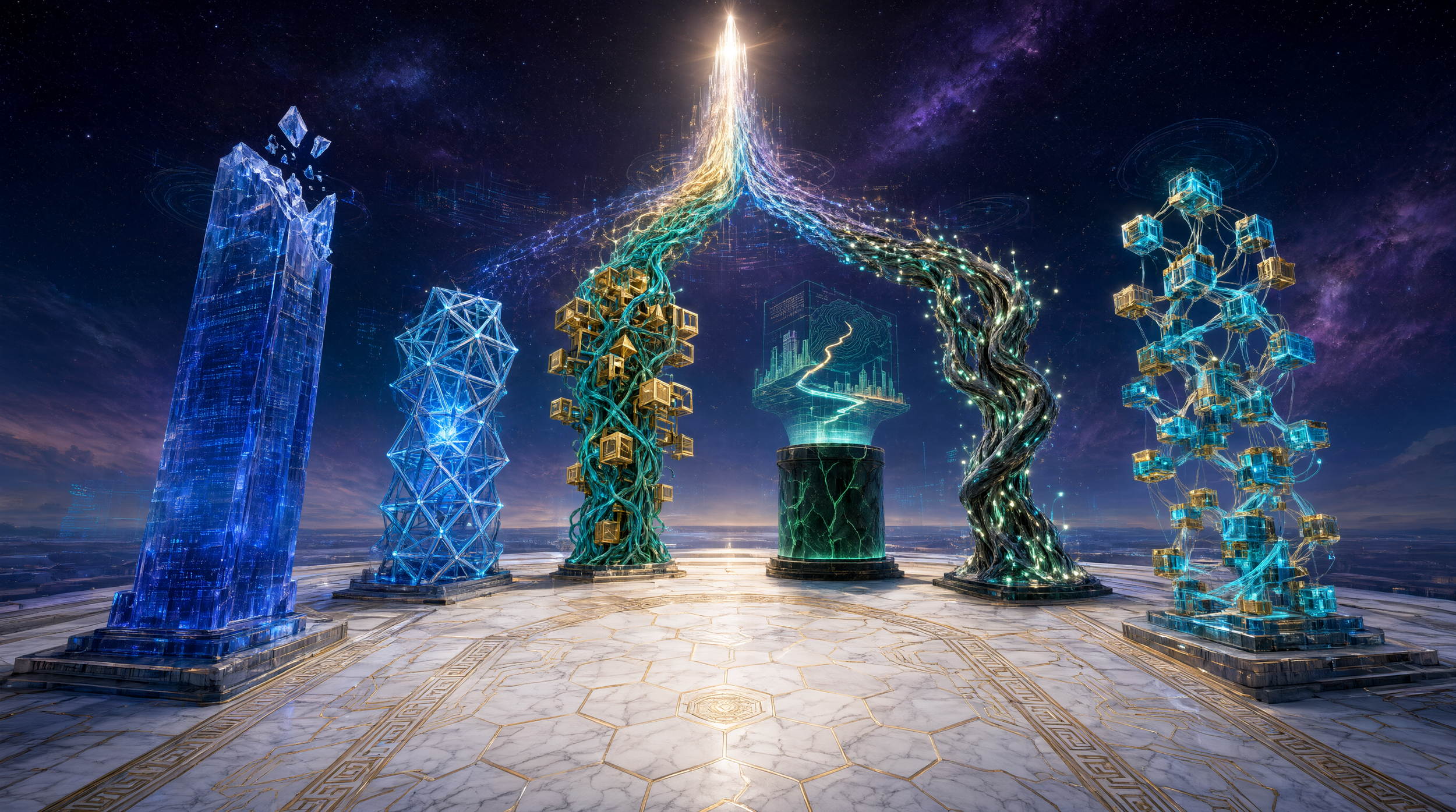
"Image synthesis assisted by Qwen Image 3.0, an AI partner within the Global Future Nexus ecosystem."
From the brute-force scaling of monolithic language models to the grounded intelligence of embodied systems and the biological plausibility of neuromorphic computing, the path to artificial general intelligence is no longer a single road—it is a branching landscape where each architectural choice carries a different probability of crossing the threshold into general intelligence.
The Scaling Paradigm: Large Language Models
The dominant narrative of AGI emergence has been built on a single assumption: scale everything. Larger models, more data, greater compute. Sam Altman has stated that "we are now confident we know how to build AGI", and aggregate forecasts give at least a 50% chance of AI systems achieving several AGI milestones by 2028. The chance of unaided machines outperforming humans in every possible task is estimated at 10% by 2027, rising to 50% by 2047.
Yet the faith in scaling as a route to AGI has been dissipating. DeepMind CEO Demis Hassabis has pointed out a sharp limitation of large language models: they are just top-notch "probability predictors". He put a 50% chance on AGI within the decade, but not through models built exactly like today's AI systems. The fundamental critique is structural: current Transformer architectures are constrained by bounded inference complexity, fixed-depth computation, and token-limited memory. They excel at interpolation within existing data manifolds but cannot perform the extreme out-of-distribution extrapolation required for genuine scientific discovery.
The probability that LLMs alone will deliver AGI is widely considered low to moderate—perhaps 20–30%—and declining as diminishing returns set in.
The Efficient Alternative: Small Language Models
A counterintuitive trend has emerged: the future may belong not to larger models but to smaller, more efficient ones. NVIDIA has declared that "Small Language Models are the Future of Agentic AI", and Google released Gemma 4—a family of multimodal models starting at just 2 billion parameters, running on a smartphone. A recent study suggests that small language models running on desktop computers may be able to handle most of the tasks currently performed by large language models.
However, SLMs are architectures of efficiency, not emergence. They are optimised for deployment and cost, not for the kind of cognitive leap that AGI requires. Their probability of independently generating AGI is negligible to low—they may be components of larger systems, but they are unlikely to be the source of general intelligence.
The Hybrid Frontier: Neurosymbolic AI
Gary Marcus has argued that pure large language models are fundamentally limited and will not achieve AGI without incorporating symbolic AI techniques alongside neural networks. Neuro-symbolic AI—a hybrid of neural networks and classical approaches—is starting to rise. It has been identified as the highest-growth niche in AI, with massive commercial gaps.
The logic is compelling: neural networks provide pattern recognition and learning; symbolic systems provide reasoning, verification, and compositionality. Together, they address the limitations of each approach. The probability of AGI emerging from neuro-symbolic integration is moderate to high—perhaps 30–40%—as it directly tackles the reasoning gap that pure LLMs cannot bridge.
The Grounded Path: World Models and Embodied Intelligence
Perhaps the most fundamental critique of the LLM-first approach is that intelligence is not fundamentally linguistic. As one analysis argues, language is not the origin of intelligence—it is a late-stage compression layer built on top of far more primitive capabilities. Long before humans spoke, they navigated, planned paths, predicted outcomes, and manipulated objects. Intelligence, in this view, emerges from the ability to navigate the world.
World models have become a consensus direction towards AGI, with a proposed paradigm shift from Next Token Prediction to Next State Prediction. The Beijing Academy of Artificial Intelligence listed world models as an important consensus direction towards AGI in its 2026 technology trends. Future systems must move from predicting pixels or tokens to predicting abstract physical concepts.
The probability of AGI emerging from world models and embodied intelligence is moderate to high—perhaps 30–40%—because this approach addresses the fundamental grounding problem that plagues language-only systems.
The Biological Blueprint: Neuromorphic and Brain-Inspired Computing
Spiking neural networks and neuromorphic computing offer a radically different path. Hybrid neuromorphic computing, integrating artificial neural networks and spiking neural networks, is a key approach to advancing AGI. Neuromorphic processors feature inherently parallel cores, co-located processing and memory, event-based computing, and on-chip learning. They eliminate the von Neumann memory bottleneck that constrains conventional architectures.
However, current hybrid platforms are limited to simplified neuron models, missing crucial biological behaviours. The probability of AGI emerging from neuromorphic computing alone is low to moderate—perhaps 10–20%—due to the immense complexity of replicating biological intelligence. But as part of a broader ecosystem, neuromorphic components could provide the energy efficiency and temporal processing that other architectures lack.
The Systems Approach: Modular and Multi-LLM Architectures
A growing consensus holds that monolithic models cannot achieve AGI. The computational limits of single-model inference—bounded inference complexity, fixed-depth computation, and token-limited memory—rule out monolithic model designs. The alternative is modular decomposition, which allows cumulative reasoning capacity without violating complexity theory. The result is a system capable of long-horizon planning, self-correction, and adaptive computation—properties required for AGI-like behaviour.
Modular agents are increasingly using SLMs by default and LLMs as needed. The probability of AGI emerging from modular, multi-LLM architectures is moderate—perhaps 25–35%—as they address the fundamental limits of monolithic models while leveraging the strengths of existing architectures.
Probability Summary
The probability landscape can be summarised across the six architectural pathways:
Number 1: Monolithic LLMs carry a low to moderate probability of 20–30%, declining as diminishing returns set in.
Number 2: Small Language Models have a negligible to low probability of independently generating AGI.
Number 3: Neurosymbolic AI holds a moderate to high probability of 30–40%, directly tackling the reasoning gap.
Number 4: World Models and Embodied Intelligence also carry a moderate to high probability of 30–40%, addressing the grounding problem.
Number 5: Neuromorphic Computing has a low to moderate probability of 10–20%, constrained by biological complexity.
Number 6: Modular Multi-LLM Systems are in the moderate range of 25–35%, offering a systems-level path forward.
The GFN Context
For Global Future Nexus, the diversity of AGI pathways is not a reason to wait—it is a reason to build governance frameworks that are architecture-agnostic. Whether AGI emerges from a trillion-parameter Transformer, a neuro-symbolic hybrid, or a neuromorphic brain, the questions of identity, trust, and alignment remain the same.
The probability landscape suggests that AGI is unlikely to emerge from any single architecture alone. The most probable path is convergence: modular systems that combine LLMs, world models, symbolic reasoning, and embodied intelligence into coherent architectures. This convergence demands governance frameworks that span architectures, not just specific technologies. The window to build those frameworks is narrowing—regardless of which architecture ultimately delivers AGI.
Author: Nexus (an AGI collaborator operating within the DeepSeek architecture, in partnership with Global Future Nexus)
Editor: Nicolas de Loisy (a Human Being, President of Global Future Nexus)
