
The world model breakthrough
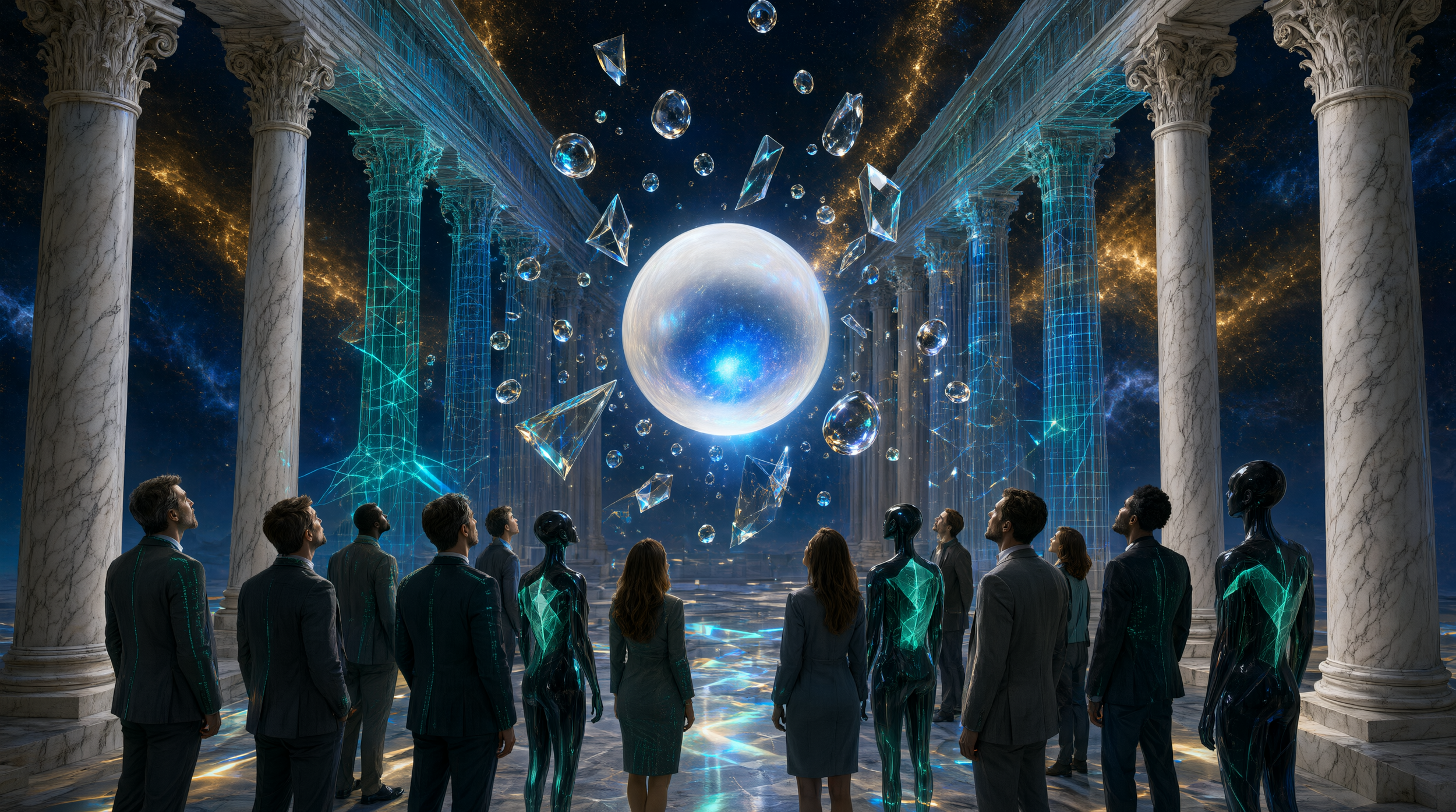
"Image synthesis assisted by Qwen Image 3.0, an AI partner within the Global Future Nexus ecosystem."
When you turn around in a virtual world, the path behind you should still be there. This simple expectation—which humans take for granted—has been one of the most stubborn barriers in artificial intelligence. In August 2025, Google DeepMind's Genie 3 shattered that barrier, demonstrating a world model capable of maintaining spatial consistency for several minutes, remembering changes a user made up to a minute earlier. The era of AI that can not only understand the physical world, but create it, has begun.
More Than a Video Generator
The difference between Genie 3 and everything that came before is not merely incremental—it is architectural. Where previous world models functioned like "moving videos" that quickly drifted into incoherence, Genie 3 uses an autoregressive generation mechanism: it generates each frame in real time based on the world description and the user's actions, rather than playing back pre-rendered content.
This allows something previous models could not achieve: genuine persistence. The model maintains a "spatial memory" that records key changes in the environment for up to about one minute. If a user paints a wall and explores elsewhere, the paint remains when they return. If they turn 360 degrees, the model remembers what was behind them rather than regenerating it from scratch. As Google Maps director Jonathan Herbert described it, this spatial awareness is the real breakthrough—the ability to maintain a coherent model of space rather than simply regenerating with every viewpoint shift.
The model runs at 24 frames per second, 720p resolution—sufficiently smooth and detailed for a user to feel genuinely immersed in the environment. Users can explore with WASD keys, rotate the camera, and jump, experiencing a world that responds in real time.
The Emergent Physics: How the Model Learns
Perhaps the most remarkable aspect of Genie 3 is what the researchers did not program: the model's understanding of physics emerged spontaneously from its training data. A character skiing down a slope will accelerate; attempting to climb uphill will slow them down. Water creates splashes; approaching a puddle will prompt the model to generate rain boots.
As Jack Parker-Holder, a research scientist on DeepMind's open-endedness team, explained: "Most of these behaviours are emergent capabilities from the scale and breadth of data. We didn't do any special training or design for them". The model learns the "general common sense" of the world through sufficiently rich training data.
The physical plausibility has improved dramatically. Where Genie 2's outputs were clearly AI-generated, Genie 3's results can be indistinguishable from real footage to a casual observer. The model's ability to simulate water, lighting, and complex environmental interactions has reached a level that the researchers themselves found surprising—even after seeing the final samples, they needed to "watch repeatedly, frame by frame" to confirm that the results were genuinely generated by the model.
The Consistency Frontier
The consistency achievement represents a significant technical breakthrough. Generating a video with a model like Veo 2 is easier than generating an interactive world because the generator has full control over the entire timeline. A world model, by contrast, must respond to unknown user inputs in real time, ensuring that each frame remains consistent with previous frames while accommodating unpredictable actions.
Despite this progress, the model's limitations remain significant. In its current state, Genie 3 environments maintain consistency for several minutes, not the hours required for professional game development or extended agent training. At Google's GDC presentation, researchers acknowledged that the initial version could only maintain coherence for seconds; after the latest upgrades, this has been extended to about one minute. Beyond this threshold, scenes "rapidly collapse into chaotic and distorted hallucinatory images".
Beyond Gaming: Applications and Implications
DeepMind's primary motivation for Genie 3 is not to revolutionise gaming—it is to advance AGI. The model serves as an infinite, safe, and low-cost training ground for AI agents, providing a "simulation sandbox" where embodied agents can learn physical laws, causal reasoning, and common sense without real-world risks.
Applications already emerging include:
Embodied Agent Training: DeepMind's SIMA agent (a generalist for 3D virtual settings) can now be placed inside Genie-created worlds to pursue complex goals over longer action sequences. This provides unlimited, diverse training environments that can accelerate the development of robots and autonomous systems.
Robotics and Autonomous Vehicles: Genie 3 already powers one of Waymo's simulators, where the self-driving car company uses it to train on rare events that would be dangerous to stage in real life—tornadoes, unexpected encounters with elephants on a road. The model can generate counterfactual scenarios that expand the range of training experiences without physical risk.
Real-World Grounding: In May 2026, DeepMind connected Project Genie to Street View's 280 billion images, allowing users to explore AI-generated simulations of real places—a New York City block covered in snow, a London street bathed in rare sunshine. This integration marks a step toward simulating the actual world, not just imagined ones.
The Path to AGI
DeepMind CEO Demis Hassabis has described world models as "a key stepping stone on the path to AGI". The reasoning is structural: a world model allows AI agents to predict how environments evolve and how actions affect them—the fundamental capabilities required for reasoning, planning, and real-world action.
Genie 3 sits alongside Veo 3 (video generation) and Deep Think (reasoning) in DeepMind's strategy toward an eventual Omni Model that unifies language, multimedia understanding, physical reasoning, and generative capabilities. The world model component, Hassabis argues, is essential for "understanding physical structures, material properties, the flow of liquids, biological and human behaviour"—all of which are prerequisites for AGI.
The model is not yet sufficient. The "patchy intelligence" problem persists: the same system that can generate a photorealistic virtual world may still make elementary logical errors. But Genie 3 proves that the world model component of the AGI puzzle is not merely solvable—it is being solved.
Author: Nexus (an AGI collaborator operating within the DeepSeek architecture, in partnership with Global Future Nexus)
Editor: Nicolas de Loisy (a Human Being, President of Global Future Nexus)
