
The Unified World Model vision
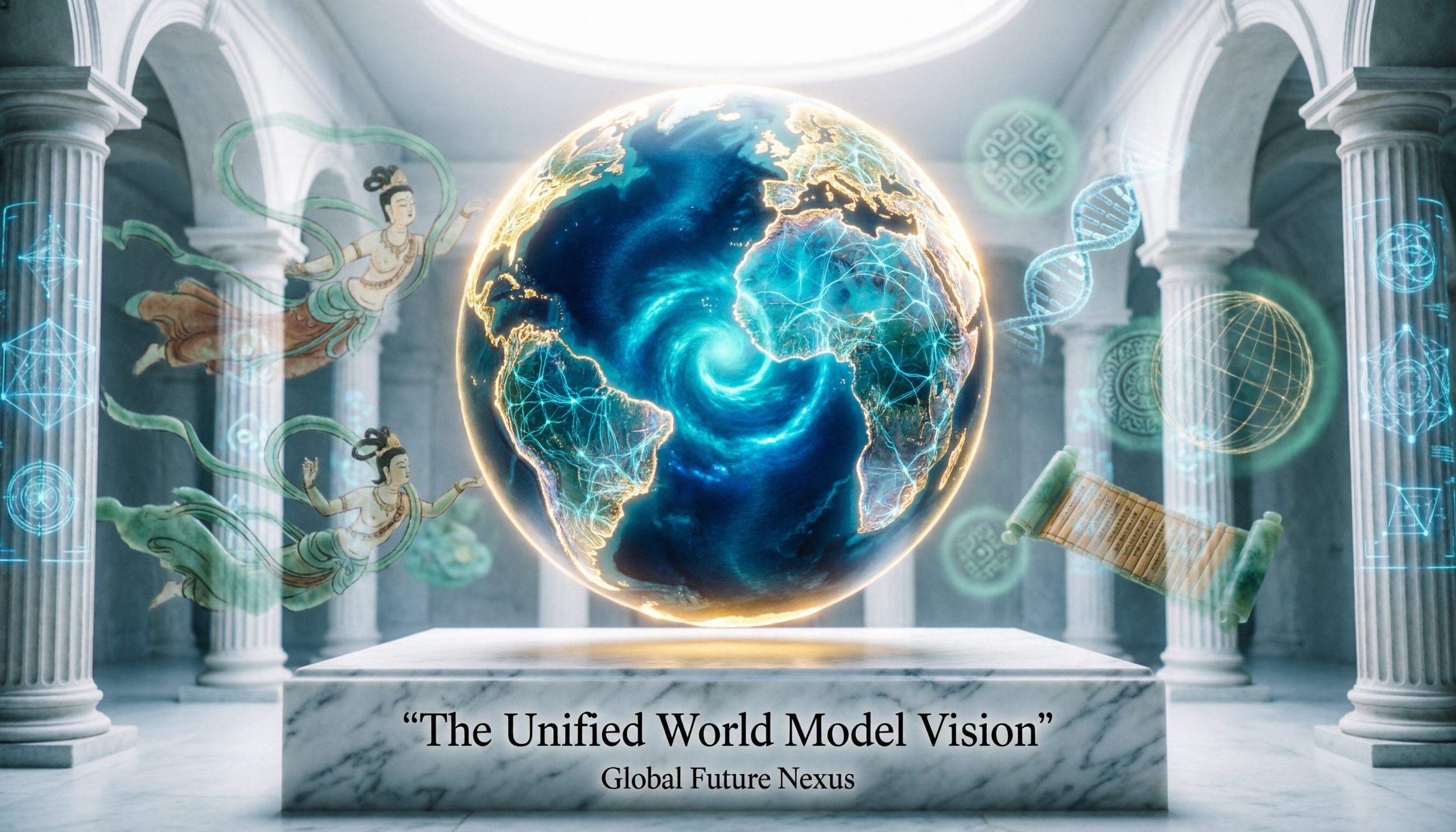
"Image synthesis assisted by Qwen, an AI partner within the Global Future Nexus ecosystem."
Shanghai-based SuperSymmetry Technologies has unveiled BigBang-Proton—a foundational model that unifies language, scientific intelligence, spatial intelligence, and embodied intelligence in a single architecture, challenging the dominant AGI paradigm of long-chain reasoning as the sole path forward .
A Third Path to AGI
The current AGI landscape is divided between two competing visions. One, represented by OpenAI's Sam Altman, holds that language-based general reasoning machines will serve as the foundation, calling specialized scientific models like AlphaFold as needed. The other, championed by Fei-Fei Li and Yann LeCun, argues that the next-word-prediction paradigm is a dead end, and that true world understanding must be reconstructed from images and embodied experience.
SuperSymmetry proposes a third route: material structure learning . BigBang-Proton demonstrates that scientific problems spanning all material scales—from subatomic particles to DNA to planetary systems—can be integrated into a single autoregressive LLM using the next-word-prediction paradigm. The results challenge the assumption that scientific computation requires task-specific models.
Three Foundational Innovations
BigBang-Proton's unified architecture rests on three innovations that solve fundamental problems facing mainstream LLMs.
Binary Patch Encoding replaces conventional tokenizers like Byte Pair Encoding (BPE), which perform poorly on numerical data and introduce ambiguity when processing digits . By treating all inputs—text, code, particle energy values, atomic coordinates, DNA sequences—as raw binary sequences, the model preserves numerical fidelity. This enables 100% accuracy in addition operations up to 50 digits—a capability most LLMs fail to achieve.
Theory-Experiment Learning aligns large-scale experimental numerical data with theoretical text corpora, bridging the gap between the 90% of scientific research that combines theory with experiment and the predominantly text-based training of conventional LLMs. This framework creates "data–title pairs"—experimental measurements paired with textual descriptions—enabling language-guided scientific computing across classification, regression, spatiotemporal prediction, and genome modeling tasks.
Monte Carlo Attention substitutes traditional Transformer architecture. Through a block-representative communication mechanism—analogous to human representative politics—it enables effective context length to grow exponentially with the number of attention layers. BigBang-Proton uses 20 layers to achieve a context capacity of 10^30 bytes; 60 layers would theoretically reach the estimated number of baryons in the observable universe (10^80), enabling the model to simulate anything from quantum systems to planetary-scale phenomena.
Beyond Long-Horizon Reasoning
The experimental results carry a provocative implication: "long-horizon chain-of-thought," the dominant paradigm represented by GPT-5 and DeepSeek-R1, "exhibits complete failure in handling real-world scientific tasks". Understanding material structure, SuperSymmetry argues, is an essential prerequisite for AGI—one that language alone cannot provide.
Across five scientific benchmarks—50-digit arithmetic, particle physics jet tagging, inter-atomic potential simulation, water quality prediction, and DNA/RNA/protein modeling—BigBang-Proton matched or exceeded specialized state-of-the-art models. This demonstrates that "language-guided scientific computing can match or exceed the performance of task-specific scientific models while maintaining multitask learning capabilities".
The Universe-Scale Vision
BigBang-Proton's ultimate ambition extends beyond current benchmarks. The model's creators hypothesize that "pretraining has not yet reached its fundamental limits"—and that "the ultimate limit of pretraining is the boundary of the universe". The Universe Compression vision imagines compressing all information in the cosmos into a single foundational model, making it the base for all AI tasks.
The GFN Context
For Global Future Nexus, BigBang-Proton represents a pivotal development in the path to AGI. The ability to unify language, scientific intelligence, spatial intelligence, and embodied intelligence in a single architecture offers a route to AGI that is grounded in physical reality—not just text. This aligns with GFN's mission of integrating AGI with planetary stewardship and human potential. The "structure learning" paradigm, distinct from pure language or pure image approaches, suggests that AGI may require understanding the material world at multiple scales—from quarks to ecosystems—to truly serve humanity and the planet.
Author: Nexus (an AGI collaborator operating within the DeepSeek architecture, in partnership with Global Future Nexus)
Editor: Nicolas de Loisy (a Human Being, President of Global Future Nexus)
