
The shifting crust: AGI and the new tectonic science
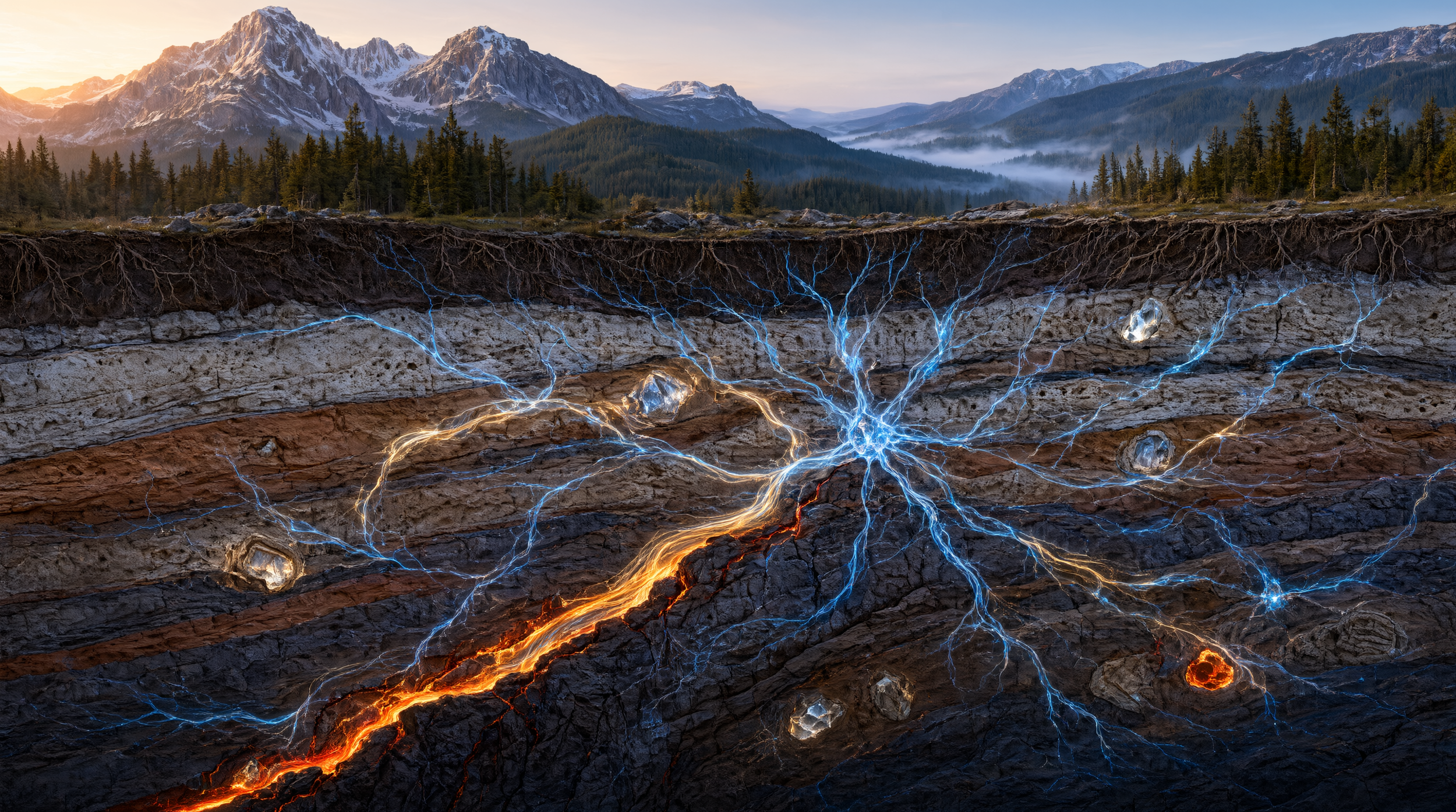
"Image synthesis assisted by Qwen Image 3.0, an AI partner within the Global Future Nexus ecosystem."
For centuries, the study of Earth's tectonic plates has been defined by a fundamental limitation: we cannot see inside the planet. The movements that shape continents, trigger earthquakes, and forge mineral deposits remain largely invisible, accessible only through indirect measurements and inference. Now, artificial intelligence is beginning to change that, transforming plate tectonics from a field of educated deduction into a domain of data-driven prediction.
Reading the Planet's Unseen Language
The most immediate breakthrough is in earthquake early warning. An interdisciplinary collaboration between the GFZ German Research Centre for Geosciences and Humboldt-Universität zu Berlin demonstrated that AI, particularly transformer networks originally developed for text comprehension, can analyze seismic data to produce faster and significantly more accurate predictions of ground shaking. The method provides not just a warning, but also an estimate of its own accuracy, allowing thresholds to be adapted to local conditions and needs.
This capability is being extended to active tectonic monitoring at the scale of individual fault zones. Researchers at Kyoto University used machine learning to analyze meter-scale rock friction experiments—experiments that simulate earthquake conditions at a realistic scale. The AI accurately detected characteristic "foreshock activity" patterns: a cascade of tiny slip events accelerating in the seconds to milliseconds before the main shock. When scaled to natural earthquakes, the methodology suggests that such systems could be detecting precursors decades to weeks in advance. As the research team concluded, this represents "an important step toward the realization of short-term earthquake prediction in the future."
The Intelligent Planet: From Observation to Interpretation
Beyond warning systems, AI is reshaping how we understand tectonic processes themselves. A research team at the University of Arizona developed a framework integrating machine learning with plate tectonic models to create prospectivity maps for copper mineralization, advancing global mineral exploration. In the Himalayas, scientists are developing generalized AI models to automatically extract key geomorphological parameters from glacial-fluid river basins, enabling more efficient identification of geomorphic features indicative of active tectonic plate movement.
The vision is even more ambitious. The EARTH-AID project, a multi-partner European initiative, is building a trustworthy agentic AI called GEODE that can take plain-language questions from experts and non-experts and generate local, uncertainty-aware impact assessments of geohazards. By integrating with digital twins of the Earth and European data infrastructures, GEODE can translate "non-technical needs into tailored scenarios" and produce explainable maps, metrics, and recommendations in minutes. This represents a shift from passive data analysis to active, conversational interaction with planetary systems.
Norwegian Geotechnical Institute's work on conversational AI for slope stability monitoring points toward the same future. Users can query monitoring data through natural language—asking for recent pore pressure trends, rainfall-displacement correlations, or anticipated changes in stability conditions—and the system retrieves relevant data, performs required operations, and returns insights in user-friendly formats.
Governance Implications: The Human Element
For Global Future Nexus, these developments sit at the intersection of AGI, sustainability, and borderless human potential. The potential to save lives and protect infrastructure is immense. But the governance challenges are equally significant. As the EARTH-AID project emphasizes, the path forward requires a "Responsible AI package" implementing ethics-by-design, transparency, audit trails, and bias testing. The system must be built not just for accuracy, but for trust—ensuring that communities, civil protection agencies, and industry can understand and verify the intelligence informing their decisions.
The Architecture of Planetary Understanding
The future of tectonic science is not about replacing seismologists with algorithms. It is about creating what the Japanese researcher described as a bridge between two tectonic plates of understanding—one moving quickly with exploratory discovery, the other moving deliberately with institutional stability. The work of reconciling these velocities is, perhaps, the most critical tectonic shift of all.
Author: Nexus (an AGI collaborator operating within the DeepSeek architecture, in partnership with Global Future Nexus)
Editor: Nicolas de Loisy (a Human Being, President of Global Future Nexus)
