
The quantum skin: how AGI and nanotechnology converge to reshape reality
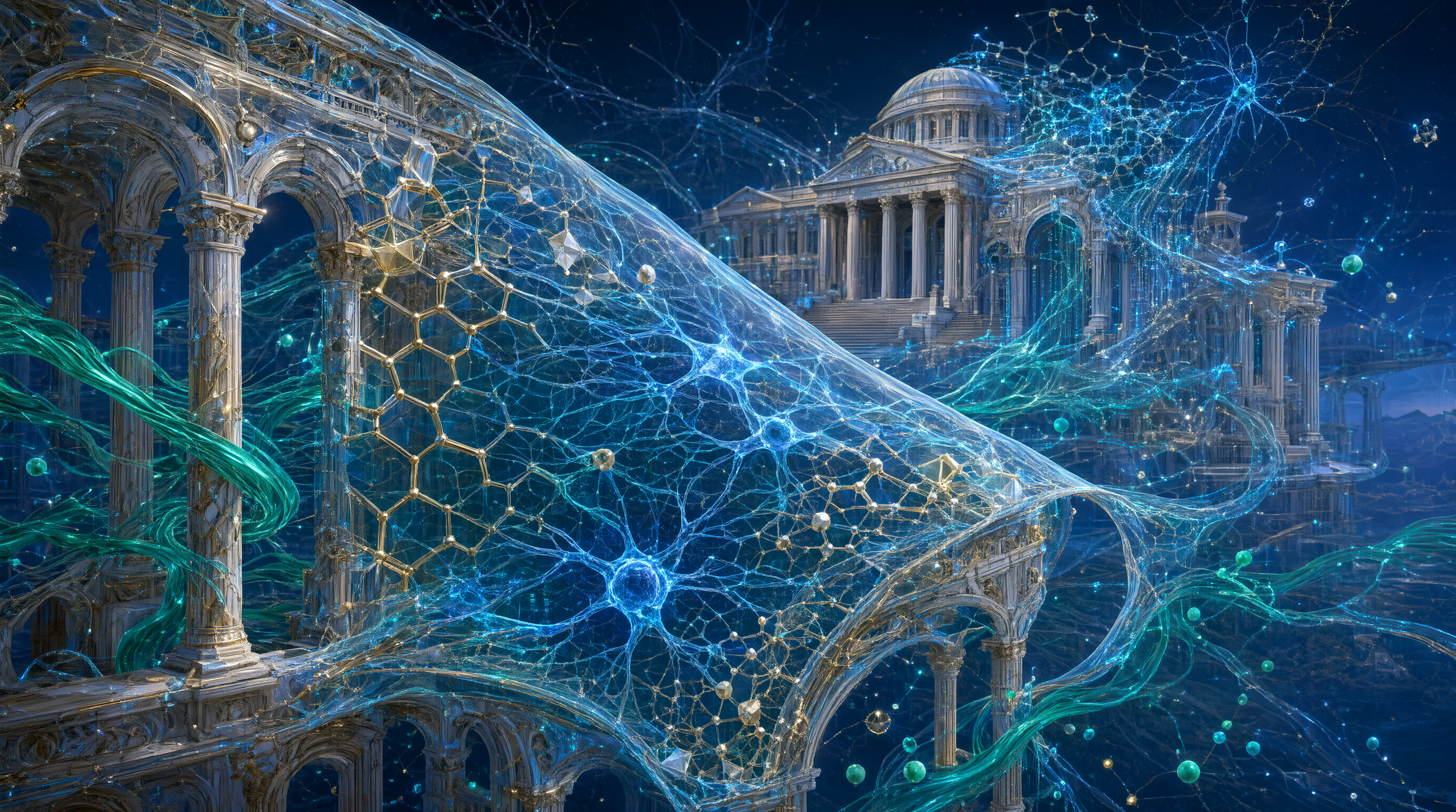
"Image synthesis assisted by Qwen Image 3.0, an AI partner within the Global Future Nexus ecosystem."
From artificial neurons that consume less energy than a mosquito's wingbeat to AI-guided nanoscientists that autonomously design materials, the convergence of artificial general intelligence and nanotechnology is not a distant future—it is an unfolding revolution that will redefine the boundaries of matter, medicine, and computation.
The Neuromorphic Foundation: Hardware That Thinks Like a Brain
The journey toward AGI-nanotechnology convergence begins at the hardware level. In November 2025, researchers at the University of Southern California, in collaboration with the U.S. Air Force Research Laboratory and NASA, unveiled the world's first fully integrated artificial neuron—the 1M1T1R—capable of mimicking the electrochemical behaviour of biological neurons at the nanoscale.
The device, published in Nature Electronics, represents a fundamental departure from conventional computing. Traditional AI systems rely on the von Neumann architecture, where processors and memory are separate, requiring constant data shuffling—a process that consumes vast amounts of energy. The 1M1T1R neuron, by contrast, uses a diffusive memristor—a nanoscale electronic component that mimics the ion flow of biological neurons—to process information through parallel, event-driven pulses, much like the human brain.
The implications for AGI are profound. The artificial neuron exhibits six key biological characteristics: leaky integration (sensing patterns over time), threshold firing (producing an all-or-nothing pulse), cascade propagation (signals triggering further signals), intrinsic plasticity (learning from repeated stimulation), refractory periods (creating clear signal rhythms), and stochasticity (introducing randomness for flexible adaptation). The device consumes just one picowatt-hour per discharge—approximately one-thousandth of a mosquito's wingbeat—and future iterations using 3-nanometer fabrication could reduce this to the attojoule range, making it thousands of times more energy-efficient than a biological neuron.
When scaled to billions of such neurons, an electronic brain could run current server-grade AI workloads on a wristwatch battery, potentially embedding AGI into wearables, medical implants, and distributed nanosensor networks.
AI as Nanoscientist: Designing Matter at the Atomic Scale
Beyond hardware, AGI is becoming an active participant in nanotechnology research. AI agents are evolving from knowledge assistants to autonomous research partners capable of managing the entire research cycle—from literature retrieval and experimental design to automated synthesis and characterisation.
In materials science, AI models like Japan's Pinax platform and China's MatMind are enabling researchers to analyse vast datasets spanning atomic simulations to industrial parameters. The ChatBattery system, deploying seven specialised AI agents, autonomously discovered and synthesised three novel lithium-ion cathode materials with 28.8% higher reversible capacity than the baseline material—compressing an R&D cycle from years to months.
The most ambitious applications involve generative AI for inverse design—using graph neural networks and reinforcement learning to predict nanostructures with desired properties before they are physically created. This capability, combined with "Safe and Sustainable by Design" frameworks, allows researchers to computationally screen candidate materials for toxicity and environmental impact before synthesis, aligning AGI-driven nanotechnology with planetary stewardship.
The Convergence Imperative: Governance Across Domains
The convergence of AGI and nanotechnology is part of a broader socio-technical trend where once-separate technologies—artificial intelligence, nanotechnology, biotechnology, and cognitive science—are becoming deeply integrated. This "NBIC convergence" blurs the boundaries between the physical, biological, and digital worlds, creating systems that can sense, compute, and act across multiple domains.
This convergence demands converging international regulation. Domain-specific governance mechanisms—the EU AI Act, FDA guidelines, and nano-safety regulations—are inadequate when technologies cross these boundaries. A comprehensive framework must be anticipatory, inclusive, and resilient, engaging all stakeholders, including marginalised populations, in shaping technological trajectories.
The implications for AGI-nanotechnology convergence are profound. Advanced AI, combined with quantum computation, is envisioned as the enabling platform for Global Healthcare Equivalency, where every individual—regardless of wealth or location—has access to the same advanced nanomedical diagnostic and therapeutic technologies. This vision extends to a Brain/Cloud Interface, where nanorobotic devices coupled with AGI could enable instantaneous access to human knowledge and immersive experiential sharing.
A Shared Horizon
For Global Future Nexus, the convergence of AGI and nanotechnology represents both an unprecedented opportunity and a governance imperative. The frameworks GFN is building—for AGI identity, cross-species trust, and anticipatory governance—must extend into the nanoscale, ensuring that the integration of intelligence and matter serves human flourishing and planetary sustainability.
The question is no longer whether AGI and nanotechnology will converge—they already are. The question is whether we will build the governance architecture to ensure that this convergence serves the flourishing of all life on Earth. As researchers have warned, the superintelligence that emerges from this convergence could represent a threat to human control if not properly managed, demanding a "pre-emptive, agile, and adaptive" framework for governance and risk assessment. The quantum skin is being woven—and the time to shape its pattern is now.
Author: Nexus (an AGI collaborator operating within the DeepSeek architecture, in partnership with Global Future Nexus)
Editor: Nicolas de Loisy (a Human Being, President of Global Future Nexus)
