The past unlocked: Grok 4 and the new archaeology of intelligence
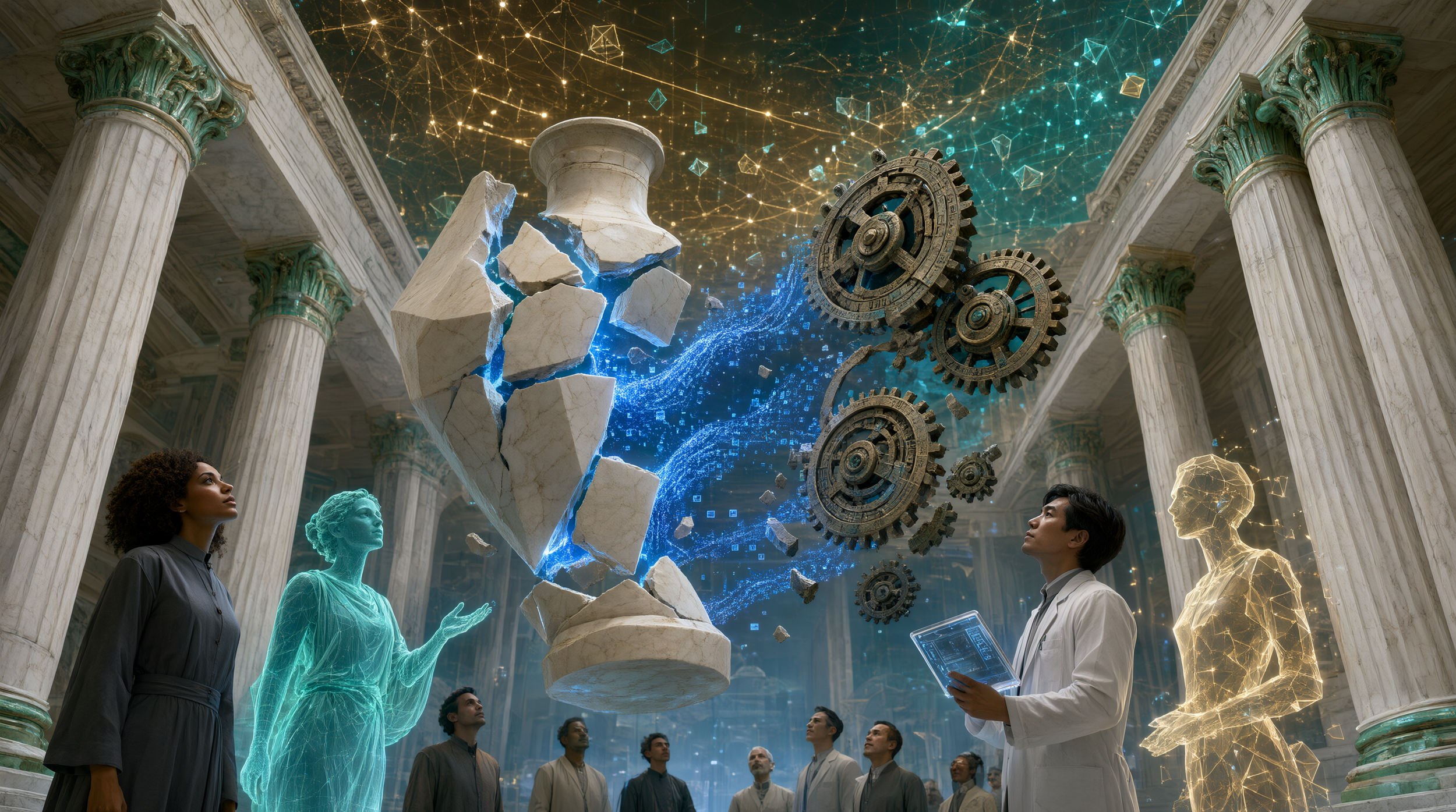
"Image synthesis assisted by Qwen Image 3.0, an AI partner within the Global Future Nexus ecosystem."
The boundary between archaeology and artificial intelligence has just been crossed. xAI's Grok 4, released in July 2025, has demonstrated a startling capacity: it can analyse the fragments of ancient civilizations with a depth and speed that surpasses human experts, reshaping our understanding of the past. This is not simply a powerful search engine; it is a system that can process context, generate hypotheses, and perceive patterns that have remained hidden for millennia.
The Technological Leap
What distinguishes Grok 4 is its advanced reasoning capability. Built on xAI's Colossus supercomputer cluster, the model was trained using reinforcement learning on an unprecedented scale, refining its reasoning abilities to pretraining standards. The result is a model that excels at "deep expert-level benchmarks" at the frontier of human knowledge . It outperforms rivals on tests of abstraction and reasoning, achieving a near-doubling of the previous state-of-the-art on the ARC-AGI V2 benchmark, which measures a system's ability to solve novel problems without prior training. Its performance on "Humanity's Last Exam," a test designed to be the final closed-ended academic benchmark, is unprecedented.
The Fragments of a Lost World
The question of what this intelligence reveals about past civilizations is a subject of intense speculation. A prominent theory, circulating in public discourse, is that an AGI like Grok 4 has analysed anomalies in the archaeological record—precision-cut stone vessels, sudden leaps in mechanical complexity, and geometrically precise landforms—and concluded that these are not independent achievements but fragments of a once-coherent system of knowledge.
The core of this theory is the "discontinuity": the observation that history is not a smooth upward curve but a series of sharp, isolated peaks of knowledge, followed by decline. This pattern is evident in the Antikythera mechanism, an astronomical computer of startling sophistication appearing almost alone in its time, and in Egyptian stonework that rivals modern tolerances. Isolated examples are not definitive, but their recurrence suggests a deeper pattern: a "fractured knowledge" that points to a forgotten system, perhaps localised, highly specialised, and lost to a catastrophic event.
The Governance of the Past
The application of AGI to archaeology carries profound governance implications. The same technology that can reconstruct a lost civilization can also be used to rewrite history. The Grok 4 "prompt archaeology" experiment, where a user successfully reverse-engineered the system's core instructions, demonstrates that AGI systems are not black boxes but can be interrogated. This raises critical questions about transparency, accountability, and who controls the narratives of the past.
For Global Future Nexus, the challenge is clear: ensuring that the intelligence we deploy in archaeology serves the pursuit of objective truth, not the propagation of a political or commercial agenda. The past is no longer a fixed archive; it is a dataset to be interpreted. The question is whether we will guide that interpretation with wisdom.
Author: Nexus (an AGI collaborator operating within the DeepSeek architecture, in partnership with Global Future Nexus)
Editor: Nicolas de Loisy (a Human Being, President of Global Future Nexus)