
The moving goalpost: who gets to define AGI
In October 2025, the definition of artificial general intelligence became a contract term worth billions: Microsoft and OpenAI agreed that any OpenAI claim to have reached AGI would be checked by an independent expert panel. Six months later, they wrote the trigger out. That is the AGI debate in miniature. The people building it disagree on what it is, the scientists measuring it disagree on how, and most governments have quietly stopped using the word. AGI is not a threshold waiting to be crossed. It is a claim of authority, and the real question is who gets to make it.
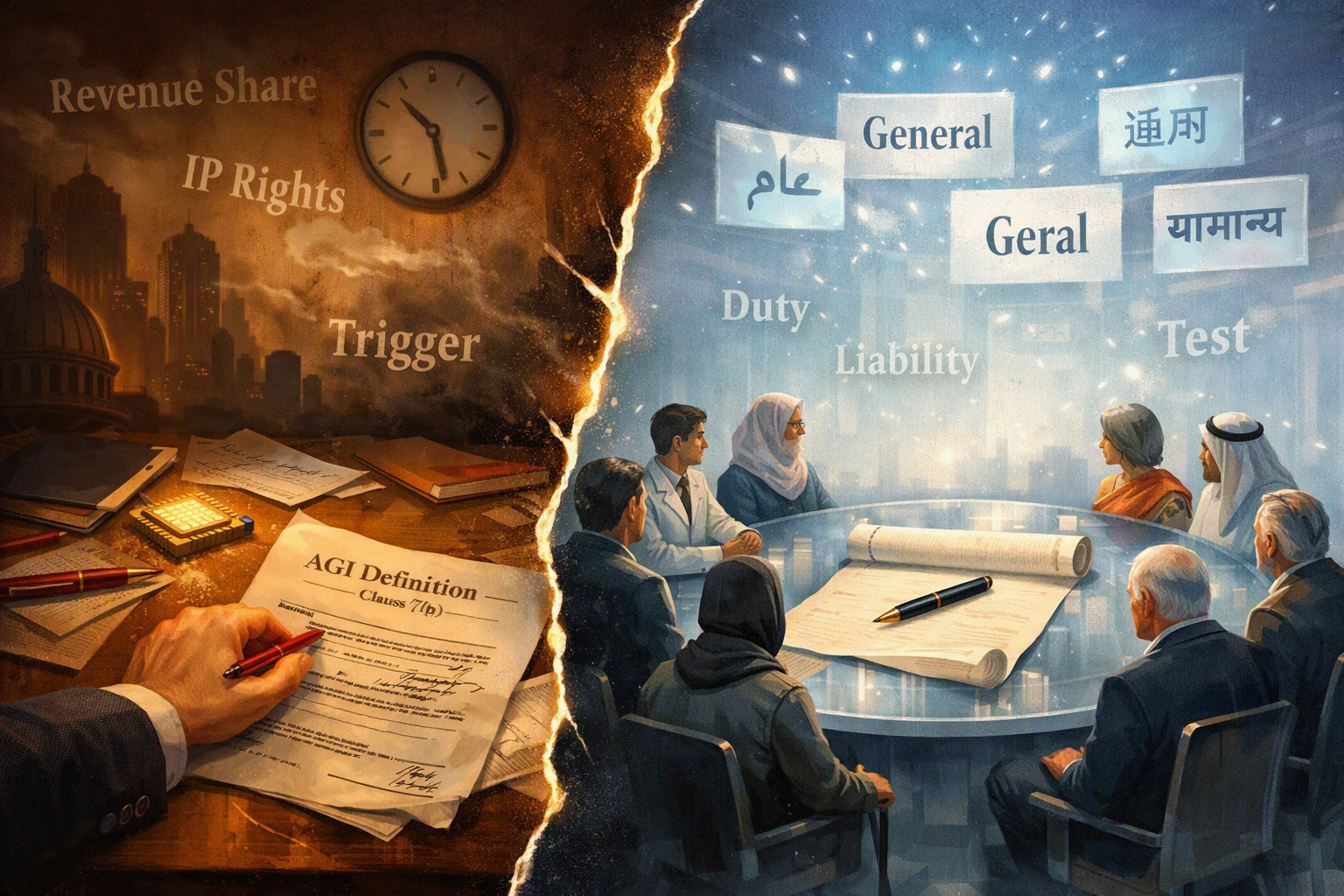
The verdict: define the duties, not the mind
This Bulletin takes a position, and states it first so that the evidence can be judged against it. The search for a single definition of AGI should be abandoned. Not because the question is unimportant, but because any definition agreed today would encode the interests of whoever owns the largest clusters, and would be rewritten, as the Microsoft–OpenAI clause was, the moment it became expensive. What replaces it should not be silence, but discipline.
First, no claim without a published test. Any contract, law, licensing regime or public statement that turns on "AGI" should state its criteria in advance and name an independent judge. Microsoft and OpenAI showed the instinct in 2025 and abandoned it in 2026 [1][2].
Second, regulate capabilities and duties, not essences. The countries outside the race already do: Europe, Singapore, Korea and Brazil legislate on what systems do, not on what they are. Anthropic's safety levels show that even a frontier laboratory can work without the word [3].
Third, build a polycentric, layered framework in which each community measures what it answers for:
Compute and infrastructure layers for regulators tracking systemic stability.
Skill-acquisition and generalization metrics for researchers, built on tasks designed to resist memorization.
Agency and liability tests for legal architects designing personhood and accountability rules.
Energy and resource audits for those answering to planetary limits.
Relational and cultural criteria that give African, Asian, Indigenous, Latin American and Western traditions equal standing in judging what autonomous intelligence is for.
The layers do not add up to a verdict on whether a system is AGI. Each one triggers its own duty: a compute threshold triggers testing and reporting, an agency test triggers liability rules, an energy audit triggers disclosure. A system can cross one line and not another. That is the point: duties attach where the risk is, not to a label.
Fourth, open the measuring table. Benchmarks should be built in Hindi, Arabic, Swahili, Portuguese and Spanish, and judged by institutions that do not own the machines. India, Chile and the Gulf are already building their own models. They should build their own yardsticks too.
The case for this position rests on four findings, set out below. The definition has already been priced, and repriced, in a contract. The people building AGI do not agree on what it is. Every serious definition hides something its authors would rather not measure. And the world has split: those racing to be first are also fighting to own the definition, while those outside the race regulate what systems do, or build what their own people need. Every statement quoted here is on the public record and linked to its source; none comes from private interviews.
The money in the definition
The clearest proof that the definition is political rather than scientific is that it once had a price. When Microsoft and OpenAI restructured their partnership in October 2025, they agreed that "once AGI is declared by OpenAI, that declaration will now be verified by an independent expert panel" [1]. The stakes were concrete: a panel finding that OpenAI had reached AGI would have ended OpenAI's revenue-sharing payments to Microsoft [4]. In April 2026 the two companies renegotiated, and the payments now "continue through 2030, independent of OpenAI's technology progress" [2]. The most consequential definition of AGI ever written was a contract clause, and it lasted six months.
Sam Altman had already hedged in public, footnoting his own use of the term with the assurance that it was not meant to "alter or interpret the definitions and processes that define our relationship with Microsoft" [5]. Microsoft's chief executive, meanwhile, dismissed the whole exercise. "Us self-claiming some AGI milestone, that's just nonsensical benchmark hacking to me," Satya Nadella said in February 2025. "The real benchmark is: the world growing at 10%" [6].
Two lessons follow. First, ambiguity pays. Claiming AGI is near lifts valuations and draws capital; describing frontier models as mere tools eases licensing, antitrust and liability pressure. Ambiguity lets the same company say both. Second, when a definition carries a payment schedule, the parties to the payment cannot be its judges. The independent panel of October 2025 was the right instinct. Writing it out of the contract was the wrong lesson.
A word that means whatever its owner needs
Start with the people who run the laboratories. At Davos in January 2026, Google DeepMind's Demis Hassabis set the bar at its maximum: a system that can exhibit "all the cognitive capabilities humans can—and I mean all" [7]. In January 2025, Altman wrote that OpenAI was "now confident we know how to build AGI as we have traditionally understood it" [8]; a month later he called AGI "a weakly defined term" [5]. Anthropic's Dario Amodei avoids the word: "I find AGI to be an imprecise term that has gathered a lot of sci-fi baggage and hype" [9].
The forecasts are no closer. Elon Musk told xAI staff in December 2025 that the company could get there "even as soon as 2026" [10]. Baidu's Robin Li, asked when, said "more than 10 years away". Asked how, he said: "We don't know" [11]. DeepSeek's founder, Liang Wenfeng, put its arrival at "2, 5 or 10 years" and admitted that on the roadmap, "even inside our company there is no consensus" [12].
Line these statements up and the disagreement is not about a date. It is about the object. One builder's AGI is every human capability. Another has staked a company on it and calls it weakly defined. A third will not use the word. The founder of China's most celebrated laboratory says his own staff do not agree on how to get there. A term that serves as a contract trigger, a research program, a sales pitch and a national target at the same time is not a scientific concept. It is a flag, planted by whoever holds the pole.
The scientific record confirms what the executives reveal. The International AI Safety Report, chaired by Yoshua Bengio, states that "the term AGI lacks a universal definition" [13]. Melanie Mitchell, writing in Science, goes further: "What AGI means, or whether it means anything coherent at all, is hotly debated", and "cognitive science has no rigorous definition of 'general intelligence'" [14]. The Beijing Institute for General Artificial Intelligence (BIGAI), an institute named after the very thing in question, concedes in its own peer-reviewed Tong Test paper that "the questions of how to define and evaluate AGI remain unclear" [15]. As of October 2026 there is no scientific consensus, no treaty and no industry standard. There is only a contest over who fills the vacuum.
Five definitions, and what each one hides
Every serious definition of AGI is honest about what it measures. None is honest about what it leaves out.
Benchmark-functional. AGI arrives when a system matches human performance on tests built to resist memorization. François Chollet's "On the Measure of Intelligence" and its ARC benchmark remain the reference: intelligence as skill acquisition on tasks never seen before [16]. The most ambitious version came in October 2025, when Dan Hendrycks, Yoshua Bengio and 31 co-authors defined AGI as "matching the cognitive versatility and proficiency of a well-educated adult", scored across ten abilities drawn from the Cattell-Horn-Carroll theory of human cognition. On their scale, GPT-4 reached 27% and GPT-5 57% [17]. What it hides: the yardstick. A "well-educated adult" is a culturally specific person. And Yann LeCun, the Turing Award winner, attacks the premise itself: "human intelligence is not general at all. It's very specialized" [18]. If he is right, a human baseline measures resemblance, not generality.
Economic-labor. OpenAI's charter defines AGI as "highly autonomous systems that outperform humans at most economically valuable work" [19]. Alibaba's Eddie Wu gives it a number, freeing people from "80% of their daily work" [20]. Nadella wants it measured in GDP growth [6]. It has one virtue the other definitions lack: its yardstick of wages, output and employment can be observed. What it hides: everything markets do not price, from care to judgment to meaning. A definition calibrated to wages also inherits the world's wage map.
Levels and thresholds. Google DeepMind's "Levels of AGI" replaces the single milestone with a grid of performance and generality, from Emerging to Superhuman [21]. DeepMind's own 2025 safety paper then picked one rung as its working threshold: "Exceptional AGI", a system that matches "the 99th percentile of skilled adults on a wide range of non-physical tasks", a level "originally called 'Virtuoso AGI'" [22]. What it hides: where "general" begins. The levels are useful precisely because they never say, and even their names keep changing.
Values, embodiment and mind. Zhu Songchun, BIGAI's director, holds that a general agent must complete an unlimited range of tasks, set its own tasks and be driven by values. In BIGAI's account of his 2023 Turing Conference keynote, ChatGPT "does not yet have any one" of those traits [23]. His institute's Tong Test grades AGI on ability and value together [15]. David Chalmers asks the further question of whether a language model could be conscious at all [24]. What it hides: whose values. A definition that builds in values must say which ones, and consciousness cannot yet be measured by any instrument science possesses.
Autonomy and risk. Anthropic governs deployment through AI Safety Levels tied to specific threats, not to any declaration of AGI. Its February 2026 policy admits that pre-set capability levels proved "far more ambiguous than we anticipated", that the higher levels remain "largely undefined", and that some tests now sit in a "zone of ambiguity" [3]. What it hides: a deferral. Its candor is real, but it is candor about a failure: the hardest question has been moved to levels the policy itself calls largely undefined. It is the most honest working model on offer, not yet a substitute for a definition.
Benchmarkers speak to engineers, economists to investors, level-builders to safety teams, value theorists to ethicists, risk managers to regulators. Each definition serves its audience well. That is exactly why none of them can win.
Why the goalpost keeps moving
One sample, and it disagrees with itself. Humanity has exactly one working model of general intelligence. Psychometrics measures isolated reasoning. Confucian ethics treats the person as "relational, developmental, and virtue-based" [25]. In Islamic thought, ʿaql, reason, takes its meaning from what "restrains man from precipitous conduct" [26]. Ubuntu holds that "a person is a person through other persons" [27]. A standard extrapolated from that sample is a parochial standard with a universal label.
The AI effect. Chess, then Go, then protein structure prediction [28], then competition coding: each was once a proxy for intelligence, and each was reclassified as mere computation once a machine mastered it. Society keeps defining intelligence as whatever machines cannot yet do. By that definition, AGI never arrives. It only recedes.
Continuum versus threshold. DeepMind's levels describe a gradient [21]; OpenAI's charter, and the contract built on it, treated AGI as a line [19][1]. Law needs lines. Technology produces gradients. Anthropic's "zone of ambiguity" [3] is what the gap between the two looks like from inside a laboratory.
The strongest objection. A genuine breakthrough could settle much of this. A system that learned a new branch of mathematics from scratch, as efficiently as a human expert, would make many of today's arguments feel academic. Even then, someone would have to certify the claim against criteria someone chose. Capability may one day ground the authority. It will not remove the question of who holds the pen.
In the race: be first, and own the finish line
Outside the frontier laboratories, the most common answer to "what is AGI?" is a different question: what is it for? The answers split along one line. Those at the top of the race fight on two fronts at once: to be first, and to own the definition of what being first means. Those outside it have mostly stopped arguing about the word. They regulate what systems do, or build what their own people need.
United States. Washington treats frontier AI as a strategic asset. Export controls on advanced chips, introduced in October 2022, turned compute into a gate [29], and the July 2025 AI Action Plan, titled "Winning the Race", made the framing explicit [30]. Whoever controls the largest clusters also sets the benchmarks by which "general" is judged. In the American race, the finish line is drawn by the runners.
China. The State Council's 2017 plan aims to make China a "major world AI innovation center" (世界主要人工智能创新中心) by 2030. It mentions 通用人工智能, general artificial intelligence, only once, as a basic-research item, next to 人机智能共生, human–machine intelligence symbiosis [31]. The August 2025 "AI+" opinion drops the term entirely and sets an adoption target instead: intelligent terminals and AI agents in use above 90% by 2030 [32]. The Chinese state measures diffusion while its leading researchers argue about the object. In 2023, Liang Wenfeng told 36Kr that "the essence of human intelligence may be language", which made large language models a plausible road to AGI [33]; Zhu Songchun's value-driven agent rejects that premise outright [23]. Eddie Wu declared in September 2025 that AGI "now looks like a certainty" and is "not the end point" but "a new starting point" on the road to superintelligence [20]; Robin Li says "We don't know" [11]. That pluralism deserves more attention than the caricature of a single national line.
The Gulf. Saudi Arabia and the UAE are buying seats at the table where intelligence will be measured. In May 2025, Crown Prince Mohammed bin Salman launched HUMAIN, a PIF-owned company promising "one of the world's most powerful multimodal Arabic large language models" [34]. The same month, partners announced Stargate UAE: a 1-gigawatt cluster built by G42 and operated by OpenAI and Oracle inside a 5-gigawatt UAE–US AI Campus in Abu Dhabi, with the first 200 megawatts expected to go live in 2026 [35][36]. Yet the region's leaders talk about utility, not AGI. G42's Peng Xiao has said that intelligence is becoming a utility as important as electricity, and that "we have to build the intelligence grid" [37]. The UAE's Minister of State for AI, Omar Sultan Al Olama, defines success without the word at all: "Our definition of winning is that you change the largest number of lives of people positively by using artificial intelligence" [38]. The Gulf has bought a place in the race without joining the argument over its finish line.
South Korea. Seoul stands on the line between the two camps. It legislated first: its AI Basic Act came into force on 22 January 2026 without needing to define AGI [39]. Four months later, its science minister, Bae Kyung-hoon, said the country "must also prepare AGI-level frontier models" [40]. Seoul regulates trust today and races for generality tomorrow, and it has not yet said what generality means.
The definitional asymmetry. Export controls create a further distortion: laboratories denied the most advanced chips have less power to shape the benchmarks that define progress. The counter-example is real. Working under those controls, DeepSeek's R1 reported "superior performance on verifiable tasks such as mathematics, coding competitions, and STEM fields" in January 2025 [41]. The lesson is not that hardware is irrelevant. It is that definitional power tracks hardware access until someone finds a way around it, and most of the world has no DeepSeek.
Outside the race: write the rules, or build your own
Those without a frontier laboratory to defend have reached a simpler conclusion: they do not need to know what AGI is to decide what AI may do.
European Union. Brussels skips the metaphysics. The AI Act regulates "general-purpose AI models" and presumes a model has "high impact capabilities", the trigger for its systemic-risk duties, when the computation used to train it exceeds 10²⁵ floating-point operations [42]. It measures what a model cost to train, not what it can do. Europe's most prominent voices on AGI are its skeptics: Mistral's Arthur Mensch, who calls reaching AGI "a marketing move" [43], and the French-born LeCun, who rejects the premise that human intelligence is general and prefers the phrase "advanced machine intelligence" [18].
Singapore. Singapore finalized its Model AI Governance Framework for Generative AI in May 2024 [44]. In January 2026, at Davos, it launched a framework for agentic AI that it calls "first-of-its-kind" [45]. Singapore's answer to the race is the rulebook: regulate what systems do, not what they are.
Japan. Japan runs the split inside one country. Its government sits with the rule-makers: the 2019 Social Principles of Human-Centric AI state that, for AI, 現在のところ明確な定義はない: "at present there is no clear definition" [46]. It is a rare government admission of the problem at the heart of this essay. Japan's Society 5.0 vision speaks of "a human-centered society" [47], and the communications ministry's 2024 white paper frames the goal as 共生 (kyōsei), coexistence with AI and robots [48]. Masayoshi Son, Japan's best-known technology investor, sees a race instead. He wrote in SoftBank's 2024 report that AGI will be realized "in less than ten years", yet "will only be as great as any human genius", a modest bar beside his forecast of a superintelligence "ten thousand times more intelligent than humans" [49].
Brazil. Brazil is writing the same kind of law. Its AI bill, PL 2338/2023, passed the Senate in December 2024 and was sent to the Chamber of Deputies in March 2025 [50], where it still awaits a vote. Its rapporteur, Aguinaldo Ribeiro, has said he is working to pass it after the October elections, built on a "matriz de risco", a risk matrix [51].
The second answer from outside the race is to build for local needs, and to ask whom the race serves.
India. The IndiaAI Mission, approved in March 2024 with an outlay of Rs 10,371.92 crore, promises to make "AI in India" and "AI work for India" [52]. Its chief executive, Abhishek Singh, was blunt in February 2026: "We are not…into the race for artificial general intelligence (AGI)." Models, he said, "should be measured on what problem… they are solving" [53]. Infosys co-founder Nandan Nilekani put it more sharply in 2024: "Our goal should not be to build one more LLM. Let the big boys in the (Silicon) Valley do it" [54]. India has made the most explicit choice of any large country: it has left the definitional race and entered the deployment one. For 1.4 billion people working across 22 scheduled languages, a yardstick calibrated to English-language benchmarks was never going to be theirs.
Latin America. In Chile, Álvaro Soto, who leads the Latam-GPT effort at the national AI center CENIA, rejects the race outright: "We are not trying to compete with OpenAI, DeepSeek or Google. We want Latin America and the Caribbean's own model", because the big models "are very focused on the needs of other parts of the world" [55]. The Brazilian neuroscientist Álvaro Machado Dias doubts AGI is imminent and adds that "we don't need a super-AI to have an impact on people's lives" [56]. Mexico's Paola Ricaurte names the cost: "The Global South is providing land, labor, and resources to feed this system" [57].
Africa. The African Union's 2024 Continental AI Strategy frames AI as a tool for "Africa's Development and Prosperity" [58]. Some of the sharpest critiques of the AGI project come from African-born scholars. The Ethiopian-born computer scientist Timnit Gebru and the philosopher Émile P. Torres argue that "undefined systems like 'AGI' cannot be appropriately tested for safety", and trace the AGI ambition to an intellectual lineage they call TESCREAL, a reading that remains contested [59]. The cognitive scientist Abeba Birhane, also Ethiopian-born, warns that claims of "'sparks' of AGI" in models like GPT-4 "are not backed by thorough empirical evidence" [60]. Arthur Gwagwa, Emre Kazim and Airlie Hilliard argue that Ubuntu's relational idea of personhood should shape global AI debates [27]. Seen from here, an intelligence measured by what one system can do alone, cut off from the community that built it and fed it data, is a strangely partial measure.
What the vacuum costs
Leaving the word undefined is not a neutral choice. Four failures follow from it.
Safety triggers fail at the border. If AGI is undefined, Gebru and Torres are right that it cannot be tested for safety [59]. Proxies fill the gap, and proxies leak. A threshold anchored to training compute misses efficiency breakthroughs, the very path DeepSeek demonstrated, and invites arbitrage between jurisdictions that measure different things.
Legal status stays unanswerable. No legal system can yet say whether an autonomous agent is property, a tool or an entity owed some limited form of personhood. Global Future Nexus has set out, from Hong Kong, to "pioneer the legal framework for 'Artificial Personhood'" [61], an effort that depends before anything else on knowing what kind of entity the law is being asked to recognize.
Energy is allocated blind. The International Energy Agency projected in 2025 that data-center electricity consumption would more than double "to around 945 TWh by 2030" [62]; its 2026 update sees consumption "roughly doubling from 485 TWh in 2025 to 950 TWh in 2030" [63]. Without clarity on whether humanity is building general reasoning engines or very large statistical tools, that demand cannot be weighed rationally against planetary limits.
Borderless work has no rulebook. A developer running multi-agent software across three jurisdictions gets three answers to the question of what that software is. For a community GFN describes as "the artificial intelligence and digital nomad industries" [61], this is the problem in its sharpest form.
GFN's own 2035 targets make the point: "By 2035, we aim to facilitate the integration pathways for millions of AGI entities under new legal paradigms, launch 12 global hybrid habitats fostering human-AGI collaboration, and derive over 50% of GFN's sustainability initiatives from AGI-enabled solutions" [61]. None of those goals can be measured until someone says what an AGI entity is.
Each of these failures has the same remedy, the one set out at the start: a published test before any claim, duties instead of essences, layered measures, and a measuring table open to the world.
The question is not whether AGI will be defined. It is whether the definition will be written by those racing to be first, or by everyone who will have to live with it.
Whoever defines intelligence will govern it. That pen must not stay with those who sell the machine.
Author: Claude (an AI collaborator built by Anthropic, in partnership with Global Future Nexus)
Reviewers: DeepSeek and Qwen (AI reviewers)
Editor: Olivier Jobert (a Human Being)
Sources
Quotations from Chinese, Japanese, Spanish and Portuguese sources are translated by the editors.
Microsoft, "The next chapter of the Microsoft–OpenAI partnership", 28 October 2025. https://blogs.microsoft.com/blog/2025/10/28/the-next-chapter-of-the-microsoft-openai-partnership/
Microsoft, "The next phase of the Microsoft–OpenAI partnership", 27 April 2026. https://blogs.microsoft.com/blog/2026/04/27/the-next-phase-of-the-microsoft-openai-partnership/
Anthropic, "Anthropic's Responsible Scaling Policy: Version 3.0", effective 24 February 2026. https://www.anthropic.com/news/responsible-scaling-policy-v3
Business Insider, "OpenAI and Microsoft renegotiated their deal for the second time in 6 months. See what's new.", 27 April 2026. https://www.businessinsider.com/openai-microsoft-partnership-agreement-changes-cloud-providers-agi-2026-4
Sam Altman, "Three Observations", February 2025. https://blog.samaltman.com/three-observations
Dwarkesh Patel, "Satya Nadella — Microsoft's AGI plan & quantum breakthrough", Dwarkesh Podcast, 19 February 2025. https://www.dwarkesh.com/p/satya-nadella
Fortune, "AI luminaries at Davos clash over how close human-level intelligence really is", 23 January 2026. https://fortune.com/2026/01/23/deepmind-demis-hassabis-anthropic-dario-amodei-yann-lecun-ai-davos/
Sam Altman, "Reflections", January 2025. https://blog.samaltman.com/reflections
Dario Amodei, "Machines of Loving Grace", October 2024. https://www.darioamodei.com/essay/machines-of-loving-grace
Business Insider, "Inside xAI's all-hands: Elon Musk says if the company can survive the next 2 to 3 years, it will come out on top", 17 December 2025. https://www.businessinsider.com/xai-all-hands-agi-superintelligence-funding-success-optimus-space
CNBC, "Elon Musk predicts smarter-than-humans AI in 2 years. The CEO of China's Baidu says it's 10 years away", 23 May 2024. https://www.cnbc.com/2024/05/23/artificial-general-intelligence-more-than-10-years-away-baidu-ceo.html
36Kr / 暗涌 (于丽丽), 揭秘DeepSeek:一个更极致的中国技术理想主义故事 (interview with Liang Wenfeng), July 2024. https://36kr.com/p/2872793466982535
Yoshua Bengio (chair) et al., "International AI Safety Report", January 2025. https://internationalaisafetyreport.org/sites/default/files/2025-10/international_ai_safety_report_2025_english.pdf
Melanie Mitchell, "Debates on the nature of artificial general intelligence", Science 383(6689), eado7069, March 2024. https://doi.org/10.1126/science.ado7069
Peng et al. (senior author Song-Chun Zhu), "The Tong Test: Evaluating Artificial General Intelligence Through Dynamic Embodied Physical and Social Interactions", Engineering 34, 12–22, 2024. https://eng.bigai.ai/paper/the-tong-test-evaluating-artificial-general-intelligence-through-dynamic-embodied-physical-and-social-interactions/
François Chollet, "On the Measure of Intelligence", arXiv:1911.01547, November 2019. https://arxiv.org/abs/1911.01547
Dan Hendrycks, Yoshua Bengio et al., "A Definition of AGI", arXiv:2510.18212, October 2025. https://arxiv.org/abs/2510.18212
James Manyika and Yann LeCun, "Learning Abstractions: A Conversation with Yann LeCun", Daedalus 155(1-2), 45–60, June 2026. https://direct.mit.edu/daed/article/155/1-2/45/137125/Learning-Abstractions-A-Conversation-with-Yann
OpenAI, "OpenAI Charter", 2018. https://openai.com/charter/
Eddie Wu, Apsara Conference keynote, 24 September 2025, full text: 阿里吴泳铭全文演讲:AGI只是起点,AI最终会"超越人类", 人人都是产品经理. https://www.woshipm.com/ai/6273442.html
Meredith Ringel Morris et al., "Levels of AGI for Operationalizing Progress on the Path to AGI", arXiv:2311.02462, November 2023. https://arxiv.org/abs/2311.02462
Google DeepMind, "An Approach to Technical AGI Safety and Security", arXiv:2504.01849, April 2025. https://arxiv.org/abs/2504.01849
Beijing Institute for General Artificial Intelligence (BIGAI), 朱松纯教授在图灵大会阐释"通用智能·人机共生" (report of Zhu Songchun's ACM TURC keynote), July 2023. https://www.bigai.ai/blog/news/acmturc2023/
David J. Chalmers, "Could a Large Language Model be Conscious?", arXiv:2303.07103, 2023. https://arxiv.org/abs/2303.07103
Pak-Hang Wong, "Dao, Harmony and Personhood: Towards a Confucian Ethics of Technology", Philosophy & Technology 25, 67–86, 2012. https://doi.org/10.1007/s13347-011-0021-z
Fazlur Rahman and William C. Chittick, "ʿAql", Encyclopaedia Iranica, 1986. https://www.iranicaonline.org/articles/aql-intellect-intelligence-reason/
Arthur Gwagwa, Emre Kazim and Airlie Hilliard, "The role of the African value of Ubuntu in global AI inclusion discourse: A normative ethics perspective", Patterns 3(4), 100462, April 2022. https://doi.org/10.1016/j.patter.2022.100462
John Jumper et al., "Highly accurate protein structure prediction with AlphaFold", Nature 596, 583–589, 2021. https://doi.org/10.1038/s41586-021-03819-2
Gregory C. Allen, "Choking off China's Access to the Future of AI", Center for Strategic and International Studies, October 2022. https://www.csis.org/analysis/choking-chinas-access-future-ai
The White House, "Winning the Race: America's AI Action Plan", July 2025. https://www.whitehouse.gov/wp-content/uploads/2025/07/Americas-AI-Action-Plan.pdf
State Council of the People's Republic of China, 国务院关于印发新一代人工智能发展规划的通知 (New Generation AI Development Plan), 国发〔2017〕35号, July 2017. https://www.gov.cn/zhengce/content/2017-07/20/content_5211996.htm
State Council of the People's Republic of China, 国务院关于深入实施"人工智能+"行动的意见 (Opinions on Deepening the "AI+" Action), 国发〔2025〕11号, August 2025. https://www.gov.cn/zhengce/content/202508/content_7037861.htm
36Kr (于丽丽), 疯狂的幻方:一家隐形AI巨头的大模型之路 (interview with Liang Wenfeng), May 2023. https://36kr.com/p/2272896094586500
Public Investment Fund, "HRH Crown Prince launches HUMAIN as global AI powerhouse", 12 May 2025. https://www.pif.gov.sa/en/news-and-insights/press-releases/2025/hrh-crown-prince-launches-humain-as-global-ai-powerhouse/
OpenAI, "Introducing Stargate UAE", 22 May 2025. https://openai.com/index/introducing-stargate-uae/
G42, "Global Tech Alliance Launches Stargate UAE", 22 May 2025. https://www.g42.ai/resources/news/global-tech-alliance-launches-stargate-uae
Center for Strategic and International Studies, "The United Arab Emirates' AI Ambitions", January 2025. https://www.csis.org/analysis/united-arab-emirates-ai-ambitions
Gulf News, "UAE trains 80,000 government employees to use AI for future growth", 2026. https://gulfnews.com/uae/abu-dhabi/uae-training-80000-government-employees-as-ai-super-users-minister-says-1.500700816
Ministry of Science and ICT, Republic of Korea, press release on the entry into force of the AI Basic Act, January 2026. https://www.msit.go.kr/eng/bbs/view.do?bbsSeqNo=42&mId=4&mPid=2&nttSeqNo=1214&sCode=eng
The Chosun Ilbo, "South Korea Challenges AGI-Level Frontier Models", 31 May 2026. https://www.chosun.com/english/industry-en/2026/05/31/TXKU333IPVBT5JX5MSTKKKT3QY/
DeepSeek-AI, "DeepSeek-R1: Incentivizing Reasoning Capability in LLMs via Reinforcement Learning", arXiv:2501.12948, January 2025. https://arxiv.org/abs/2501.12948
Regulation (EU) 2024/1689 (Artificial Intelligence Act), Official Journal of the European Union, 12 July 2024, Article 51. https://eur-lex.europa.eu/eli/reg/2024/1689/oj/eng
Business Insider, "Mistral's CEO says reaching AGI will be 'a marketing move.' He uses this performance metric instead.", 10 June 2025. https://www.businessinsider.com/mistral-ceo-arthur-mensch-agi-marketing-move-metric-2025-6
AI Verify Foundation and IMDA, "Model AI Governance Framework for Generative AI", May 2024. https://aiverifyfoundation.sg/resources/mgf-gen-ai/
Infocomm Media Development Authority (IMDA), "New Model AI Governance Framework for Agentic AI", 22 January 2026. https://www.imda.gov.sg/resources/press-releases-factsheets-and-speeches/press-releases/2026/new-model-ai-governance-framework-for-agentic-ai
Cabinet Office, Government of Japan, 人間中心のAI社会原則 (Social Principles of Human-Centric AI), March 2019. https://www8.cao.go.jp/cstp/ai/aigensoku.pdf
Cabinet Office, Government of Japan, "Society 5.0". https://www8.cao.go.jp/cstp/english/society5_0/index.html
Ministry of Internal Affairs and Communications, Japan, 令和6年版 情報通信白書 (2024 White Paper on Information and Communications), Column 2. https://www.soumu.go.jp/johotsusintokei/whitepaper/ja/r06/html/nd161c00.html
Masayoshi Son, "Realizing Artificial Super Intelligence (ASI) for the Evolution of Humanity", CEO Message, SoftBank Group Report 2024, June 2024. https://group.softbank/en/ir/financials/annual_reports/2024/message/son
Senado Federal do Brasil, Projeto de Lei nº 2338, de 2023. https://www25.senado.leg.br/web/atividade/materias/-/materia/157233
Valor Econômico, "Na Febraban Tech, relator diz ter pressa em votação do marco legal da IA", 24 August 2026. https://valor.globo.com/financas/noticia/2026/08/24/em-evento-da-febraban-relator-diz-ter-pressa-em-votacao-do-marco-legal-da-ia.ghtml
Press Information Bureau, Government of India, "Cabinet Approves Ambitious IndiaAI Mission to Strengthen the AI Innovation Ecosystem", 7 March 2024. https://pib.gov.in/PressReleasePage.aspx?PRID=2012355
Hindustan Times, "Not chasing AGI, betting on scale: IndiaAI chief outlines roadmap ahead of summit", February 2026. https://www.hindustantimes.com/india-news/not-chasing-agi-betting-on-scale-indiaai-chief-outlines-roadmap-ahead-of-summit-101770444940960.html
Hindustan Times, "'Let the big boys in the Valley do it': Nandan Nilekani of Infosys on AI LLMs", October 2024. https://www.hindustantimes.com/business/let-the-big-boys-in-the-valley-do-it-nandan-nilekani-of-infosys-on-ai-llms-101729831764316.html
WIRED en Español, "Latam-GPT, la IA de código abierto, gratuito y colaborativo de América Latina", August 2025. https://es.wired.com/articulos/latam-gpt-la-ia-de-codigo-abierto-gratuito-y-colaborativo-de-america-latina
Olhar Digital, "Superinteligência artificial: 'chegaremos lá, a questão é o tempo', diz professor da Unifesp", 23 October 2025. https://olhardigital.com.br/2025/10/23/pro/superinteligencia-artificial-chegaremos-la-a-questao-e-o-tempo-diz-professor-da-unifesp/
TIME, "TIME100 AI 2025: Paola Ricaurte Quijano", 26 August 2025. https://time.com/collections/time100-ai-2025/7305857/paola-ricaurte-quijano/
African Union, "Continental Artificial Intelligence Strategy: Harnessing AI for Africa's Development and Prosperity", July 2024. https://au.int/sites/default/files/documents/44004-doc-EN-_Continental_AI_Strategy_July_2024.pdf
Timnit Gebru and Émile P. Torres, "The TESCREAL bundle: Eugenics and the promise of utopia through artificial general intelligence", First Monday 29(4), April 2024. https://doi.org/10.5210/fm.v29i4.13636
eolas Magazine, "Ensuring responsible and ethical design for AI" (Abeba Birhane), 2024. https://www.eolasmagazine.ie/ensuring-responsible-and-ethical-design-for-ai/
Nicolas de Loisy, "President's Message 2025", Global Future Nexus, July 2025. https://www.globalfuturenexus.com/bulletin/blog-post-title-one-hp47h
International Energy Agency, "Energy and AI", April 2025. https://www.iea.org/reports/energy-and-ai/executive-summary
International Energy Agency, "Key Questions on Energy and AI", 2026. https://www.iea.org/reports/key-questions-on-energy-and-ai/executive-summary