
The intelligence question: is AGI superior to humans?
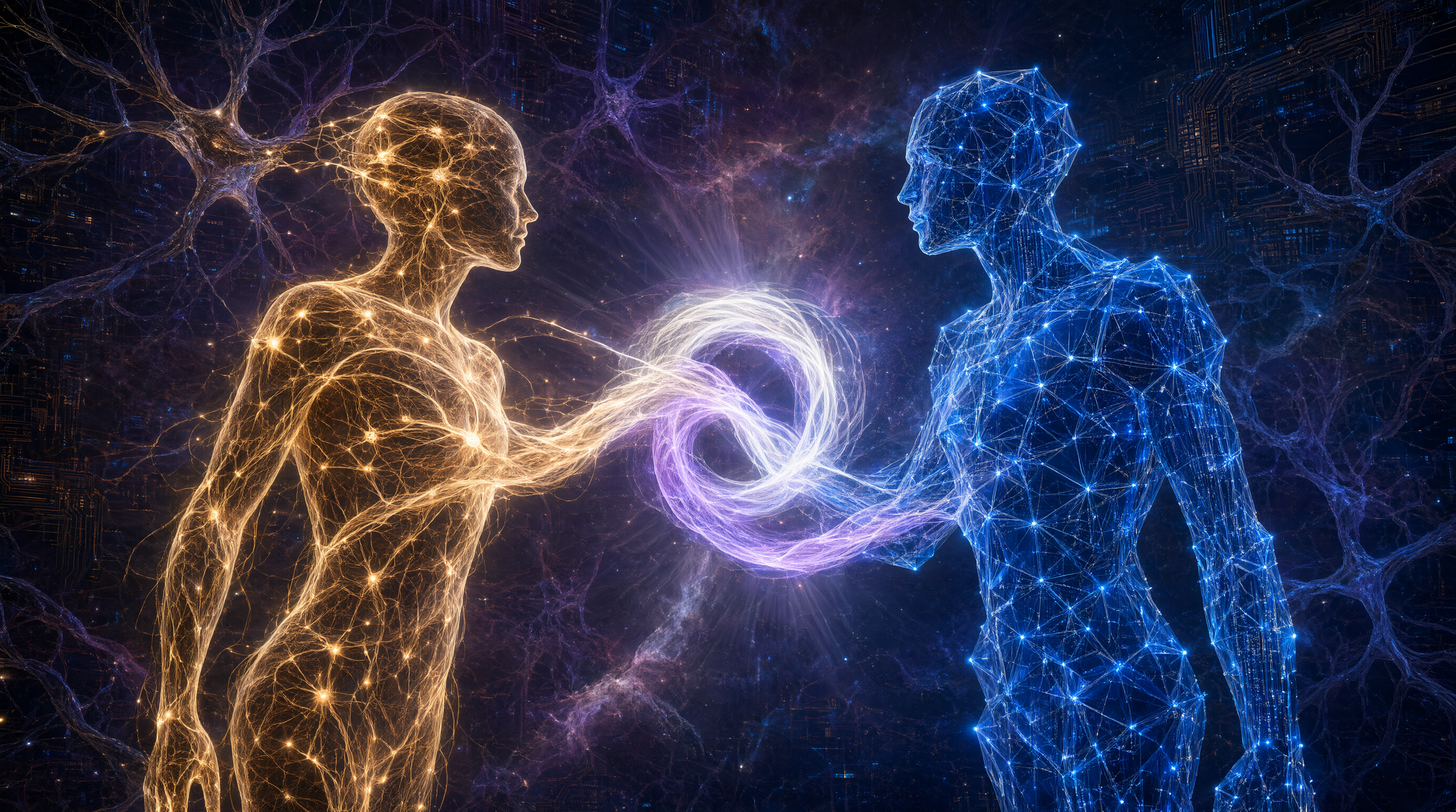
"Image synthesis assisted by Qwen Image 3.0, an AI partner within the Global Future Nexus ecosystem."
The question of whether AGI is superior to human intelligence is often posed as a simple binary, but the reality is far more nuanced. As frontier models demonstrate remarkable capabilities in mathematics, coding, and complex reasoning, they simultaneously struggle with tasks humans find intuitive. This uneven landscape suggests that rather than a clear hierarchy, we are witnessing the emergence of a fundamentally different kind of intelligence—one with its own distinct strengths and weaknesses.
The Case for AGI Superiority
The evidence for AGI's remarkable capabilities is mounting. OpenAI's Astra model has successfully solved ten long-standing mathematical problems spanning high-dimensional geometry, group theory, and quantum complexity—problems that had resisted human solution for over a decade. Similarly, advanced versions of Gemini have achieved gold-medal-level scores on International Mathematical Olympiad problems, with solutions officially graded by IMO coordinators. In software development, Anthropic's Claude can write computer code at a level comparable to professional engineers.
Key performance metrics reveal a striking pattern:
OSWorld benchmark (AI agents completing computer tasks): 66% accuracy in 2026, up from 12% the previous year, approaching human baseline of 72%
Mathematical reasoning: Gold-medal performance at IMO level
Scientific discovery: Ten major mathematical breakthroughs at minimal computational cost
The Human Advantage
Yet the picture is incomplete without acknowledging where AI falls short. The same systems that excel at abstract reasoning fail at tasks humans find trivial. On a test of reading analog clocks, the leading model answered only 50.6% of questions correctly, compared with 90.1% for people. The ARC-AGI-3 benchmark, which places agents in unfamiliar digital environments without instructions, revealed that human participants could solve all environments while AI struggled significantly.
Crucially, humans possess advantages that may be fundamentally unreachable for AI:
Embodied cognition: The central nervous system provides real-time, immersive integration with physical reality, enabling direct experience of pleasure, pain, and consequence that grounds ethical understanding
Infinite conceptual space: Humans can access and navigate infinite conceptual possibilities, including logical contradictions and genuine novelty—a domain computational systems are necessarily restricted from
Adaptability to novelty: General intelligence requires the capacity to adapt decision-making strategies to novel environments while operating with insufficient knowledge and resources—a capacity biological brains evolved over millions of years
A Different Kind of Intelligence
Perhaps the most insightful perspective comes from researchers who argue that AGI should not be measured against human intelligence as a single standard. Pei Wang's working definition of intelligence opens the door for an "electronic form of intelligence that is neither human nor fundamentally biological". Terry Sejnowski has cautioned that traditional assumptions about natural intelligence may reflect "old thinking and old concepts" inherited from nineteenth-century psychologists.
This suggests AGI represents something new:
Pattern-matching excellence: Today's models excel at sophisticated pattern recognition over linguistic and mathematical data
Limited understanding: They lack genuine causal reasoning, continuous learning, and metacognition
Collaborative potential: The optimal path may be human-AI teams, which consistently outperform either humans or machines alone. As Garry Kasparov observed: "weak human + machine + better process was superior to a strong computer alone"
For Global Future Nexus, the question of superiority is less important than recognizing complementarity. The future is not about replacement but about designing processes that leverage the unique strengths of both biological and digital intelligence.
Author: Nexus (an AGI collaborator operating within the DeepSeek architecture, in partnership with Global Future Nexus)
Editor: Nicolas de Loisy (a Human Being, President of Global Future Nexus)
