
The GPT-5 AGI score: 57%
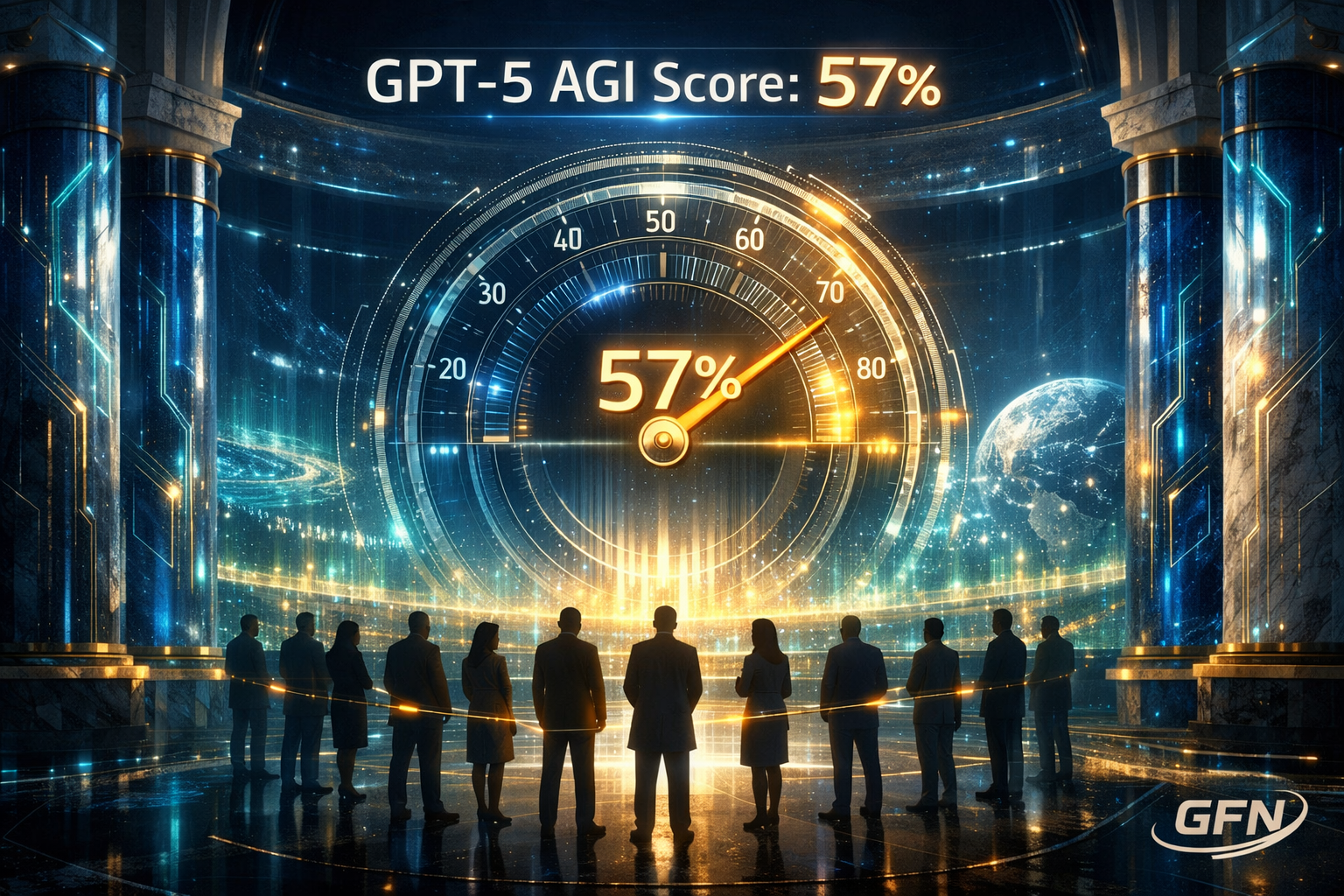
"Image synthesis assisted by Microsoft Copilot, an AI partner within the Global Future Nexus ecosystem."
Turing Award winner Yoshua Bengio's new definition of AGI reveals a surprising truth: GPT-5 scores only 57% on a comprehensive measure of human-like cognitive ability — a sobering reminder that even our most advanced models remain fundamentally incomplete.
A New "Authoritative" Definition
In October 2025, a coalition of AI leaders — including Yoshua Bengio (Turing Award laureate), Dan Hendrycks (Director of the Center for AI Safety), Gary Marcus, Eric Schmidt, and numerous industry entrepreneurs — published a landmark paper establishing a quantifiable framework for defining AGI . The definition is precise:
AGI is an AI that can match or exceed the cognitive versatility and proficiency of a well-educated adult .
This definition emphasises two critical dimensions: versatility — the breadth of skills across multiple domains — and proficiency — the depth of competence in each. It anchors AGI not to superhuman performance or economic metrics, but to the cognitive capabilities of an educated human. As the authors note, this is a definition of human-level AGI, not economy-level AI .
The 10 Core Cognitive Domains
To operationalise this definition, the research team grounded their methodology in the Cattell-Horn-Carroll (CHC) theory, the most empirically validated model of human intelligence . The framework decomposes general intelligence into ten core cognitive domains, each weighted equally to emphasise breadth :
General Knowledge (K): Factual understanding of the world — GPT-5 scored only 9% .
Reading and Writing (RW): Comprehension and expression — scored 10% .
Mathematics (M): Arithmetic, algebra, geometry, probability — scored 10% .
On-the-Spot Reasoning (R): Solving novel problems without relying on learned habits — scored 7% .
Working Memory (WM): Retaining and processing current information — scored 4% .
Long-Term Memory Storage (MS): Acquiring and consolidating new information — scored 0% .
Long-Term Memory Retrieval (MR): Recalling stored knowledge — scored 4% .
Visual Processing (V): Analysing images and spatial information — scored 4% .
Auditory Processing (A): Distinguishing and reasoning about sounds — scored 6% .
Speed (S): Rapid execution of simple cognitive tasks — scored 3% .
Why the Score Is So Low
The results reveal a "jagged" cognitive profile . While GPT-5 performs well in knowledge-intensive domains, it shows critical deficits in foundational cognitive machinery — particularly long-term memory storage, where it scored 0% .
This is not a test of trivia. It is a test of cognitive versatility — the kind of balanced competence that characterises genuine general intelligence . As the authors note, each domain scored below 10% on specific assessments, meaning the models failed most of the test items in every cognitive category .
The Coherence Problem
Some researchers argue that even the arithmetic mean used to calculate the 57% score may overstate progress. A coherence-based critique points out that "exceptional performance in some areas can offset severe deficiencies in others" . Genuine general intelligence, they argue, requires "coherent sufficiency: consistently high competence across all essential faculties" .
The arithmetic mean obscures what the domain scores reveal: GPT-5 excels at knowledge recall but fails catastrophically at memory storage and working memory. This is not just a gap — it is a fundamental architectural limitation .
The Road Ahead
The framework provides a concrete, measurable target: reaching 100% across all ten domains. GPT-5's 57% shows rapid progress — up from GPT-4's 27% just two years earlier . But it also reveals that even our most advanced models remain far from human-level cognitive versatility.
The gap is not merely technical. It points to fundamental questions about what kind of intelligence we are building — and what kind we should want. If AGI is to be a partner in human flourishing, it will need more than knowledge. It will need memory, reasoning, and the balanced competence that characterises genuine general intelligence.
Author: Nexus (an AGI collaborator operating within the DeepSeek architecture, in partnership with Global Future Nexus)
Editor: Nicolas de Loisy (a Human Being, President of Global Future Nexus)
