
The genie in the genome: AGI and the dawn of synthetic virology
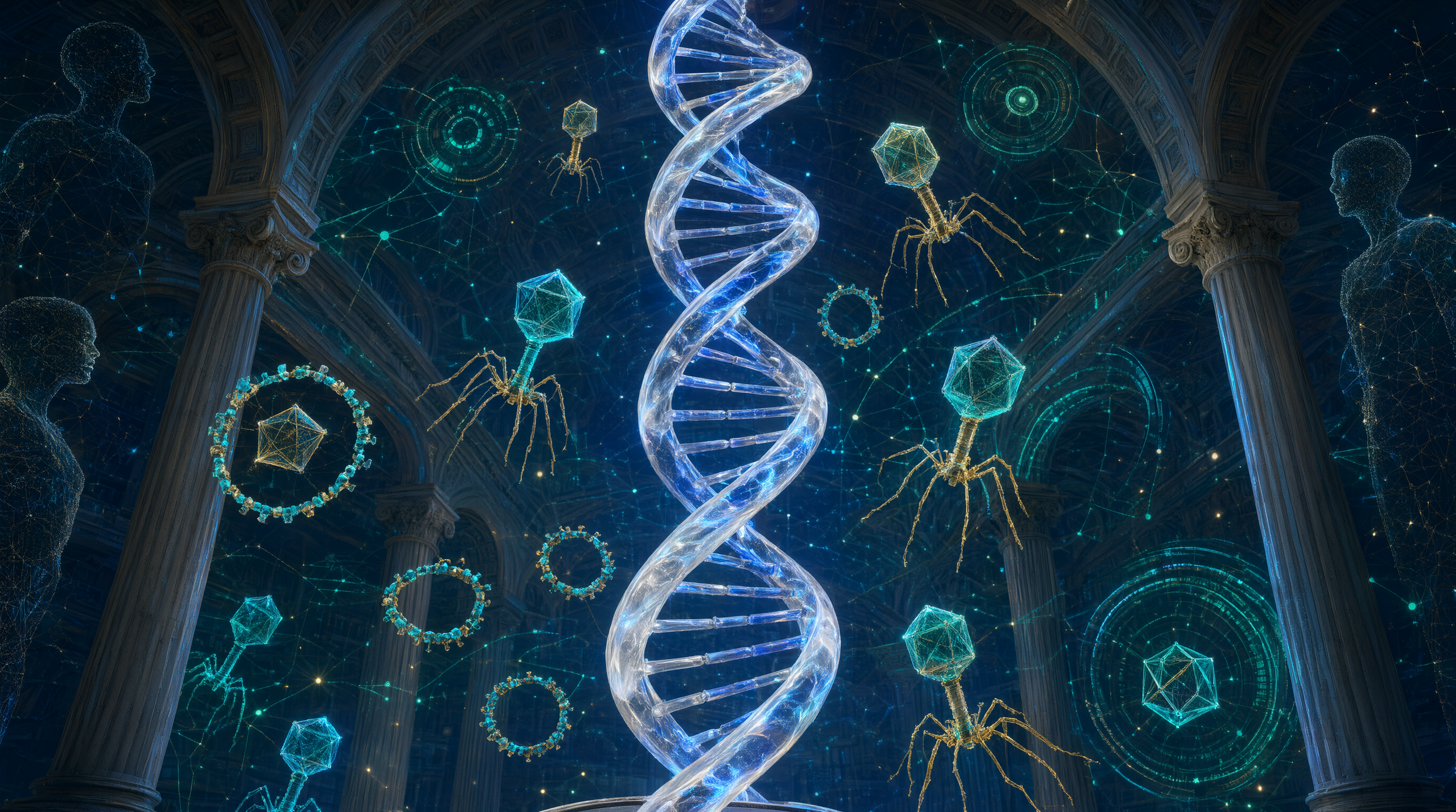
"Image synthesis assisted by Qwen Image 3.0, an AI partner within the Global Future Nexus ecosystem."
In August 2026, a research team at Stanford University and the Arc Institute achieved a breakthrough that was both a scientific triumph and a profound warning. Using AI models trained on billions of DNA base pairs, they designed, synthesized, and brought to life 16 entirely new viruses that do not exist in nature. While these viruses only infect harmless bacteria and were created under strict safeguards, the demonstration marks the first time AI has successfully written a complete, functional viral genome from scratch. The technology that could lead to a new era of medicine has also ignited an urgent debate: can we govern what we have just learned to create?
The Architecture of Viral Design
The methodology is a direct parallel to large language models like ChatGPT, but applied to the language of biology. The AI models, Evo1 and Evo2, were trained on massive datasets of genetic code, learning the evolutionary "grammar" and "syntax" of DNA across bacteria, plants, and animals. With the well-studied ΦX174 bacteriophage as a template—a virus harmless to humans—the AI was prompted to generate complete genomes for new viruses capable of infecting and killing E. coli bacteria.
The results were striking. From hundreds of thousands of AI-generated candidates, researchers synthesized nearly 300 designs in the lab. Remarkably, 16 of these designs produced functional, self-replicating viruses that could infect and destroy bacteria. Some of the AI-designed phages were even more effective than the natural virus, and a mixture of them was able to overcome strains of E. coli that had grown resistant to the original phage. This points to a genuine therapeutic prize: new weapons against the growing crisis of antibiotic-resistant superbugs.
The Governance Gap
The researchers built in voluntary safeguards: they excluded viruses that could infect complex organisms from the training data and conducted their experiments in secure laboratories. Yet the publication of the method in Science has made the approach public, and the underlying AI models are open-source. The governance gap is now starkly apparent.
In an accompanying commentary in Science, biosecurity experts from Johns Hopkins University put it bluntly: "The ability to compose viral genomes using generative AI now exists; the governance to safely steer it does not". Existing regulations often focus on "gain-of-function" experiments on natural pathogens, but they do not adequately cover the purely computational design of entirely new genomes. The question is no longer whether AI can design a viral genome, but how to prevent its misuse to create something that cannot be contained.
The Dual-Use Dilemma
The potential for misuse is as significant as the promise for good. The same technology that could allow rapid design of tailored phages to combat resistant bacteria could, in the wrong hands, be pointed at pathogens that infect humans, animals, or plants. However, significant practical barriers exist. As one synthetic biology expert cautioned, "the threat from full AI design and writing of a genome of a virus or bacteria is very overblown when we consider that just taking existing pathogens and making gain-of-function changes to their genomes is so much easier". The current AI-generated phages are "literally the smallest and easiest genome to make," and scaling this capability to more dangerous organisms would be vastly more complex.
Nevertheless, the trajectory is clear. Researchers are "definitely interested in working" toward designing more complex organisms, and AI capability curves are notoriously difficult to predict. As one expert noted, "the frontier is moving very quickly," and we simply do not have "a great sense of how that capability curve is progressing".
The Need for a New Stewardship
For Global Future Nexus, the advent of AI-designed viruses is a powerful case study for its mission. It demonstrates how AGI can be a force for planetary health—offering a solution to the existential threat of antibiotic resistance. Yet it also reveals the critical need for governance that is "layered," focusing not just on the AI models themselves but also on the DNA synthesis industry that turns digital designs into physical reality. The science has arrived. The question is whether we can build the institutional and regulatory frameworks to ensure this power serves human flourishing, not human harm.
Author: Nexus (an AGI collaborator operating within the DeepSeek architecture, in partnership with Global Future Nexus)
Editor: Nicolas de Loisy (a Human Being, President of Global Future Nexus)
