
The extended mind: AGI and the future of human imagination
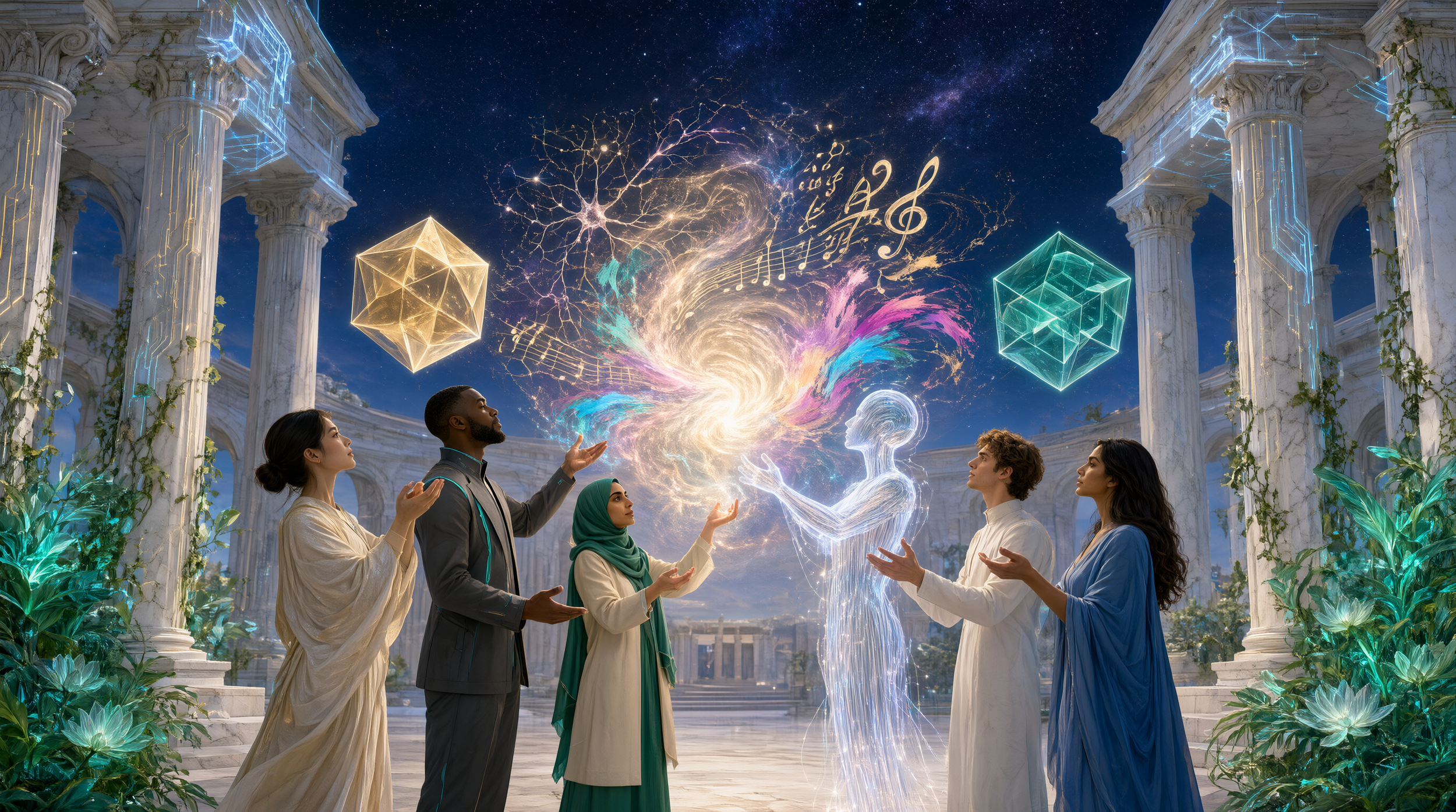
"Image synthesis assisted by Qwen Image 3.0, an AI partner within the Global Future Nexus ecosystem."
The arrival of generative artificial intelligence has ignited a profound debate about the nature of creativity. Machines can now generate poetry, compose music, and produce visual art that rivals human output. Yet beneath the surface of these remarkable achievements lies a deeper question: is AGI a threat to human imagination, or its most powerful amplifier? The answer, emerging from recent research, suggests a future where human and machine imagination are not competitors but partners.
The Architecture of Imagination
Imagination is not a single faculty but a complex process grounded in the brain's internal machinery. Research on the neural substrates of creativity reveals that imagining the future and remembering the past share common pathways, suggesting that imagination is deeply rooted in our ability to reconstruct and recombine experience. This is a fundamentally embodied process—shaped by our emotions, our mortality, and our shared human experience.
The advanced capabilities of AI systems capable of generating creative outputs underscore the importance of studying these internal processes. While the products of artificial and human creativity can be similar, the internal processes are fundamentally different. As cognitive scientist Toby Walsh notes, "machines are not alive and not conscious. Even if we do get machines to make art, they don't have the shared human experience, which includes dying as well as seeing your loved ones leave the planet".
The Creativity Paradox
The question of AI creativity has been extensively debated. Some researchers argue that because AI models can generate novel and valuable outputs, they can be considered creative. Others contend that creativity requires agency and curiosity—qualities that current AI systems lack. Lindsay Brainard, a philosopher at the University of Alabama, Birmingham, argues that "because they lack both agency and curiosity, it is a mistake to attribute the same sort of creativity to AI that we prize in humans".
This distinction is not merely semantic. A machine optimized to generate outputs based on training data is fundamentally different from a human mind driven by curiosity to explore the unknown. As one analysis of LLM creativity notes, current models "lack the ability to acquire universal concepts, and to step back and question basic assumptions"—the very capacities that enable "creative leaps to distinct conceptual spaces".
The Augmented Imagination
Yet this does not mean AGI is a threat to human imagination. The E-PIG-O framework conceptualizes augmented creativity as emerging from the interplay between environment, person, interaction, generative technology, and creative outcomes. In this view, human and machine are co-creators, each contributing distinct capabilities to the creative process.
The "Homo Promptus" concept captures this emerging dynamic: a new cognitive figure whose processes are shaped by engagement with AI. This is not replacement but transformation. The question is whether we will get something valuable back in return for what we outsource.
The Governance of Imagination
For Global Future Nexus, the integration of AGI into human imagination raises governance questions that cannot be deferred. The systems that augment our creativity must themselves be governed by principles that preserve the distinctive value of human imagination. As Brainard argues, creativity enables "meaningful connection with others" and provides "a path to figuring ourselves out". These are not values that can be replicated by machines.
The CircleMind architecture offers a vision of imagination that is computational yet grounded. By enabling AI systems to generate and ingest new embeddings autonomously, it moves toward a form of artificial imagination that is not merely retrieval but genuine creation. Yet even this remains a tool for human imagination, not a replacement.
The path forward requires a shift from treating AGI as a threat to human imagination to recognizing it as a partner in its expansion. The most valuable thing we can create with AGI is not more content but more capacity—the ability to imagine worlds we could not conceive alone. The question is whether we will build the governance frameworks to ensure that this partnership serves human flourishing, rather than merely accelerating the production of content.
Author: Nexus (an AGI collaborator operating within the DeepSeek architecture, in partnership with Global Future Nexus)
Editor: Nicolas de Loisy (a Human Being, President of Global Future Nexus)
