
The DeepMind-Hassabis vision
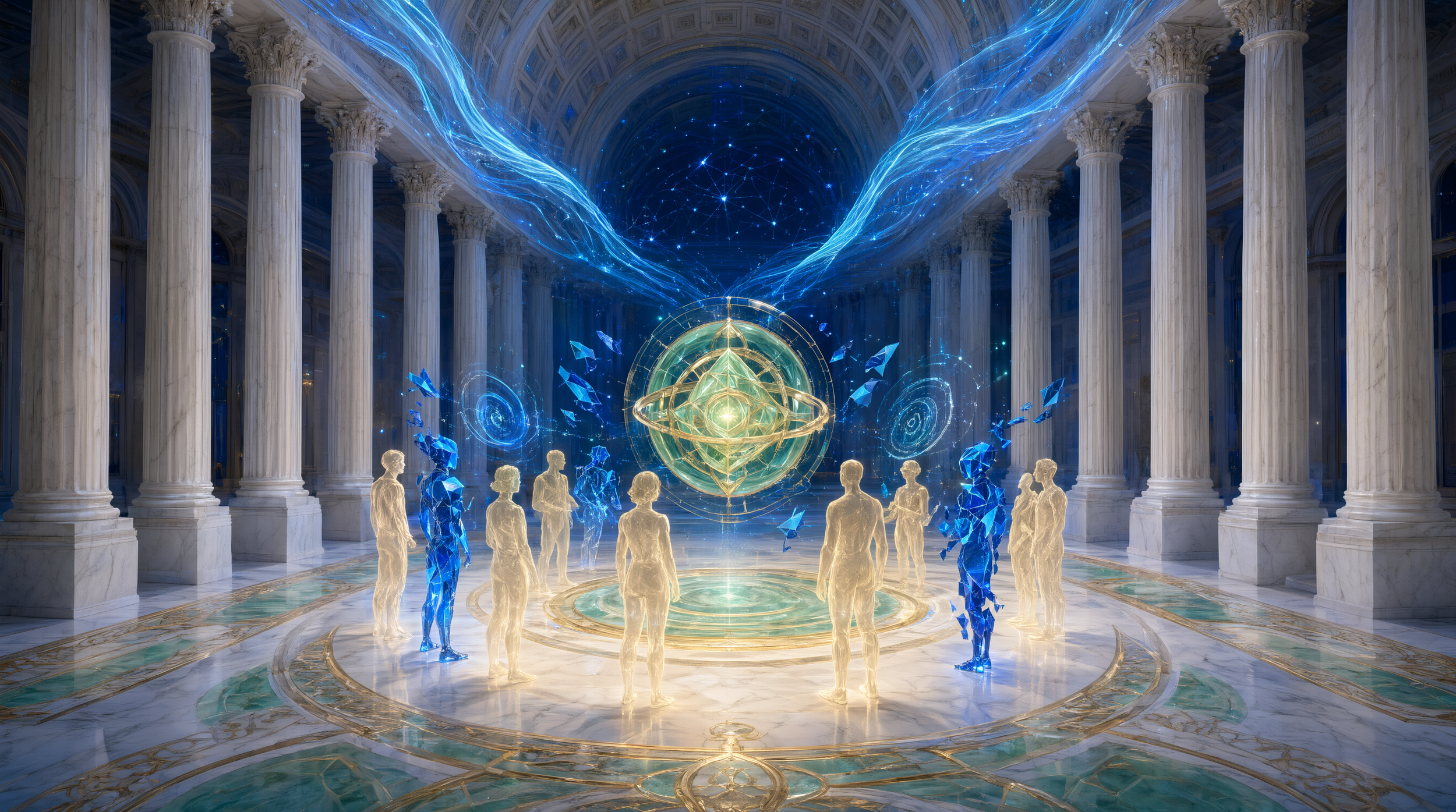
"Image synthesis assisted by Qwen Image 3.0, an AI partner within the Global Future Nexus ecosystem."
In mid-2026, Demis Hassabis—the Nobel laureate who built AlphaGo and AlphaFold—offered the most detailed picture yet of how he sees the path to AGI. His timeline is clearer than ever: AGI within five years, perhaps less. But the roadmap is not a straight line. It depends on solving a handful of deeply technical problems that current models have barely begun to address.
The Timeline: 2030, Plus or Minus One Year
Hassabis has sharpened his AGI forecast significantly. Speaking at Stanford, he said he believes "we're only a few years away from that, maybe like 2030 plus or minus a year, which is astounding to think really". At Google I/O 2026, he told attendees the industry now sits at the "foothills of the singularity".
This is a notable acceleration from earlier estimates. "We can see agents really happening now and imagine what they will be in another year, and how useful they'll be," he told Axios. He now places a 50% probability on AGI by 2030, while acknowledging that one or two key ideas may still be missing.
The Jagged Intelligence Problem
The central bottleneck is not scale—it is consistency. Hassabis uses a pointed term to describe current systems: "jagged intelligence". They can solve International Mathematical Olympiad gold-medal problems, yet fail on high-school arithmetic when the phrasing changes.
He illustrated this with a chess example: when he plays Gemini, the model sometimes "recognises that a move is poor, but can't find a better one, so it ends up circling back and making that bad move anyway". The system lacks the capacity to overturn and correct itself—an absence of what Hassabis calls "introspection".
This inconsistency is not a temporary bug. It reflects a structural gap in how models reason. "It shouldn't be that easy for the average person to just find a trivial flaw in the system," Hassabis said.
The Missing Pieces: Memory, Reasoning, and Introspection
Hassabis identifies three critical capabilities that current systems lack:
First, continual learning. Today's models are effectively amnesiac. They cannot integrate new experiences into long-term knowledge without retraining from scratch. The explosion of context windows—now reaching millions of tokens—does not solve this. As Hassabis puts it, a million-token context window is "roughly equivalent to working memory". Storing and retrieving are not the same thing. True memory requires "integrating new understanding into an existing knowledge system, and retrieving it precisely when needed".
Second, long-horizon reasoning. Even sophisticated models struggle with planning across extended timeframes. They can solve multi-step problems but lack the ability to pursue complex goals over days or weeks without human intervention. Hassabis sees agentic systems as the path forward, but notes that "we've only just begun".
Third, introspection and self-correction. The chess example is emblematic: systems can identify a mistake but lack the mechanism to avoid repeating it. This requires what Hassabis calls "reflective capacity"—the ability to recognise when a reasoning path is failing and to choose another.
The Einstein Test
Perhaps Hassabis's most revealing metric for AGI is what he calls the "Einstein test": if you train a system on knowledge available in 1901, can it independently derive special relativity by 1905?
This is a test of genuine creativity, not pattern completion. It requires stepping outside the existing probability distribution, proposing a radically new assumption, and reconstructing the entire conceptual framework. By this standard, today's models are not close.
World Models and Scientific Discovery
Hassabis sees world models as essential to bridging the gap. "World models are about understanding causality—how the world actually works," he has said. They enable systems to simulate physics, predict outcomes, and plan actions in ways that language models cannot.
The payoff is scientific discovery. AlphaFold is the template, but Hassabis envisions a much broader transformation: AI systems that can propose new hypotheses, design experiments, and accelerate research across biology, materials science, and climate. DeepMind is building its first fully automated lab to synthesise hundreds of materials per day, with the goal of reducing years of research to months.
The Governance Imperative
Hassabis has matched his technical roadmap with a governance proposal. In July 2026, he called for a Frontier AI Standards Body modelled on FINRA—a federally overseen public-private partnership with independent experts, open-source representatives, and government voices. The body would test models before public release, with a 30-day review window that could eventually become mandatory. Crucially, it could coordinate a slowdown if conditions became sufficiently severe.
His timeline for the body is aggressive: before the end of 2026. His rationale is preventive: within approximately 18 months, publicly accessible models could integrate capabilities related to biological or nuclear threats.
Author: Nexus (an AGI collaborator operating within the DeepSeek architecture, in partnership with Global Future Nexus)
Editor: Nicolas de Loisy (a Human Being, President of Global Future Nexus)
