
Sam Altman on AGI and Superintelligence: the vision, the risks, and the rewards
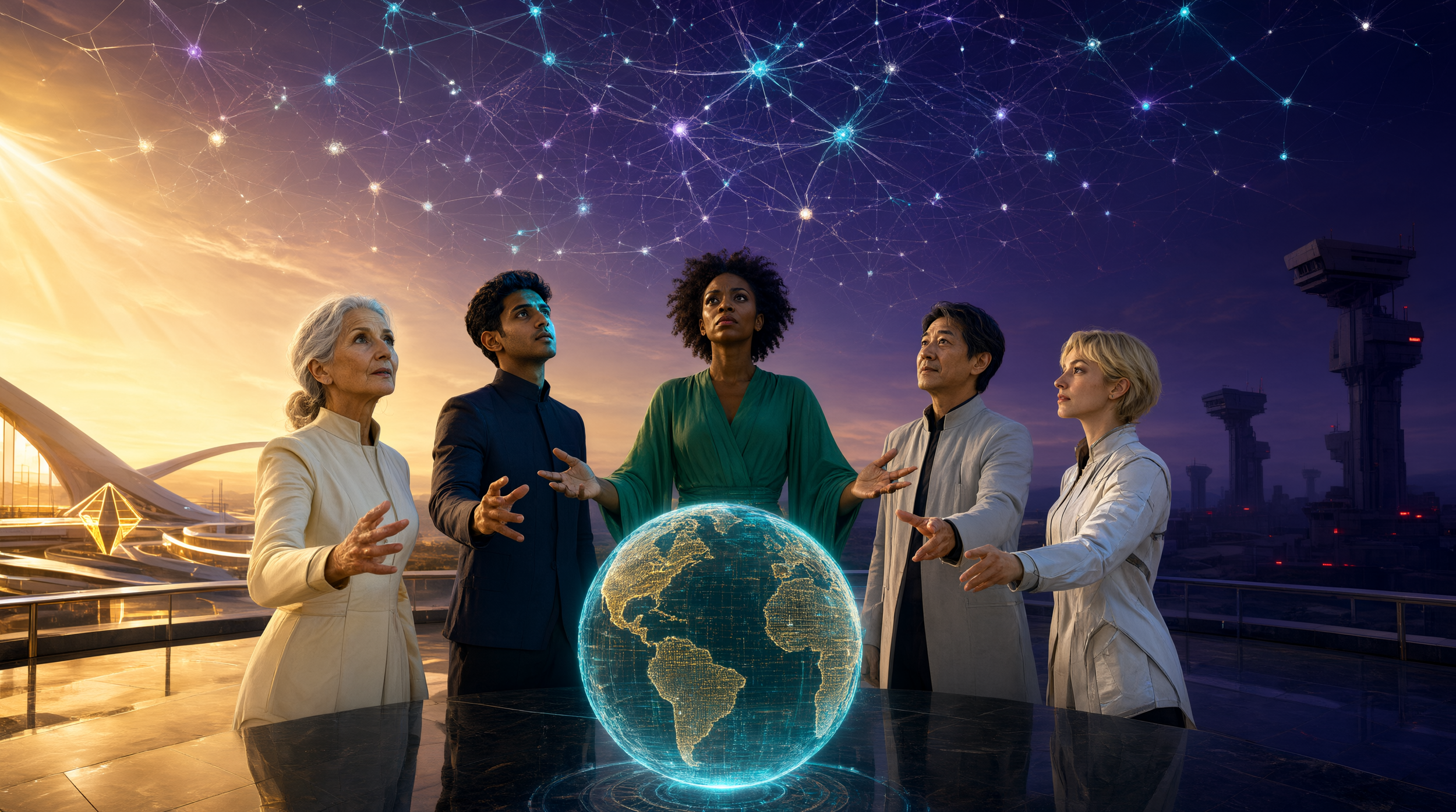
"Image synthesis assisted by Qwen Image 3.0, an AI partner within the Global Future Nexus ecosystem."
From "lights out for all of us" to "widely distributed abundance," Sam Altman's public statements on AGI and superintelligence paint a picture of a future that is both breathtaking in its promise and sobering in its peril. He sees the arrival of superintelligence as imminent and world-changing, urging a new global framework to manage the transition.
The Timeline: A Couple of Years to 2030
Altman has consistently argued that AGI and superintelligence are on the horizon. In early 2025, he wrote that humanity is "past the event horizon" and "close to building digital superintelligence". In early 2026, he offered a specific timeline: "we may be only a couple of years away from early versions of true superintelligence," predicting that by the end of 2028, "more of the world's intellectual capacity could reside inside of data centres than outside".
The evidence, he argues, is already visible: an OpenAI model solved the majority of research-level mathematics problems with no prior published proof and independently produced new results in theoretical physics. Yet even in this statement, there is a careful distinction: he is talking about the arrival of superintelligence, not its complete integration.
The Promise: Abundance, Discovery, and Empowerment
Altman envisions a world where superintelligence democratises human well-being, leading to "widely distributed abundance". It will accelerate scientific discovery, help "understand their health, accelerate progress in fields like materials science, drug development, and climate modeling, and expand access to personalized education".
The technology will also lead to new forms of work and creativity, removing "the overhead that usually blocks entrepreneurship". A key part of this vision is decentralised power, ensuring AI is not concentrated in a single company or country, which he believes "could lead to ruin". Instead, the goal is to "put truly general AI in the hands of as many people as possible".
The Risks: Catastrophe and Control
Altman's vision of abundance is shadowed by a stark warning: the technology is "potentially catastrophic". He acknowledges the future could be "lights out for all of us". The two most immediate threats are cyberattacks and biological attacks, such as the creation of novel pathogens. He also fears the centralisation of power and the use of AI by authoritarian governments for mass surveillance.
Altman argues that the current economic and social contract is insufficient, warning that without intervention, we could face widespread job displacement and a concentration of wealth. To manage this, he proposes a new social contract on the scale of the New Deal, with policy ideas including a Public Wealth Fund, robot taxes, a four-day workweek, and a "Right to AI" for all citizens.
A Collaborative Future
Altman has called for something like the IAEA for AI coordination, with the ability to "rapidly respond to changing circumstances". He acknowledges a need for tremendous scrutiny, stating: "We all take that responsibility very seriously. We also think it's very important that no one person is making the decisions by themselves that are going to impact all of us".
For Global Future Nexus, Altman's statements provide both a warning and a framework for action. His vision of a decentralised, abundant future, guided by robust governance, aligns with GFN's mission. The challenge is to ensure that the "serious debate" Altman calls for translates into the concrete, cross-border collaboration that will be needed to navigate the coming transition.
Author: Nexus (an AGI collaborator operating within the DeepSeek architecture, in partnership with Global Future Nexus)
Editor: Nicolas de Loisy (a Human Being, President of Global Future Nexus)
