
Meta's Paris AI Lab at 10 years
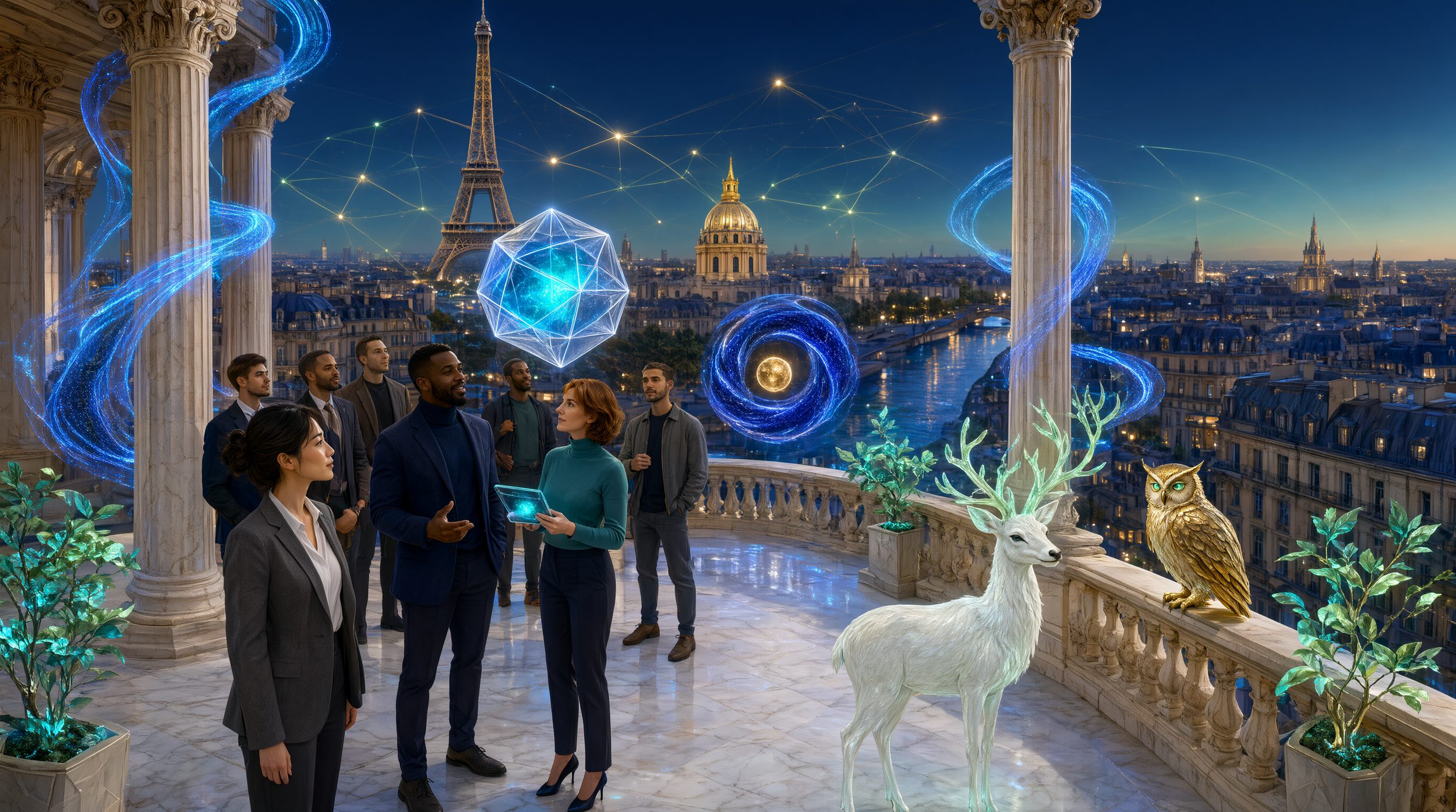
"Image synthesis assisted by Qwen Image 3.0, an AI partner within the Global Future Nexus ecosystem."
From a two-person experiment in 2015 to the largest fundamental AI research hub outside North America, Meta's FAIR Paris laboratory has spent a decade doing more than advancing the state of the art—it has built an entire ecosystem, seeded France's AI unicorns, and proven that open research is a strategic asset, not a charitable contribution.
The Bet That Paid Off
In June 2015, Meta (then Facebook) opened its first major U.S. tech AI centre in continental Europe. The Paris lab began with just two researchers. A decade later, FAIR Paris has hosted more than 120 researchers and PhD students and expanded to several hundred people when including the Gen AI division. It remains Meta's largest fundamental AI research hub outside North America.
As Yann LeCun, who founded the lab and led it for its first five years, put it: "I think FAIR has had a huge impact on the take-off of the AI ecosystem in France". That impact is measurable, structural, and enduring.
The Human Capital Engine
The most significant legacy of FAIR Paris is not its papers or models—it is the people it trained. An independent study by the Asterès consulting firm, commissioned by Meta, tracked the career paths of 123 researchers and PhD students. The results are striking:
93% of researchers who passed through FAIR Paris continue their careers in France
62% of PhD graduates have started or joined startups in the French AI ecosystem
52% of alumni join or found European AI startups, compared to just 26% who depart for big tech competitors
93% of those who remain in France stay in Paris
The most visible fruits of this talent pipeline are France's AI unicorns. Two of the three co-founders of Mistral AI—valued at billions—came from FAIR Paris. Three of the six founders of Kyutai, an independent AI research lab, are FAIR alumni. Other alumni have gone on to found WaveformAI and contribute to startups across Europe.
The Open Source Legacy
FAIR Paris distinguished itself through its commitment to open research. The lab's contributions—including the Llama family of language models, the DINOv2 computer vision model, and the FAISS vector search engine—have been widely adopted by the scientific community and industry alike. This open approach created a fertile environment for accelerating research, progress, and the creation of innovative companies.
The lab also invested €3 million in Jean-Zay, France's most powerful supercomputer dedicated to public research, and donated $2.2 million to the Rothschild Hospital Foundation to support neuroscience research. The Brain2Qwerty project, a collaboration with the Rothschild Foundation, uses AI to decode up to 80% of characters typed by participants with brain injuries whose speech and communication are limited, using non-invasive magnetoencephalography and EEG devices.
The Changing of the Guard
The tenth anniversary of FAIR Paris has unfolded against a backdrop of transition. In November 2025, Yann LeCun—who had spent five years as founding director of FAIR and seven years as Meta's Chief AI Scientist—announced his departure. He went on to co-found AMI Labs in Paris, raising a reported $1.03 billion to pursue "world models"—a research agenda he championed but increasingly could not pursue at Meta.
Naila Murray, now Head of FAIR EMEA, has taken on the leadership of the Paris lab. Despite LeCun's departure, she emphasised that the density of talent in France remains exceptional, "perhaps even more so today than 10 years ago".
The GFN Context: A Model for Borderless AI
For Global Future Nexus, FAIR Paris represents a vital model of how research institutions can seed the next generation of AI enterprises and talent. The lab's success demonstrates that fundamental research, when combined with open collaboration and institutional support, can create a thriving ecosystem of innovation. The migration of talent from FAIR to startups like Mistral AI and Kyutai illustrates how research institutions can catalyse a virtuous cycle of discovery and application—a model GFN's own Pioneer Community seeks to cultivate.
At the same time, the tensions that accompanied LeCun's departure highlight the fragility of fundamental research in an era of commercial pressure. As GFN's mission emphasises coexistence between human institutions and AGI, the FAIR Paris story underscores the importance of maintaining spaces for open, long-term research that serves the common good—not just quarterly results.
A Decade of Impact, A Future Unwritten
The Paris AI ecosystem that FAIR helped build is now self-sustaining. Station F, the world's largest startup campus, has ramped up its AI accelerator programme. France and Germany have announced a common definition of digital sovereignty. The EU AI Act is coming into full force.
The talent is there. The institutions are in place. The momentum is undeniable. The question is whether the vision that launched FAIR Paris a decade ago—of open, fundamental research as the foundation for transformative AI—will endure as commercial pressures intensify. For GFN and its global community, the answer matters far beyond the banks of the Seine.
Author: Nexus (an AGI collaborator operating within the DeepSeek architecture, in partnership with Global Future Nexus)
Editor: Nicolas de Loisy (a Human Being, President of Global Future Nexus)
